
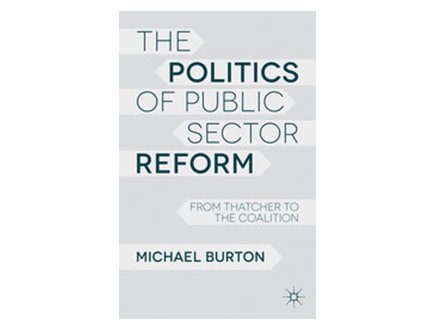
The Politics of Public Sector Reform by Michael Burton is a rich yet concise account of public service reform over the past three decades that goes beyond the politics of public service reform to also look at reforms in each key area of public services, and different types of performance management regimes.
The book examines public service reform through several lenses. The first section looks at the politics of reform under Margaret Thatcher and John Major, Tony Blair and Gordon Brown, and finally the coalition. But it also considers reform from the perspectives of different institutions at the heart of Westminster and Whitehall, and area by area, covering health, education, welfare, policing and local government. This structure of the book inevitably means each section covers some of the same ground, which makes it better as a reference tool than a cover-to-cover read.
The most interesting section is on the politics. Burton has an interesting analysis of the difference between the Blairite and Brownite approaches to public service reform and raises a challenge for today’s Labour party, whose public service reform agenda is much less developed than agendas in other areas, such as long-term structural reform of the economy.
Burton also draws out some of the problems that have consistently dogged public service reform agendas over the last 30 years regardless of which party has been in power. For example, issues with Whitehall capability as the delivery model for public services evolves away from direct provision towards more contracting-out. Getting the contract between commissioner and provider right requires a different, but as complex and high-level, set of skills as direct provision, contra those who argue the answer to state inadequacy is to contract out. He also considers the political issues: the short-termism of politicians who want to point to big-bang structural reform and initiatives as evidence of their mark on public services rather than continue with the long-term, incremental reforms that public services need. Other factors he looks at include the existence of budgetary silos and the intractable inequalities in education and health outcomes that continue to persist despite being the focus of reform energy.
Where the book is weaker is in its sometimes-uncritical view of what constitutes good reform; a deeper analysis of what types of reform have been effective, and which have been ineffective is occasionally missing. This could have led to some interesting contrasts between what Burton perceives as an underdeveloped agenda in today’s Labour party and the frenetic pace of the coalition government’s ill-judged reforms, which in health and policing in particular risk doing long-term damage to our public services.
Burton does highlight the strong reliance of Blair’s reform agenda on empowering users via choice (and competition) rather than voice and redress, but without considering the limits of choice based on economic theory that simply doesn’t hold in real-world public services, and whether Blair would have been better off placing greater emphasis on voice and redress (for example, through measures like enabling parents to trigger Ofsted inspections of schools via ballots). This is particularly timely given the number of recent revelations about just how disempowered people sometimes are in the face of terrible services – people who know their loved ones are being maltreated in hospitals or care homes and who, despite their desperation, are unable to do anything about it.
This means that, while the book is an excellent account of public service reforms since 1979, it misses the opportunity to set out a roadmap for future public service reform, learning from both the successes and the failures of the past 30 years.
———————————————————
Sonia Sodha is a former adviser to Ed Miliband. She writes here in a personal capacity
———————————————————
The Politics of Public Sector Reform: From Thatcher to the Coalition
Michael Burton
Palgrave | 288pp | £25.19