
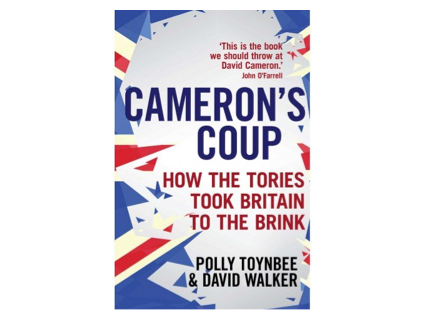
In a week in which even deeper future cuts to welfare have been announced by Cameron, the publication of Cameron’s Coup: How the Tories took Britain to the Brink by Polly Toynbee and David Walker seems particularly timely. With less than 100 days to go to the 2015 general election, their depiction of Britain after almost five years of coalition is both damning of the government’s record and utterly depressing.
Despite being well written, the book is in fact so utterly depressing in its portrayal of the damage being done to Britain, and to Britons, that it took me several attempts to get past the first couple of chapters. However, persistence is recommended for anyone who wants ammunition to put a rocket up anyone who is not considering doing everything in their power to secure a change of government.
As always, Toynbee and Walker’s research is impeccable and they take readers on a journey through a state – and individuals – laid waste by cuts, the war on welfare and a lacklustre economic recovery. They describe the growing inequality and poverty pay. The journey continues through the shifting landscape of the United Kingdom in the run-up to and in the aftermath of the Scottish referendum and the haphazard approach to policymaking, particularly in relation to education and health, based more on ideology than evidence.
Cameron’s Coup opens with a description of Cameron’s Cotswold constituency and of the extremely narrow social circles at the heart of the ruling elite. Cameron’s Britain is one in which land in Knightsbridge, Belgravia, Kensington and Mayfair is worth more than gold ingots but where ‘our poor are poorer than elsewhere’. One of the most successful aspects of the PR man Cameron’s approach to politics has been the vilification of the poor, particularly those on benefits and the chapter on the Tory war on welfare highlights foodbank Britain and the deliberately cruel regime of sanctions.
Toynbee and Walker write in the past tense for most of the book. The technique is presumably to ensure the book has an element of longevity and provides a stylistic detachment and retrospective that is only broken in the conclusion. The shift in the conclusion – looking ahead to the implications of an outright Tory majority after the election – jolts the reader into the present. The authors pose the question towards the end of the book as to why people, though ‘grumpy because household income was not keeping up’, did not actively oppose what they describe as ‘radical, even revolutionary change’. This question remains largely unanswered and one of the most interesting sections of the book follows as the failure is described of the normal checks of balances on politics. Cameron’s Coup is scathing of the performance of the Liberal Democrats in their failure to act as moderating coalition partners and highly critical of the politicisation of the civil service since 2010.
For those of us on the left who want to see a change of direction, with hiding under the duvet being no substitute for campaigning, the book overall serves as a stark reminder of what has been lost in the past five years, and what would be lost in the next five if the Tories win in May 2015. So the only recommendation I can make to Labour activists is to read this book but read it on a train or a bus on a campaigning trip to a key seat (as I did this weekend on my way home from Grimsby).
———————————-
Fiona Twycross is a member of the London assembly. She tweets @fionatwycross
———————————-
Cameron’s Coup: How the Tories took Britain to the brink
Polly Toynbee and David Walker
Guardian Faber Publishing | 320pp | £9.99