
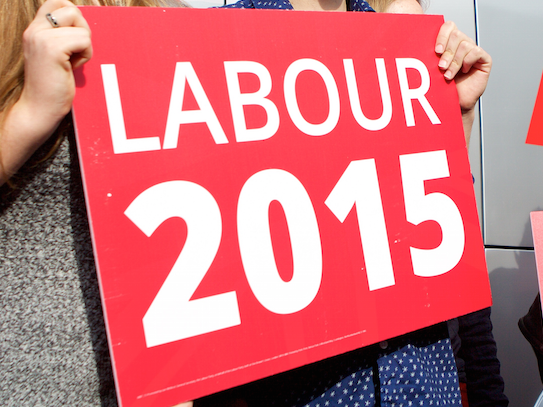
Five things you need to know about the 2015 election – and five about 2020[column-group][column]
Five things you should know about how bad the 2015 result was:
- In the run-up to polling day Labour was targeting 88 seats held by the Tories. We lost eight to Cameron’s party, won back just 10 – a net gain of two – and only decreased their majority in another 10. In 68 constituencies their actually majority went up.
- The party ended the short campaign 39 percentage points behind the Conservatives on economic credibility. Our lead on our best issue – the NHS – was just 19 points.
- For a manifestation of what this means for Labour look no further than the C1 and C2 voters. These are the electricians, salespeople, shop floor supervisors and plumbers of Britain, but in May they were not driven away from the Labour party because our manifesto was not leftwing enough. A massive 41 per cent of C1, and 32 per cent of C2 voters went Conservative. Only 29 and 32 per cent respectively voted Labour.
- The ‘lazy Labour’ explanation – that Labour lost because three million Labour supporters stayed at home – is implausible. This would have pushed up turnout to 82 per cent. These levels were last achieved since 1951, when Clement Attlee’s government was boot from office.
- South of Mitcham and Morden, the seat I am proud to represent, Labour made just one gain from the Tories, in Hove. We held Southampton Test and Exeter and lost two – Southampton Itchen and Plymouth Moor View – to the Tories. Sadly we did not pick up any of the 11 seats we were targeting from the Conservatives in the eastern region of England.
[/column][column]
Five ways 2015 impacts on our 2020 chances:
- According to Fabian Society research, four out 1 of five of the additional voters Labour will need to convince in marginal seats in 2020 voted Conservative in 2015. In May this year the figure had been just one out of five due to the Liberal Democrat meltdown.
- The rest come will from the Scottish National party, and a smattering of other small parties. It should be remembered that only a quarter of the seats we lost to the SNP have majorities of less than 10,000.
- The electoral swing required in marginal seats to win a majority will be over twice that which Labour needed for victory in 2015. In 2015, the 106th target seat needed a swing of 4.6 per cent; in 2020 the 106th target seat will require a swing of 9.5 per cent. That is assuming a similar rate of progress in England,Wales and Scotland; no gains in Scotland means Labour will need to perform as well as in 1997 in England and Wales to win a majority.
- To win a majority, Labour will now need to win Tory seats that have never been Labour such as Canterbury and Chingford and Woodford Green, currently held by Iain Duncan Smith.
- The Liberal Democrat and Green party together 5 won a 12 per cent share of the vote. This is even lower in the marginal seats Labour now needs to win.That means that in most of the seats Labour needs to win, Liberal Democrats and Green voters will be too few in number to have a major impact on seat results.
[/column][/column-group]The night of 7 May 2015 was extremely painful for anyone who supports progressive politics, wants to see a fairer society and cannot wait to see David Cameron out of Downing Street and the Tories out of government. While the realities of that night are sore to revisit, it is vital that our party realises the scale of the defeat, so that lessons can be learned and a path to victory in 2020 be mapped out.
As Labour members of parliament who lost seats to the Tories know all too well, the defeat in May was more akin to the events of 1979 or 1983 than any other. Comparisons with the surprising defeat of 1992 are futile. In 1992, though falling short of a majority, Labour gained 42 seats – 40 from the Tories. This compares to the 60 seats lost to the Conservatives in 1983, and 50 lost to them in 1979. Although the result in Scotland was shocking, the ground lost to the Tories in the rest of the country must be our focus.
Labour got 9.3 million votes in 2015; the Tories received 11.3 million. The ‘lazy Labour’ theory has been offered by pollsters – among others – to explain why they predicted the result so wrong. Can non-voters deliver an election? Unlikely. After a lot of hard work by party members and a highly intensive ‘get out the vote’ operation run in 2015, turnout was 66 per cent. Not only is this higher than 2010’s 61 per cent, it is the highest turnout recorded since Tony Blair’s landslide victory in 1997.
A Labour majority can be won in 2020 but not by offering a retail list of policies and not by ‘uniting the left’. With retail politics your opponent will always be able to offer a bit more, especially when they are the incumbent government. A comprehensive vision, resonating across regions, social divides and generations, is the only way the Labour party will make itself relevant and be taken seriously by the electorate again.
Not only is a 35 per cent strategy arithmetically deluded, it is morally questionable. We are Labour because we want to unite, not divide, people, and therefore the politics of ‘or’ are nothing to be proud of. Rather than pitting those who have more against those who do not, we should represent those who are affluent and those who are poor, north and south. Social mobility and economic credibility are the start of an inclusive, not exclusive, vision that all can buy into.
———————————–
Siobhain McDonagh is member of parliament for Mitcham and Morden
———————————–
Both Liz Kendall and Yvette Cooper have stated that they may be willing to join the Labour for the Common Good group, together with Tristram Hunt and Chuka Umunna. Is this the new ‘Gang of four’; who refuse to even contemplate that it may be they who are the dinosaurs; clinging to outmoded views and opinions, while the wider electorate has moved on?
Why not write a draft manifesto of what you think would attract a majority of voters to enable Labour to win and form an administration in2020. Something like the Euston Manifesto of recent years. I am getting tired of being told of all the mistakes labour made in 2015.
Most notable thing about the 2015 campaign was that some thought it was a good idea to drive around in a pinkbus.
To ignorant, to stubborn and full of their own self importance to see the real problems and why Labour would fail but it didn’t matter because they would still be in a job, some could even apply to become party leader after the disaster….
Thanks to them and those who pandered to them, we now have the charge of the idiot left with Corbyn nothing more than a figurehead for a tide of resentment…
Hang on. Labour GAINED a nett 2 seats from the Tories. That’s clearly far from enough, but in itself it’s hardly more disastrous than 2010, the trouncing of the New Labour rump.
Hang on. Labour lost 40 seats to the SNP, overturning enormous majorities in record swings. We now see all but a smattering of those seats as unattainable: voters lost forever, with no real consensus as to what we lost them to.
Of course we need a comprehensive vision. We need a far greater understanding of what’s going on than we had earlier this year. Of course we need to appeal to the whole of society, not 35%. That has to include the people who didn’t vote for us in Scotland as much as it does those in Kent.
There’s a lot going on out there. There’s a huge division between soaring private and austere public being carved out. There’s a technological age upon us, an entrepreneurial devil-take-the-hindmost age, an age that cocks its thumb at traditional borders: only this week, Sainsbury’s announced that despite being the 70th most profitable corporation in the UK it’s the 7th biggest contributor to our exchecquer. These changes will affect ALL our citizens and a responsible party should make plans to create a responsible framework to protect and promote our fragile, changing society.
At the same time we’re experiencing enormous human change. We’re getting older. Our birthrate is increasing. We’re seeing huge migrations both from our neighbours and from elsewhere; we’re seeing desperate refugees, often from situations that we’ve had a hand in creating, and who we have no credible solutions for; we have crises in our housing and healthcare systems that we’re hardly beginning to address, as well as a school policy and a benefit system being driven by dogma which will take extraordinary skill to repair. All this demands long-term commitment from a responsible opposition, so that it stands a chance of being a responsible government.
All of the above demands encompassing vision, huge change. Aspiration and community politics, important though they are, hardly scratch the surface when compared to the whole. The left/right thing that has dominated the last few weeks looks a bit silly in the face of the task in hand. We need behemoths, thinkers and visionaries, economists and orators. We need people who can map out a future we can live in, all of us.