
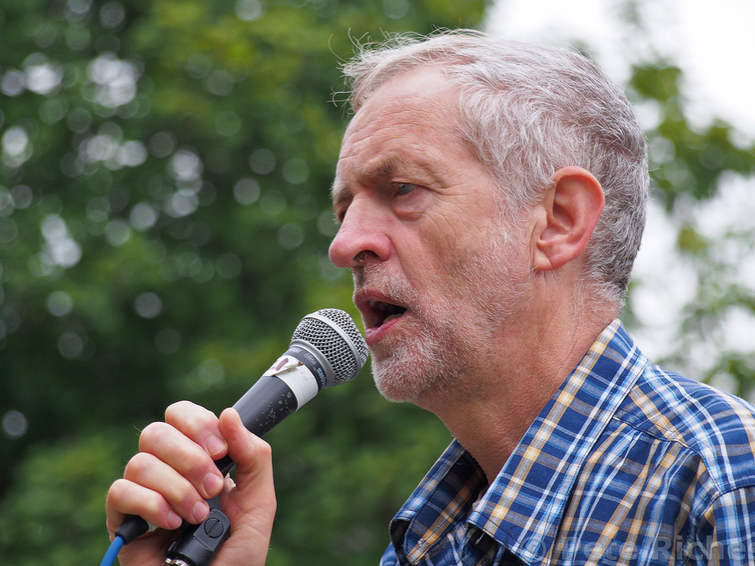
Stuart Hudson presents five steps to regaining Labour’s economic credibility
Dear Jeremy,
It would be churlish not to start with congratulations. After the painful election defeat in May, and all those subsequent exhortations to tack to the centre, the way the leadership campaign unfolded must have felt like a vindication of a leftwing strategy.
As you travelled around the country, you will have been struck by the level of anger about the Tory government’s cuts to public services. You will have seen the widespread support for a tough approach to big business, and even calls for Labour to go further on some issues, for example, by renationalising the railways.
How, then, can we explain the dichotomy between your experience in recent months and what the public said to us back in May?
Partly it comes down to who you were speaking to. Those who like to spend a balmy summer evening at a Labour party hustings are not exactly typical of the public at large. It is the people outside the hustings we need to reach.
And partly it is that some individual ‘leftwing’ policies are popular with voters. If you ask people whether they would like to see higher taxes on the rich, less austerity bearing down on people like themselves, and a slower pace of cuts overall, a sizeable number will agree.
The difficulty is that, as Anthony Wells of YouGov has written, ‘The key question on Labour’s economic positioning at the election isn’t whether people were pro- or anti-austerity, it’s which party people trusted on the economy.’
No party in modern times has won a general election without being trusted on the economy. We were not trusted on the economy. We did not win. It really is that stark.
And the challenge of winning that trust is tougher for Labour because the economy is an issue on which we are always held to a higher standard than the Tories.
Voters know that our instincts are for public services to be well funded and the state to be more active. Rightly so. But it naturally leads to a fear that we might go too far and waste money or meddle unnecessarily.
That risk is particularly acute for those who would shift Labour to the left. After 2010, Ed Miliband proclaimed the end of the ‘neoliberal consensus’ on the economy, advocating more intervention and a slower pace of cuts.
Compared with some of the rhetoric of recent months, Miliband’s critique of New Labour looks rather moderate. But even he found it hard to win people’s trust for his approach, despite the plaudits he occasionally received from academic macroeconomists.
If we want to have the political space to run a Keynesian policy the next time there is a downturn, we need to build up our credibility while we are in opposition and we need to safeguard the public finances while we are in government.
Whatever the outcome of your policy review, there are five basic principles that must be followed from this point onwards if we are to win back trust on the economy.
First, remember that most of the time voters are not paying attention. While you are giving your carefully crafted keynote speech, they are at work. And if they are not at work, they have got better things to do than listen to you.
This means that the occasional op-ed proclaiming your fiscal probity will not be enough. Nor will waiting until the 2020 manifesto. It will take five years of relentless consistency of message to rebuild Labour’s brand on the economy so that voters understand what your priorities are.
Second, the early decisions that you take will stick with you. In 2010, Miliband’s announcements and speeches against cuts helped give a sense of his priorities and establish his reputation.
Think carefully about the messages you send in your early weeks. The vote on George Osborne’s fiscal charter will be seen as a litmus test of whether the party under your leadership will be fiscally credible.
The same will go for your reaction to the spending review. For example, you could announce that Labour will only vote against a cut when we are in opposition if we are specifically pledging to reverse it when we are in government.
You could also quickly and publicly concede that the last Labour government was spending too much in 2007. You will face criticism for this from your closest supporters, but only by being prepared to have – and win – such a fight will the voters see that you are determined to rebuild trust. First impressions stick, so these early judgements are crucial.
Third, you have an opportunity to be a genuinely pro-business leader.
Osborne may think he has shot Labour’s fox by increasing the minimum wage significantly. But in helping to tackle low pay he will also mitigate one of Labour’s biggest criticisms of business. And at the same time the Tories are hopelessly divided over Europe, Heathrow and immigration – three areas which matter significantly to business leaders.
You should give your shadow secretary of state for business a mandate to take a vocally pro-business line on each of those three issues and to talk about them to the exclusion of almost anything else. Every time they appear on television or address the CBI, their tone and content should make abundantly clear they are on the side of the wealth creators.
Fourth, make crystal clear the circumstances in which you will intervene in markets.
The flipside of celebrating competition and wealth creation is that monopoly abuses and exploitation of customers cannot be tolerated. In your policy review, you might reform markets to toughen consumer protection and competition laws. We should not shy away from that.
But when you have decided which new laws are necessary, you should leave it to the independent regulators to enforce them in individual cases, free of political intervention. That means no more pledges from Labour spokespeople on energy price freezes or bank break-ups.
Fifth, you will need a simple and credible political attack on the Tory government. To be successful, this should focus on its incompetence, not its callousness or its cuts.
If you say the Tories are uncaring, it does not help us. People expect a Tory government to be uncaring. And if you criticise them for their cuts, it suggests Labour’s answer is more spending.
Margaret Thatcher won three elections while being seen as uncaring and while support for the vulnerable was being cut. It was only when John Major’s government was seen as incompetent in its handling of the economy and public services in the 1990s that support for the Tories came unstuck – and that was the focus of Labour’s attack on them under Tony Blair and Gordon Brown.
Now, I can hear your advisers scoff at these recommendations. For some, the disagreement will be on principle. Others will rule them out for reasons of party management. When I served in Downing Street, I was equally disparaging of what looked like glib advice from commentators who failed to understand the political constraints under which we were operating.
And your advisers would have a point. It is true that you do not have a clear mandate to follow the approach I am suggesting, even if you wanted to. The manner in which the leadership campaign was conducted means that you (and, to be fair, other candidates) told party activists a lot of what they wanted to hear rather than what they needed to hear.
This makes it hard now for you to tell shadow ministers they cannot have that spending commitment, or party members that they cannot have that totemic policy, or trade unionists that they must back down on that strike, even if you wanted to do any of this.
But let us assume for a moment that you accept the argument about the importance of winning back economic credibility.
As leader you will not get a second chance to make a first impression. You will never be more powerful than on the day you are elected. If you put off the difficult decisions they will only get harder in the months and years ahead.
The battle to regain economic credibility must start now and this is the way to do it.
Yours, Stuart.
———————————
Stuart Hudson is a former adviser to Gordon Brown
———————————
How about starting to tell the story about the Banks and their culpability for the crash – something we should have been doing after the 2010 election, and in fact before it. Instead – not a word, and leaving the field for the Tories to create their false narrative and see it accepted?
The banks are responsible, but “new” labour continued with the paradigm within which they worked.
I think what we can all agree on is that labour finally have a leader that WOULD ensure banks were properly regulated. Something most voters can get behind I’m sure.
I hope you’re right, but we need to bear in mind yhat it’s a pan European, or more correctly a western issue, and needs fixed at that level to be completely effective.
True but don’t forget the UK has been one of the countries most vocal about NOT increasing banking regulations when Germany and France have been arguing for it, it was the UK that attempted to stop the introduction of the EU wide financial transactions tax a couple of years ago.
Correct, but to be fair, that was the tories – not that I have any great belief that labour would have behaved any differently. I believe that it’s all rooted in the Whitehall/Square mile/Westminster bubble; the belief that Britain is an island surrounded by the M25.
‘Trusted on the economy’ is an incredibly vague idea isn’t it. Until the financial crisis hit the labour party were completely trusted on the economy and let’s not forget the tories were promising to match labour spending plans. What this article suggests in reality is that in fact it does not matter much what labours plans are for the economy, the electorate will give them their chance once the tories are proved to be running it badly again. Whether that happens in the next 5 years or not is entirely out of the labour parties control.
The banks were and are regulated – it’s the effectiveness and purpose of regulation that’s the issue – what precisely would you regulate? It’s too late to argue about who was to blame for the 2008 crisis, we’ve lost that battle and need to move on. The real problem is that the current Labour leadership are seen as supporting the failed policies of Labour circa 1982. Reducing inequality can not be achieved simply through redistribution. Labour needs credible policies on wealth creation, on productivity, on dealing with trade inbalances, on competition. Re-opening mines isn’t really an economic strategy.