
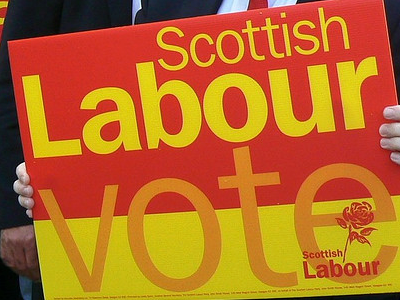
Dialogue on a doorstep this week:
Man: ‘I’ve given up on Labour. I’m Scottish now – SNP all the way.’
Me: ‘Is there anything specific putting you off Labour?’
Man: ‘Everything! Now you’ve let us down again.’
If drawing a pen picture of a ‘core Labour voter’ this man would be it. Late 60s, retired skilled worker, bought his council house but did not change his politics.
Note the emphasis on being Scottish and the growing conflation of that with voting Scottish National party, encouraged by Scottish National party politicians. Point out falling educational standards and the response is, ‘Stop talking Scotland’s children down’.
It seems fairly typical too that a request for specific things Labour has done or not done did not get much of a reply. The response to Labour has become about perception and emotion.
The reference to letting us down ‘again’ is significant. We did not win in May and so failed in our main ‘offer’ – protecting Scotland from Tory policies. 2010 was a good election in Scotland. We held all our seats, increasing majorities in many. Scots accepted our argument that only Labour could keep the Tories out. But saying the same five years later just did not work.
Given all the apparent ‘Scottish’ focus, it might seem odd to reflect that many voters still identify us most by our UK leadership, although we have changed our organisation to make it more Scottish, and Labour leaders in Holyrood from the outset in 1999 pursued different policy positions. This chimes with one of Deborah Mattinson’s findings, that, while Scottish voters express hostility to ‘Westminster’ they identify it as very important. So voting for SNP in May 2015 was seen as crucial to give Scots more ‘clout’.
At every Scottish parliament election turnout has been around 10 per cent lower than for Westminster. People still refer to the latter as the ‘big election’. One initially surprising comment from Mattinson’s report is, ‘Holyrood is basically irrelevant – with no sense that SNP should be tested on their track record there.’ Admittedly this was soon after May, but it perhaps helps to explain why such little traction is being achieved by the very cogent criticisms made of that record, by Labour and others. Scots still see power residing at Westminster (‘bad but powerful’), a view encouraged by the SNP.
Holyrood gets new tax powers in April, with much more to come. However, the SNP has made it clear that it has no intention of using the new powers this year, on the largely spurious argument that it would be ‘unfair’ to raise the rate of income tax because it does not yet have the power to raise it differently for different bands. This is despite the fact that it is pursuing the ‘unfair’ council tax freeze much more vigorously than George Osborne is. This stance encourages people to see Holyrood as powerless relative to Westminster.
One of the recommendations Mattinson makes is to ‘consider rebranding Scottish Labour as independent’. This is very much an ongoing debate. But have steps down this road helped at all? Or should we be making a virtue of the fact that we are a party that can gain power at Westminster and use the greater economic power of the United Kingdom to benefit the people of Scotland? That, after all, was our argument during the referendum. But we need to demonstrate we can win in England!
In 2011 we fought a strong ground campaign in the Holyrood election but failed in the ‘air war’. Indeed we ended up sounding like a ‘mini me’ to the SNP on many issues. BritainThinks found that Scots had many of the same worries as the English participants (jobs especially for young people, high prices, and immigration) but were less optimistic about the future. We need to show there is a way to create a better and fairer future, achievable in Scotland using both old and new powers. For instance, parents worry about rising class sizes and costly childcare. We have well-costed education policies and we need to tie these into a narrative which can persuade people that Labour can realistically deliver in Scotland over the next five years because we are not afraid to use the powers the Scottish people fought hard to get. Some of that (for example, reintroducing the 50p tax, not cutting air passenger duty, restructuring local government finance) may be less ‘comfortable’ than the SNP message, which does not challenge people’s comfort zones. But people keep saying they want a more honest prospectus from politicians. They are not getting that from the ‘jam tomorrow’ SNP.
———————————
Sheila Gilmore is former member of parliament for Edinburgh East. She tweets @SheilaGilmore49
———————————
Just to keep the discussion in the UK and grounded, I will refer to one specific.
Labour’s election offer on child care was to increase the allowance from 15 hours to 25 hours – the Tory offer was to increase it to 30 hours (i.e 6 hours x 5days – how grounded and practical they are?). If only Labour was as in touch with its grassroots parents as the Tories seem to be, we would be making a start.
Scottish Labour cannot do anything that will turn their fortunes round. The car has already crashed. It is unrepairable; a right off. It is worth nothing.
Shiela Gilmore should not worry herself any longer.
May this year will see the Scottish Tories become the main opposition party in Scotland as Labour slip into irrelevancy at Holyrood. Next May Scotland will cleanse iteself of its last remaining useless, corrupt Labour councils.
There is nothing Labour can do to stop these events. They have been anti Scottish since the poll tax and they are now reaping the rewards.