
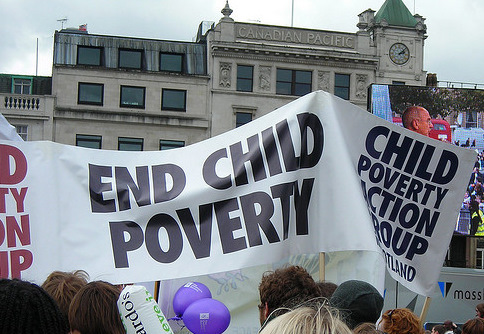
If there is one issue that must never slip from the political radar it is child poverty. Tackling and ending child poverty has to remain central to Labour’s cause. This is something we must work as hard at and be as committed to now in opposition as we were in government. It has been said before and it will be said again, but this generation must be the one that cracks the cycles of deprivation and ends child poverty.
Our record in government is one of which we should be proud. From establishing the first ever explicit aspiration for ending child poverty to formalising these targets and making efforts to reduce child poverty a statutory responsibility through legislation, Labour’s work in office was important. Crucially, it was a record of action as well as words. Achievements with which we are now familiar and which frustratingly are easily forgotten, apart from when they drift back into the public eye because of the coalition’s efforts to unpick them.
Sure start children’s centres in every community; nothing short of a sea-change in the provision of active and accessible early years provision and parental support; tax credits and other financial interventions to boost family incomes and lift households out of poverty; the child trust fund, scrapped by the coalition government, and too often dismissed ignorantly as a gimmick, but making sure every child had a modest nest egg when they reached adulthood.
The coalition got to work quickly on unpicking and scrapping initiatives which combined to be an important and busy framework of interventions designed to lift children out of poverty. Alongside the child trust fund, the health in pregnancy grant was also axed. This one-off tax free payment of £190 would help mums-to-be prepare for their new arrival.
No one can criticise the Labour government’s commitment or efforts to eradicate child poverty. Numerous policy programmes from across Whitehall were designed to drive this agenda directly, underpinned by an economic policy creating jobs and supplementing family incomes to make work pay for families.
A frustration often felt by policymakers is that things don’t change quickly enough. Despite our very best efforts in office child poverty rates remained stubbornly too high. Labour’s efforts reduced the numbers of children in poverty by 900,000 between 1998 and 2010. However, in 2009-10 3.8 million children were still growing up in poverty (based on the after-housing costs measure).
The child poverty challenge in this country is significant and urgent. We know why tackling child poverty is important. Young people who grow up in poverty will do worse at school, they will be less likely to get a job and will have poorer health outcomes. Poverty in childhood has a devastating impact on life chances going forward.
This challenge is urgent: child poverty is predicted to increase because of current policy decisions and the economic crisis. Increasing levels of unemployment and long-term worklessness are seeing more and more families slip under the poverty line. The axing of some of the initiatives listed previously have taken cash from the household budgets of hard-pressed families at a time when living costs continue to rise. Welfare benefit changes are already hitting hard, with tax credit changes perversely making not working a better option than staying in employment.
The commitment to end child poverty should remain. We should make sure the current government does not try to sidestep its obligations to properly measure child poverty. Labour’s job in opposition is to hold this government to account and its dreadful record to date on household incomes, welfare changes and wider social policy should be exposed and challenged at every opportunity.
Our policy thinking now should be drawing on the best of our interventions from 1997-2010. A modern welfare system will reward employment and will be built on the founding assumption that work is the best route out of poverty. Tax credits need to remain as the building blocks of a fair, rewarding system of in-work support for family income.
Where Labour is in control in local government reducing and ending child poverty needs to be more than a statutory duty from the 2010 act. In Leicester we have set up a child poverty commission to develop new solutions to the child poverty challenge locally. This commission brings together senior policymakers, academics, politicians and the Child Poverty Action Group to drive this work forward. Decisions have reflected this commitment. Despite devastating budget cuts from the government, the doors of all our 23 children’s centres have remained open.
As we move towards 2015, Labour should reaffirm its commitment to ending child poverty. The original timescale is unlikely and needs to be revised, but our next manifesto should carry this commitment and spell out how we will lift more children out of poverty.
We should be bold in developing new ideas and new policy, while building on what we know worked between 1997 and 2010. The coalition will carry on unpicking the fabric of Labour’s social policy. The child poverty challenge is not going away. It is a challenge which must remain central to Labour’s mission. We will need new ideas and unstinting determination as we pick up the pieces of whatever the coalition leaves behind.
—————————————————————————————
The Leicester Child Poverty Commission is holding a conference on 25 May, bringing together all those with an interest in tackling child poverty. For information and to register please see more here
—————————————————————————————
Rory Palmer is deputy city mayor of Leicester and chair of the Leicester Child Poverty Commission. He tweets @Rory_Palmer
—————————————————————————————