
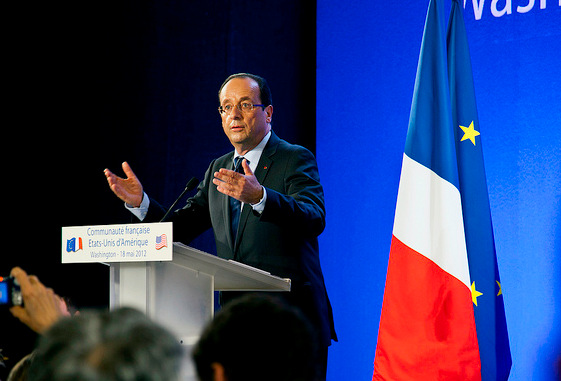
François Hollande’s victory was that of a pragmatic progressive, writes Matt Browne
The election of François Hollande as president of France last month could mark a turning point in the economic fortunes of Europe and perhaps also the political fortunes of Europe’s progressive political parties.
Those commentators concerned that Hollande’s victory and forthcoming policy shifts in favour of economic growth as a complement to budget austerity might put financial market stability at risk are mistaken. The new French president is no ideologue. On the contrary, he is a pragmatic progressive who realises that austerity alone has not worked, and that what Europe needs is a realistic strategy for job creation and economic growth.
This is precisely what Europe needs today. And a pragmatic, progressive, pro-growth agenda is what Hollande will pursue to deal with the continent’s slumping economies and government budget deficits. However, it is far from clear that a pro-growth agenda will automatically lead to a revival of progressive fortunes across the continent, or indeed what lessons progressives in the UK should take from Hollande’s campaign and the victory that it delivered.
Hollande’s election has been compared to two historical precedents – Barack Obama in 2008 and François Mitterrand, the first socialist president of France, in 1981. In the wake of the result last month, Olaf Cramme of Policy Network contrasted the ‘era of hope’ that saw Obama elected to the one of fear that defines the Hollande victory. Much of Europe is back in recession, unemployment continues to grow, and the eurozone sovereign debt crisis seems to be spiralling out of control again. Yet when Obama was elected, he too was faced with a dramatic economic crisis, a financial system on the brink of collapse, and rising unemployment. In 2008, just like today, it was the candidate, not the context, that provided hope for a better future.
Perhaps the more telling comparison in the French context is with Mitterrand, until now the only socialist president in France’s history. Thirty-one years ago Mitterrand defeated the incumbent centre-right president, Valéry Giscard d’Estaing – the last time an incumbent president seeking re-election was defeated. Like the loser in this year’s election, Nicolas Sarkozy, Giscard d’Estaing had become increasingly unpopular with the French people – not least because of his adherence to liberal laissez-faire economics. Like Hollande today, Mitterrand promised a change in the economic agenda.
Unlike Hollande, however, Mitterrand tried to pursue a purely national policy of economic renewal, seeking to defend the inflated value of the French franc on the international markets and pursue an industrial policy of national champions. Ultimately he failed and embraced Europe as the route to resolving France’s economic woes and saving his own presidency. Interestingly, Hollande was an early opponent of Mitterrand’s failed strategy and one suspects his own approach today will be well informed by the lessons of that failure.
Hollande realises that the policy options open to any one nation in a highly integrated European economic area are marginal. From day one of his campaign he has focused on Europe. Speaking two days after becoming the Socialist party’s nominee at the Global Progress summit, organised by the Center for American Progress and Fundación IDEAS in Madrid last October, he called for an end to austerity. As his campaign evolved he presented arguments in favour of a financial transaction tax in the eurozone to fund industrial-led growth, a renegotiation of the European Union’s fiscal pact, which was agreed in December and which imposes overly tough fiscal constraints and European supervision of member state budgets, and the creation of eurobonds issued by the European central bank to mutualise the EU’s sovereign debt burdens.
Despite the rhetoric Hollande used to guard his left flank during the presidential campaign, it is important to remember that he won the Socialist nomination running as a pragmatic centrist. His major opponent, Martine Aubry, had argued that a ‘hard left’ was necessary to take on an increasingly ideological right. For his part, Hollande argued that the French were tired of ideology and what they wanted was a competent, less erratic, leader.
Interestingly, Hollande’s economic advisers pivoted back to his pragmatism and began to sketch out a realistic European agenda as the run-off campaign against Sarkozy progressed. On the eve of the first round of the election, Elisabeth Guigou, former finance minister and adviser to Hollande, addressed a meeting of the progressive parliamentarians’ network co-organised by the Center for American Progress in Rome where she suggested that, rather than pursuing a burdensome renegotiation of the EU fiscal pact and eurobonds for mutualising debt, Hollande would actually seek to complement the pact with a jobs and growth protocol at the continental level. She added that he would push for the creation of European ‘project bonds’ designed to leverage private capital into much-needed European infrastructure and industrial investment projects. Days later this vision was echoed by Michel Sapin, another former finance minister advising Hollande, in an interview with the Financial Times.
Indications are that this is an agenda that France’s most important partner might already be willing to accept. In the days running up to the second round of the election, as Michael Miebach, editor of the Berliner Republik political journal, has noted, Angela Merkel had already started one of her trademark repositioning manoeuvres when she signalled her readiness to accept a European growth agenda alongside an expanded role for the European Investment Bank. This is also a position supported by the leader of the Italian technocrat government, Mario Monti. It would not, then, be surprising if Merkel and Hollande were to agree on a complementary ‘fiscal and growth pact’ in the near future.
Indeed, the German chancellor has already begun to stress that the expansionary pro-growth aspects of Germany’s domestic economic policy have been misunderstood. This shift in stance, or emphasis, allows her to retain the primary objective of German foreign policy, namely, a strong Franco-German axis at the heart of Europe. Interestingly, however, it also simultaneously allows her to close the space for the German Social Democratic party, Hollande’s sister party. The German Social Democrats had supported Hollande’s position during the campaign at a time when it looked like Merkel herself would campaign for Sarkozy. Regardless, Merkel may now take credit for the policy, and Hollande’s first official visit was to meet with her in Berlin.
So what does this all mean for the United Kingdom?
For one, it seems clear that the UK has never been such a marginal player in Europe as it is today, at least not since our entry into the European Economic Community in 1973. David Cameron’s refusal to meet Hollande on several occasions now looks to have backfired. And, again, following his early departure from the fiscal pact summit in December last year, European rules will be set with little regard for British interests and without British input.
For Ed Miliband, Hollande’s victory can provide hope. A complementary growth agenda could strengthen his opposition to Cameron’s failed economic policy. But Labour should be wary of learning the wrong lessons from Hollande’s campaign. Despite his populist rhetoric, what Hollande has offered is a pragmatic response to Europe’s crisis and France’s ills. Should Labour be able to do the same, then victory in France might well prove to be the beginning of a new progressive dawn in Europe.
—————————————————————————————
Matt Browne is a visiting fellow at the Center for American Progress and director of Global Progress
—————————————————————————————