
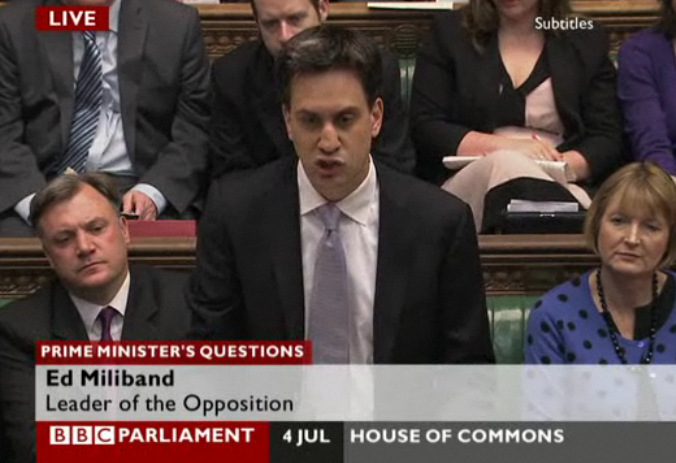
It has been one of those weeks in politics where the predetermined focus of prime minister’s questions was obvious to all. In certainly not making an unfamiliar appearance, it was banking and the banking system which, in the main, wrought the field of play. Of course, this week’s session brought the inevitable debate in wake of Libor – the interest rate manipulation furore primarily concerning Barclays, which led to chief executive Bob Diamond’s resignation earlier this week.
And some interest it has generated too, certainly not least by both sides of the House who exchanged fire soon into the questions as to what we do with the latest scandal on the block. It was, in fact, the second question of the day from Conservative MP Nicholas Soames asking the prime minister to agree with him that ‘the City is important’, ultimately setting the ball rolling. Aside from the self-evident agreement, surely to be given by people of most political persuasions –
that a strong banking sector is ‘important’ to our country – it was Ed Miliband who began to fuel some proper scrutiny. Indeed, his well-thought questioning style which time and again frustrates David Cameron into hard answers didn’t fail today (Dave actually loses his temper and resorts to shouting just slightly earlier in the proceedings each week now as a result). Miliband continued Labour’s appropriate call of a wider judge-led inquiry, importantly asking how the PM could possibly convince people that a parliamentary inquiry will restore confidence in the industry. It was Cameron’s response, however, which seemed a little contradictory, the first contradictions of a few today. In saying an inquiry must be ‘swift and decisive’, thus favouring a parliamentary inquiry as a result, it either undermines his support for establishing Leveson on the other matter of the press, or, if it is just Libor he wishes to investigate, questions arise as to Cameron’s concern about opening the closet of banking more fully. Miliband proposed there be a two-part inquiry, investigating Libor and reviewing the banking system more widely.
‘He hasn’t understood the depths of public concern’, countered Miliband, true not only in itself, but again because Cameron’s concern is most probably about his own situation in all of this. After witnessing the underlying anger of his media supporters as a result of Leveson, a repeat of such an inquiry into the City may probably lead to fallout from his supporters there which could impact far more severely. He may just well be in fear should the banking lid be blown off in the same way.
Miliband went on to say he doesn’t think Cameron ‘gets it’ with regard to the need for a fuller inquiry into the corruption of banking, fired back at by the ever-present arrogance in Cameron’s style – that one where he averts away from constructive debate to point scoring when he has no response – with the PM stating he ‘won’t take lectures in ‘getting it’ from Labour. Unfortunately for him, after criticising Labour’s lack of regulation in office during a time when ‘these failures took place’, Miliband had an apt quote to hand. In what was a set point for Miliband, he told the house of the prime minister speaking to the City on 25 March 2008, in which he stated: ‘I [Cameron] am a free marketeer by conviction. It will not surprise you to hear me say that the problem of the past decade is too much regulation’.
Miliband’s example of Cameron’s ‘double standards’ from there on in left Cameron without much of a leg to stand on with regard to Libor and banking. If the Libor scandal and the state of British banking should be on the shoulders of Labour as Cameron infers, it begs the question as to why it is the Labour opposition calling for a full transparent inquiry in the face of a prime minister who wants to shun such thing away? Again, behind it all appears to be a much bigger concern in the Conservative party than in Labour as to what skeletons are in the banking closet. Cameron’s party, ‘bankrolled by the bankers’, fits the conclusion that the rejection of a public inquiry demonstrates that this prime minister cannot act in the public interest.
In what may become to be known as the government of indecisiveness, among many other labels, it wouldn’t surprise me if Cameron has a change of heart (or whatever it is that Tories have as a substitution for one) and shifts towards a judge-led inquiry. Either way, Miliband’s comfortable victory today in both his dispatch box negotiation and share of the mudslinging will no doubt progress into firm ground for long-term success on the issue. Miliband’s real win came, though, in proving Labour, unlike the coalition, can be truly the voice of the people in parliament, genuinely a party working in the national interest opposed to that of the elite.
—————————————————————————————
Josh Newlove is a Labour councillor on East Riding of Yorkshire council
Ed’s points victory over Cameron was plain to see by anyone not blinded by political bias (though I think he would be even more impressive if his attacks were more cutting and if he used humour and ridicule). Why then, in the BBC’s ‘Daily Politics’ show following PMQs do they always read out MORE viewer comments criticising Ed Miliband’s performance than praising him? Is it possible that the BBC is politically biased against Labour? Viewers may also have noticed how Andrew Neil, like a ravenous shark spying a lone swimmer, repeatedly heckled John Mann and inferred that Ed Balls, Lord Myners etc. were conspirators in the Libor fraud even though they all vigorously denied the allegations. Neil displayed the same despicable behaviour shown by Osborne.
“the government of indecisiveness”
Damning words from a councillor of a party led by the utterly ineffective Miliband who hasn’t offered any coherent policies concerning the problems he and Balls helped create. Mind you, he’s very good at throwing quotes at Cameron, who strangely fails to fall to pieces on hearing them in PMQs.