
It is the thriving private sector which should inspire us about Scandinavia, argues Ed Miliband
LIKE many, I admire the achievements of social democracy in Scandinavia. For decades, the combination of strong social security programmes, a narrower gap between the very rich and the very poor, and a consistent commitment to women’s rights at work, has set the benchmark for centre-left governments across the world.
What has been striking about countries such as Denmark and Sweden more recently, however, is that their economic models have proven so resilient in times of great trial. The change in our global economy, a Scandinavian banking crisis in the late 1980s, and the spillover effects of the 2008 financial crash all gave rise to apocalyptic predictions of the imminent demise of social democracy in this part of Europe. But on my recent visit to northern Europe I was impressed at how the achievements of social democracy in these countries have remained so strong, even when social democratic parties themselves have often faced difficulties.
Those achievements have survived and prospered not by governments setting their face against change, but by keeping true to the fundamental values underlying historic Scandinavian achievements and by adapting to changing economic, social and demographic circumstances. How has this been possible? The answer, in my view, lies not so much in the much-heralded welfare states of Scandinavia, nor in a different approach to taxation and spending. Instead, it is the supply-side of the economies that make these welfare systems affordable. Underlying the commitment to greater equality and social security is a distinctive approach to how to grow and how to compete, an approach that offers a number of lessons for Labour as we seek to build a different kind of economy for the future, a recovery made by the many, not just a few at the top.
What are the ingredients of this approach? First, Sweden and Denmark are committed to being open, export-led economies. These are countries where there is a broad consensus that being able to pay their way in the world requires investment in strong exporting industries, and that putting a premium on competitiveness in selling goods and services abroad brings a discipline and responsiveness to the economy as a whole that serves the national interest. In addition, their membership of the European Union is an important part of this commitment, and they see Britain as a crucial ally in the fight for a more open, transparent and efficient EU.
Second, both Sweden and Denmark know that the only way for advanced economies to compete in the world is on the basis of high-skill, high value-added industry. They know that trading with China, India and Brazil cannot mean a race to the bottom, but must involve a serious investment in the education and skills of their workforce.
This is why Denmark has the highest participation rates in adult education and continuing training in the EU. If you visit some of Denmark’s world-leading companies, like Novozymes, a major biotech firm in Copenhagen, you realise that this investment is not only crucial for ensuring productivity and competitiveness for Denmark as a whole, it is also the smartest way of ensuring labour market flexibility so that companies can respond to changing demand and technologies.
Third, the Scandinavian approach to innovation is not to leave it to a few large companies, but to build a strong partnership between large companies, smaller companies and the government. In Sweden, I visited VINNOVA, a government agency that not only helps build innovative capacity in Swedish companies, but challenges companies to find new responses to public policy challenges such as how to build sustainable cities in the frozen snowy north of the country.
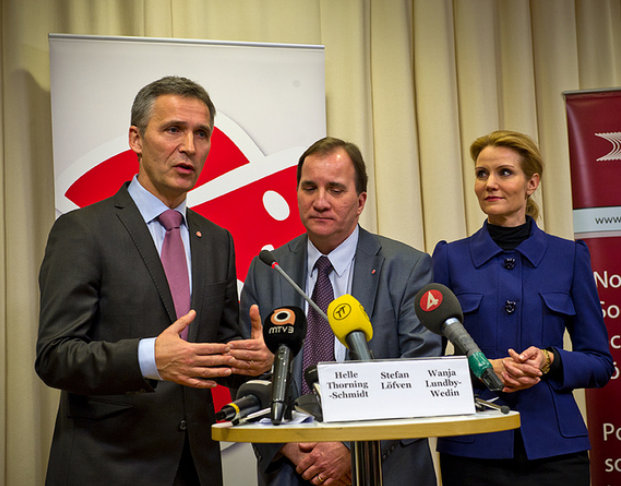
Last, the Scandinavians think of their welfare system as much from a supply-side point of view as from the point of view of fairness. Helle Thorning-Schmidt, the Danish prime minister, told me about the importance of childcare to her and her country. She said that the Danish system – which provides local, high-quality childcare for all children from one year of age upwards – is as much a way of improving participation in the labour market as it is a way of providing a social service. High-quality childcare is a virtuous circle for women in particular, both offering them highly esteemed careers in professional services providing childcare and also enabling significantly higher rates of participation of women in work than in other countries.
All countries are different and, in learning lessons for Britain, it would be wrong to think we can simply import policies wholesale from Scandinavia or anywhere else. Britain has distinctive strengths that the Scandinavian countries do not have, as well as some unique challenges. But the contrast with the approach adopted by the current government here in Britain is sobering. We have an approach driven by the ideology of trickledown economics, committed to an unrelenting squeeze on the middle and a race to the bottom. Scandinavia teaches us it is possible to build stronger, more innovative, more productive and more inclusive economies at the same time. That is a lesson we should not forget.
—————————————————————————————
Ed Miliband MP is leader of the Labour party
—————————————————————————————
Interesting. Cannot help mentioning, again, our little, report on ‘Contested Nordic Models of Work and Employment’. http://www.akesandberg.se/contested-nordic-models-of-work-and-employment-volvo-uddevalla-and-welfare-capitalism/
Contested due to global pressure (but there is obviously room for politics!). Contested by the Conservatives/Moderates who change the meaning of Swedish/Nordic Model, emphasizing only the individual liberation aspect, forgetting the solidarity and equality aspect – thus taking the model apart. And also via cuts in unemployment and social security systems undermining union power and the labour market model based on strong unions and employers.
We develop these ideas further in a forthcoming book, which happens to be called “Nordic Lights” -Northern Lights happened to be taken by a book on Scandinavian management research. The subtitle will be “Work, management and welfare in Scandinavia”. To be published by SNS forlag Stockholm and by a US publisher, scheduled for early summer 2013.
Åke Sandberg
prof.em. Stockholm university
[email protected]
Our book NORDIC LIGHTS. Work, management and welfare in Scandinavia, is now published in print (June 25) and will soon also be available as e-book. SNS förlag, Stockholm, publishers information: http://www.sns.se/forlag/nordic-lights-work-management-and-welfare-scandinavia
Twenty-five Scandinavian researchers contribute to the book.
See also http://www.akesandberg.se/nordic-lights
/Åke Sandberg, editor