
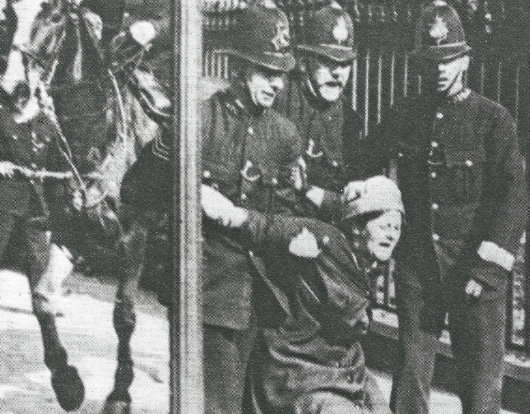
Nothing demonstrates the importance of the right to vote more than a consideration of the sacrifices of previous generations to obtain it. This month, April 2013, marks the 100-year anniversary of the passing of Prisoners (Temporary Discharge for Ill Health) Act 1913. Passed by the Liberal government of 1905-15, it was extraordinarily illiberal.
On 3 April 1913, the famous suffragette, Emmeline Pankhurst, had stood trial for causing an explosion at the home of the then chancellor of the exchequer David Lloyd George. She did not even offer a plea to the charge and gave a speech in the dock threatening to hunger strike to death if she was sent to prison. Pankhurst had called her fight for votes for women the ‘last fight for human freedom’. After she was imprisoned, and started her hunger strike, the home secretary, the North Monmouthshire MP, Reginald McKenna, released her after only days in Holloway. She was later re-arrested in May 1913, by which time the government had rushed the policy he was pursuing into legislation on the statute book.
The idea was cruelly simple. The government did not want to face the adverse publicity of force-feeding suffragettes who were attempting to starve themselves to death. Thus, suffragettes on the point of death who were severely weak would be released on licence from prison. In that state, the government reasoned that they could not cause problems on the streets. Once they ate and regained strength, they would be re-arrested. The statute has become known in history as the ‘Cat and Mouse Act’. The label itself illustrates the brutality of the act. The government could toy with the suffragettes in the way the cat overpowers the mouse at will.
George Lansbury, who served as Labour leader from 1932-35, had resigned his parliamentary seat, Bow and Bromley, in 1912, to contest a by-election on the issue of votes for women. He had lost, but he remained committed to the cause, and addressed a Women’s Social and Political Union Meeting in the Albert Hall on 10 April 1913, while Pankhurst was still in prison. His speech, which sought to rally support for the cause, went so far as to defend the suffragettes’ violent methods of seeking to achieve their goals, and he was himself then summonsed. Pankhurst herself returned to prison only to be released and returned again.
The government’s main concern was to avoid the creation of a martyr to the cause of votes for women. However, no government minister had the power to ensure that this did not happen. Two months later, in June 1913, another suffragette, Emily Davison, threw herself under the king’s horse at the Derby, and subsequently died of her injuries. With voter turnout often so low in modern-day elections, the hundredth anniversary of the ‘Cat and Mouse Act’ provides a jarring reminder of how the right of every adult to have a say in how our country was governed was won, and of its fundamental importance.
—————————————————————————————
Nick Thomas-Symonds is the author of Attlee: A Life in Politics published by IB Tauris (2010). He writes the Labour history column for Progress tweets @NThomasSymonds
—————————————————————————————