

We are at a key point in the influence of different generations on our society. The pre-1945 generation is dying out and being replaced in the adult population by generation Y whose members have a very different perspective. The national balance of opinion is shifting as a result.
One of the most important areas of overall change and generational difference is on views of welfare. A question that we regularly ask at Ipsos MORI – whether the government should increase benefits for the poor even if it leads to higher taxes – reveals that support for more spending has halved and opposition nearly doubled between 1987 and 2011.
But it is vital to understand for future welfare policy how this varies between different generations. Our new analysis suggests three major patterns. First, all generations show a downward trend in their support for more welfare spending. There is a clear ‘period effect’, where the general mood has shifted. There will be a number of explanations for this, including the shifting economic context, but also the changing narrative around welfare benefits. Studies have shown an increase in media coverage in recent years of the ‘undeserving’ nature of many benefit recipients.
Second, the generations are different and stay different from each other. This suggests that attitudes to welfare do have a very important generational aspect: the context you grew up in is important in forming your views.
Third, there is a clear generational rank order: the prewar generation is the most supportive of further redistribution through welfare, followed by baby boomers, then generation X then generation Y. The practical point here for policymakers is that the younger generation seems to have a different view of welfare, even after allowing for the general shift in attitudes across society.
Some of this could, of course, be explained by differing stages in life people are at, and for example, varying personal financial resources and ability to pay taxes. But it is a pattern seen across a number of questions, including one on overall pride felt in the welfare state.
If we look just at overall levels of pride, we see very little change over the last decade. But this masks huge generational differences : 70 per cent of the prewar generation think the welfare state is one of Britain’s proudest achievements, but only 30 per cent of generation Y do – and neither has shifted in their views in the past decade. This should not be too surprising, given the direct experience of the creation of the welfare state among the oldest generation – but we need to remind ourselves of this range when deciding future direction.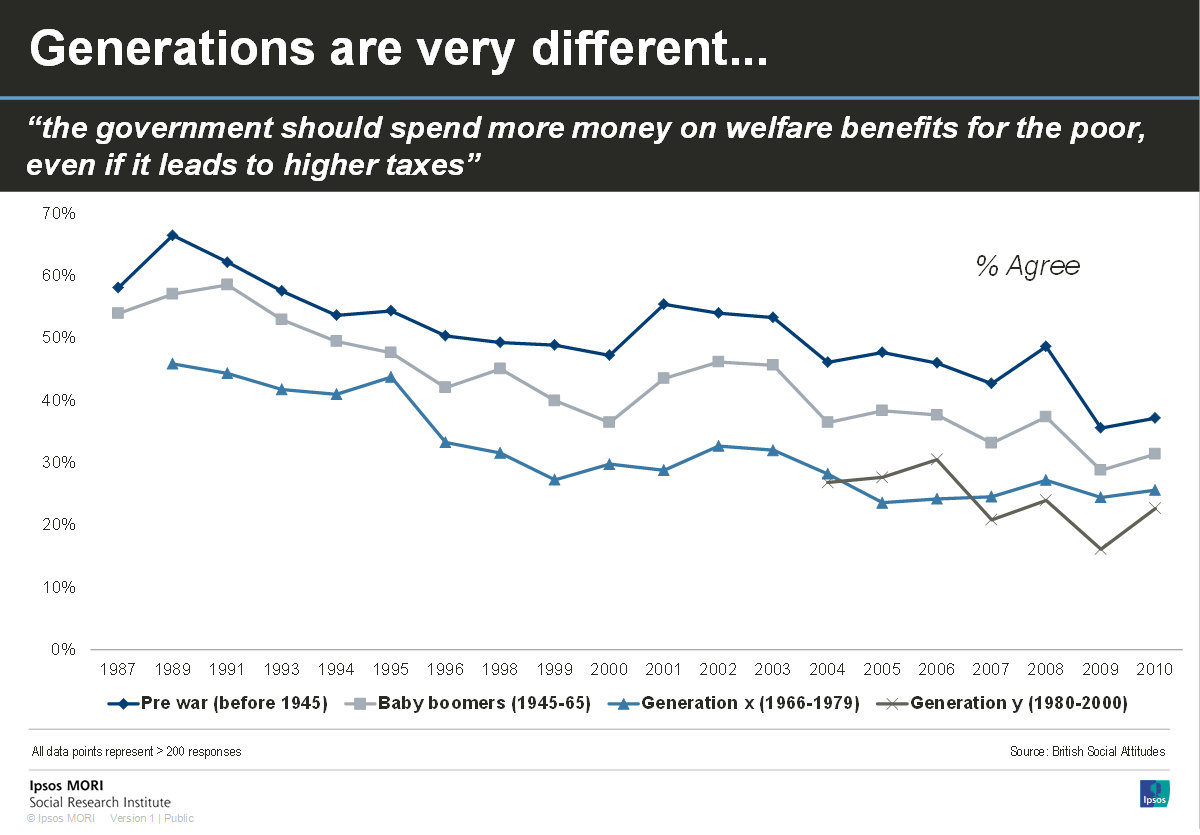
Overall, the survey data suggests a more ‘individualised’ perspective on rights and responsibilities among younger cohorts, which is perhaps related to three key points. First, the purpose and importance of the welfare state is not just a distant memory for most young people, it is not a memory at all.
Second, the welfare state itself is much messier now, with incremental shifts blurring understanding of whether it is based on contributory principles, universalism or means-testing. And, third, at a more individual level, young people are receiving much less support now across such a wide range of areas of their lives, and they have responded by expecting to have to look after themselves more.
The challenges are very clear; the response much less so. We are exploring generational views of welfare further in a project for the Joseph Rowntree Foundation, jointly with Demos, which reports in the summer. So far the research suggests it is not just a problem of policy or perception, but both. The welfare system needs to have greater relevance to a wider range of people, and to be explained in a way that provides a coherent picture of its purpose that we are all part of – a contract that seems relevant not just to those old enough to remember what came before.
—————————————————————————————
Bobby Duffy is managing director of the Ipsos MORI Social Research Institute
—————————————————————————————
As a member of generation Y I support higher taxes and better welfare for the poor. Which makes this article very depressing for me to read.