
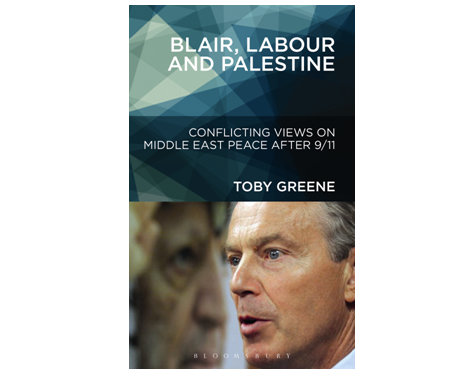
This is a fascinating and important book which examines both the broad sweep of Labour’s attitude to Israel and Palestine over the decades, and looks in detail at how New Labour policymakers grappled with contradictory views – at home and abroad – of Israel’s importance to the Iraq war and to the growing threat of domestic extremism post-9/11.
But author Toby Greene also does Labour a service by compellingly depicting how foreign policy – and, in particular, attitudes to the Middle East – has become akin to an identity badge in the modern politics of the left.
‘Pro-Israel’ and ’anti-Israel’ as labels signifying your wider position in the party is a phenomenon that predated New Labour by many decades. Greene describes how the rise of the influence of New Left politics on the Labour party in the 1980s manifested itself in a decisive turn against Israel after the 1982 Lebanon war by those who used the country as a prime symbol of the US-led imperialism they fervently opposed. It turned on its head the position of many on the left of the party at the time of Israel’s creation in 1948 – they had hailed their Israeli sister party’s success in founding a whole country on the liberal, social democratic values they were striving to mirror in their own green and pleasant land.
But the prevalence of Israel as identity badge nevertheless increased under New Labour when, as Greene sets out, Tony Blair and Gordon Brown’s roots in Christian socialism gave them an instinctive support for the country’s status as a liberal democracy in a region surrounded by dictatorships.
So it came to follow that if you were a supporter of New Labour in the early days of Blair’s leadership of the Labour party, you typically identified yourself with Labour Friends of Israel as a signal of your support. Not only did it dutifully follow those at the top, it was part of a pattern of New Labour rejecting the pillars of old Labour – of which a deeply held antipathy for Israel had become one. In the parliamentary party, chairing LFI came to be seen as part of a route to the top for ambitious young Blairites.
Then, as Greene records the astute political commentator Martin Bright observing, a position on Israel became a handy signal for those wishing to get back into favour with those who were disgruntled about New Labour domestic reforms: ‘You may think that I have kowtowed too much to the Blairite agenda … but look at my position on Israel. That’s where you can test if I am genuinely a person of the left.’
People will have differing views on the validity of that analysis, but we should be united on one thing: using foreign policy as a badge – whatever it signifies – is a terrible way to reach a view on issues where it is often the case that whatever action Britain supports will cost lives elsewhere and cause great suffering.
The Syrian crisis has rightly raised questions about what Labour’s attitude should be to fundamentally important international issues that impact greatly on security and justice across the world. Whatever course Ed Miliband sets, he must ensure that the badge-making kit is consigned to the dustbin of history.
———————————————————
John Woodcock MP is a vice-chair of Progress and former chair of Labour Friends of Israel
———————————————————
Blair, Labour and Palestine: Conflicting Views on Middle East Peace After 9/11
Toby Greene
Bloomsbury Academic | 312pp | £70
If Blair had ever known the first thing about Christian Socialism, then he would have known that it was fundamental to Arab nationalism.