
If you’ve been out doorstep canvassing, the chances are you’ll have had someone ‘running the board’ – calling out the door numbers for people to knock on, and manually recording any information that’s passed back to them. You may also have experienced the wait on a corner while the sheets are reorganised, because ‘it’s quicker to do this side street before we carry on along the main road’.
If your local party is well organised, then this local knowledge will already be reflected in manually entered ‘road groups’ which means the sheets will print in the correct order.
When we joined the Obama campaign in Florida in 2008, we were working using similar paper lists. Four years later, we found campaign technology had radically changed the way things were done.
Think back a few years to the days when if you got lost, you needed to carry an A-Z map book or be prepared to ask a stranger for directions. Nowadays, smartphone technology means you can just open a GPS-powered map application and work out where you are.
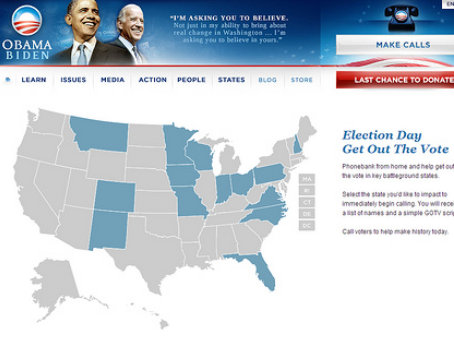
Returning to Florida last year, we found ourselves working not just with campaign officials and party volunteers, but with a coalition of immigration reform campaigners and trade union activists, all working together using the Votebuilder app, which neatly combines a GPS map with a set of target addresses. This showed where the nearest doors to knock were, and, once you selected a household, it displayed the residents’ names, age and any registered party preference. It also included a script for the conversation and enabled you to enter the data as you made your way to the next door. This technology is all available to the canvasser via smartphones. With a recent 2013 Deloitte study showing that almost three-quarters of UK population now own a smartphone we should harness this technological opportunity. As the election drew closer we were even reminded to contact our Facebook friends to remind them to vote.
This approach eliminates the logistical need for someone to run the board. But at the same time it removes the gatekeeper who helps protect your data from contamination – for example, the all-too-common assumption that because one occupant of a house is a supporter, everyone who lives there votes the same way; or the tendency to misrecord a person who says they will be voting for our local candidate this time because they know him/her as a supporter of our party, which is not necessarily accurate. If adopting this kind of system, volunteers need to be trained to be more rigorous and less optimistic when recording data.
When a large group is canvassing together, having someone ‘on the board’ helps keep the group together and, almost as importantly, keeps things moving at a decent pace. In less densely populated areas, sending out a group is unlikely to create the visual impact that ‘blitzing’ a neighbourhood can have.
Back in the campaign office in Ybor City, Tampa, the same system was being used on desktop PCs to run a phone bank and it could be used to make calls from home too.
Using conventional paper-based phonebank lists, you tend to motivate yourself to finish ‘one more page’. One heartening aspect of this system was the on-screen progress bar that showed how many contacts you personally had made, and how the group was doing overall.
The Labour party has this ‘online phonebank’ technology in place but it is not sufficiently promoted. The regular emails we receive from the party are more likely to ask us to donate than to make 10 calls using the online phonebank.
We need to make full use of the latest campaign technology we have, and help our members get involved in campaigning in a way they can fit around their lives.
This is an area where the Labour party’s unique link with the trade unions may come into its own. There’s a debate right now about how the Labour party and trade union members can work together more meaningfully. We all know that a ‘save your local hospital’ campaign is generally more effective than a ‘stop NHS cuts’ campaign, or simply asking people to vote for us. Labour’s online Campaign Engine Room is a good start, because it allows members to generate their own campaigns.
Let’s take a leaf out of the Americans’ book – get party members, trade union members, public service workers and users all campaigning together on the issues that unite us.
Link together the tools that we have, make full use of them, and get more people involved and we can really get some traction. Labour needs to make full use of latest campaign technology if we are to win the battle for votes.
—————————————————————————————
Chris Clark is a TSSA union representative and a Labour and Cooperative party councillor on Ashford council. He tweets @ChrisClarkKent. Rav Seeruthun was PPC for Maidstone and the Weald in 2010. Having previously worked as a GP in the NHS, he is a consultant in pharmaceutical medicine and is currently a senior director in a company running clinical trials. He tweets @RavSeeruthun
—————————————————————————————
I’d love an iPhone/iPad app for VoterID – but would still want one person to retain control of it in a similar way to the person running the boards, for exactly the reasons you describe above.
The virtual phonebank would be used more if you could pick a ward to canvass, rather than just a constituency. It’s hard enough to get some of our members to canvass at all, let alone canvass for another ward!
or another constituency, whose identity and issues you don’t know until it’s given to you (nor even then, as to issues). I’m also noticing how many people seem to have telephone preference in place but the Labour Party seems to still pick those phone numbers; and answering machines in place. I’m not a total enthusiast of telephone canvassing which seems more applicable for say rural areas.
TPS rules apply to marketing calls and do not cover survey work by political parties. So long as you aren’t asking for donations you’re fine.
Those called may not handle this subtle difference – and just resent getting cold callers on anything.
As a second thought though – our current program, Contact Creator, isn’t even compatible with any browsers other than Internet Explorer, so I don’t suppose we have much hope of getting any other platforms any time soon. If we could get it running on Firefox, Chrome or Safari, that’d be nice.
The clipboard caller also has the downside that voices carry, upwards especially – and I dread to think how many electors hear some cheery voice saying “You do Mabel and Henry at number 14, they’re Tories, obsessed with immigration, but once were Labour and have a rotten voting record”.
I don’t see the Internet Explorer only issue as a serious barrier to its use. When you are keying in, finding Internet Explorer is the least of your problems. It’s deciphering handwriting and wrong codes from soggy paper that’s far worse.
The biggest asset would be a system that enabled direct keying in of canvassing results – or into a electronic holding pool in the case of novice canvassers – instead of transcription onto A4 sheets of paper and then further transcription into Contact Creator. And when it comes to telling at polling stations, we need a comparable system that enables direct keying in of polling numbers so that the business of cyclist runners getting the numbers back to committee rooms for manual entry into the computer is ended. The key to successful polling day operations is getting the knockers out with wholly up to date information as fast as is possible. Ideally no paperwork should be involved at all.
I believe in nuanced canvassing. the days of hit-and-run “Can we rely on your support” canvassing and vote-weighing are over, What we should be doing now is going out doing a listening exercise, asking people if there are issues about their street, their neighborhood , their council they would like to raise, it might be praise, it might be a small issue like a flickering street lamp or a bigger issue like the way the school application system is in practice operating. Nuanced canvassing certainly takes longer than hit-and-run, but the rewards are a better understanding of precisely what is getting up the electors’ noses and for the electors a realisation that we genuinely care about what they say rather than nodding and ignoring..
If we convey sincerity – you have to be sincere to do that! – a genuine belief that we are interested in what they say, then the final questions of how do you intend to vote in the next general election, the next council election, and – if push comes to shove – would you rather see a Labour government or a Tory one then become that much easier. But the technology needs to be able to record – tersely – the key issues that are uttered, unprompted, by the elector. as being important to them. If they say immigration, record that – it does not make them bad people per se. The trouble is that in the past the undercurrent issues were not recorded, only the blank LLYL or TTNT (afficianados of doorstep work will know what these mean).
I agree with you on telling and polling day.
Mind you, which of your volunteers are offering to have a soggy iPad instead of giving you soggy paper?
An umbrella can protect an iPad though you need one hand to hold it, one hand to hold the iPad and one hand ot enter data on it.
Plus I left my umbrella on the stairs of a block with secure access when canvassing and thus am one umbrella down now.
Complex entry of large data sets, as opposed to a bit of form filling, is actually still quite a difficult online process and hard to make quick and enabled for all browsers. IE isn’t ideal but you’d hopefully rather put up with it than have CC work well with Chrome at the cost of paying for two or three organisers.
UNISON has the capacity to search membership records on-screen. 3 of us used this to phone UNIOSN members for the Croydon North by-election and it worked very well. What’s more, I can’t think of one person contacted that objected to the result being passed on to the Labour Party. Think on!
Good stuff, though it is a shame that in the private sector the % of union membership is so low. We cannot survive just being dependent on public sector electors.
Btw, I like the typo UNIOSN – making Unison part way to being one of the Unions.
There are a number of issues that the authors may not have considered:
1) It rains a lot in the UK and when paper gets wet you dry it on the radiator. Trying the same trick with an iPad doesn’t work as well.
2) It will cost £50k to develop
3) In America the centre is in change of data selection. Think HQ choosing your voter pool for you. This simplifies app design.
4) Unlike the US we knock on doors all year round and Voter ID doubles up for community engagement and casework gathering – and thus complicates computerised gathering.
5) Digital mapping misses any property that is not matched to the postal address file – especially HMO flats, tenements and new builds. Contact Creator road groups do not.
6) Most parties are not actually short of volunteers to enter data.
7) Many voters would find doorstep data entry freaky on a phone but, perhaps oddly, don’t feel the same about paper or for signing digitally for a parcel.
8) Mobile reception can be quite patchy so either you cache loss of sensitive data and risk it being stolen / lost or rely on a data connection and are lost when you don’t have one.
9) Following on from the above. The UK has better data protection laws than the US and in media terms losing a few sheets of passport is easier to manage than losing digital data.
Overall a better use of digital data collection would be a limited app for polling day. Perhaps one function to return telling data and another to return simple GOTV. This is actually closer to the model used in the US – where politicians really do only knock on your door at election time.
Most parties are indeed not short of volunteers to enter data, but it’s a misuse of activist time if they are fit enough for doorstep work. I, on the other hand, prefer sitting down ….
I’m all in favour but apps may not give those memorable experiences – like searching in the streets of Middlesbrough in the 70s for Bob Smith – who had ‘run off with the board’ to have a cuppa with somebody he met! Now what do I do with my box of ‘reading pads’ – oh for the good old days.