
In April, the New Statesman published a special supplement marking its centenary. It included reprints of classic articles by some of its most celebrated writers – including TS Elliott, George Orwell, and Virginia Woolf – and contributions by AS Byatt, Melvyn Bragg and David Hare.
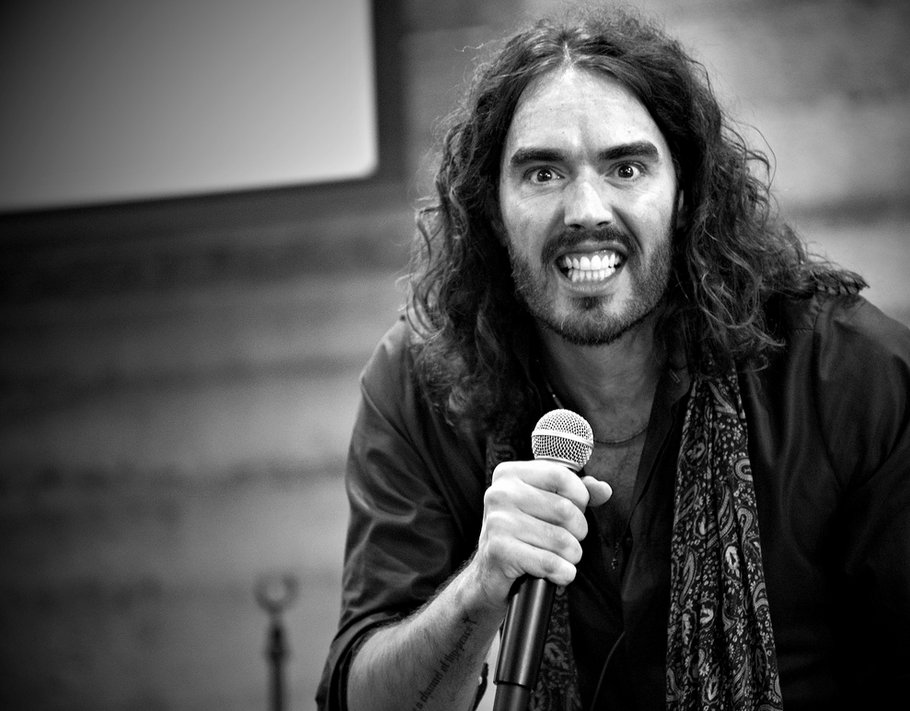
The latest edition of the magazine hits the newsstands today, guest-edited by Russell Brand, the author of My Booky Wooky, former host of Big Brother’s Big Mouth, and star of Despicable Me and Despicable Me 2.
While it is debatable whether Brand’s place in the pantheon of British culture and literature is yet secure, it is probably not too soon to judge his contribution to the nation’s political discourse.
A peculiar mix of Dave Spart and Adrian Mole, Brand last night told a restrained but incredulous Jeremy Paxman that he had ‘never voted and never would’, that the UK political system had created a ‘disenfranchised, disillusioned underclass’. Calling for a ‘revolution’, he explained, ‘It’s not that I am not voting out of apathy. I am not voting out of absolute indifference and weariness and exhaustion from the lies, treachery and deceit of the political class that has been going on for generations.’
There is no denying that there is widespread and deep disillusionment with politics both in the UK, and in many western democracies. Although it recovered slightly in 2010, turnout in general elections over the past decade has been lower than at any point since the introduction of universal suffrage. Distrust of politicians matches that of bankers and journalists. None of this is a happy state of affairs and all of it needs addressing. I admit, too, that as a member of a political party, and someone who has spent most of my working life in politics, I represent a peculiar and unrepresentative minority, with a partial viewpoint.
However, Brand’s contention – that people should not vote because all politicians are the same and nothing ever changes – is neither novel nor a particularly sophisticated piece of political analysis.
Brand’s heart clearly lies on the left, but his head is somewhere else completely. Take this assertion from his New Statesman piece: ‘The formation of the NHS, holiday pay, sick pay, the weekend – achievements of peaceful trade union action were not achieved in the lifetime of the directionless London rioters. They are uninformed of the left’s great legacy as it is dismantled around them.’
While Brand’s grasp of history is somewhat tenuous – on reading Oliver Cromwell’s Wikipedia, he tells us, he formed the view that the father of British parliamentary sovereignty was ‘a right arsehole’ – this claim is self-evident nonsense. Within the lifetime of the ‘directionless London rioters’ Britain saw the introduction of a national minimum wage, the right to trade union recognition at work and paid leave, civil partnerships and a ban on discrimination against gays and lesbians in the workplace and the provision of goods and services. Any and all of these measures are comparable with those that Brand lists. And it is also within the lifetime of many Britons that Labour governments legalised abortion and homosexuality, abolished capital punishment, and introduced race relations and sex discrimination laws and equal pay. Many, if not most, of these measures were opposed by the Conservatives at the time: a point I make not for partisan reasons but simply to highlight the fallacy of Brand’s claim that all parties stand for the same thing.
It is, of course, convenient for Brand to credit the trade unions for the ‘left’s great legacy’ rather than the Labour party. While no one would take away from the trade unions the role that they played in achieving many of these rights for working people, it was, of course, precisely because the trade unions recognised that such measures could, ultimately, only be achieved through the ballot box and parliament that they formed the Labour party. It is also the case that, whether here or in the United States, all of the great progressive gains of the postwar years came through a mixture of action inside and outside the legislative chamber. You can’t, for instance, tell the story of the struggle for civil rights in America without Rosa Parks, the freedom riders, James Meredith, Martin Luther King and the March on Washington. But the story would be incomplete if John Kennedy’s historic civil rights speech of June 1963 or Lyndon Johnson’s struggle to pass the Civil Rights Act and Voting Rights Acts were omitted.
Although it will no doubt be lost on Brand, there is also something ironic about the fact he chose to make his remarks in the month that Barack Obama’s Affordable Care Act came into operation – in the face, as recent weeks have shown, of huge resistance from the American right. For the 45 million Americans without health insurance, the 1.5 million Americans who lost their homes in 2009 due to healthcare costs, and all those who previously couldn’t get insurance because of a pre-existing condition, the introduction of ‘Obamacare’ – nearly a century after Theodore Roosevelt first made the case for universal coverage and 50 years after Johnson introduced healthcare for the elderly and very poor – is hardly insignificant. All of which rather undermines the implication of Brand’s argument – that it really didn’t matter if John McCain or Obama had won in 2008 or if Mitt Romney, who pledged to repeal his healthcare legislation, had defeated the president last year. And if, as it seems, whether millions of Americans have access to decent healthcare isn’t a big deal to him, then perhaps it’s worth Brand considering this simple question: is he really, seriously, arguing that whether Al Gore or George W Bush became president in 2001 was utterly without consequence?
Buried deep in Brand’s impenetrable essay he bemoans the fact that there is no ‘genuinely popular leftwing movement to counter UKIP, the EDL and the Tea party’. This is really the heart of his argument: that if only the ideological chasm between left and right would open up, people would re-engage with politics and flock to the polls. Again, this is unsupported by the facts. Between 1979 and 1983 very clear red water opened up between Labour and the Conservatives. What was the result? Turnout dropped and Labour’s support plunged to its lowest level since 1918. In contrast, between 1987 and 1992 the gap between the two parties closed as Neil Kinnock shifted Labour to the centre-ground and the Tories displaced Margaret Thatcher in favour of John Major: turnout rose – to almost its highest level since 1959 – and Labour’s vote recovered significantly. The correlation here isn’t between turnout and Labour’s vote, but between the fact that as the election came to be seen as competitive – the polls indicated 1992 would be the closest election since February 1974, another high turnout election – more people went out to vote. We saw this pattern repeated again during Labour’s time in power: turnout plunged in 2001, in part because Tony Blair’s re-election appeared a foregone conclusion, but began to climb again in 2005 and 2010 as the outcome seemed more up for grabs.
Writers and comedians can often popularise important issues and use their position to give a voice to the powerless. Stephen Fry’s current BBC series exploring homophobia around the world is a case in point. Sadly, Brand’s call for people not to vote will only help to perpetuate the very things he claims to care most about. Last night’s Evening Standard published an excerpt from Brand’s essay a few pages before its property section informed readers that he has just purchased a £1.3m home in Hollywood Hills West, complete with an office, movie theatre, five bedrooms and 5.5 bathrooms. Perhaps that’s why, ultimately, Russell Brand can afford to be so blasé about whether people vote or not.
———————————————————
Robert Philpot is director of Progress. He tweets @Robert_Philpot
———————————————————
We all need to be provoked from time to time. Our bias might lean towards sweet reasonableness but it rarely gets you anywhere. Brand expects a revolution but if the 18th, 19th and 20th centuries didn’t give us a British one I can’t see the 21st delivering. We are too fat and complacent.
I welcome Brand’s challenge. But he’s not the Messiah despite those staring eyes. But it’s good to encounter a very naughty boy from time to time….
What is the point of Russell Brand? He is stupid and not very funny!
How can you be so churlish? It was a complete delight to see pompous Paxman silenced by a
non-stop revolutionary tirade!
TS Elliott and Virginia Woolf were a pair of Nazis…and you slag off Russell Brand !
Don’t think of either of them are alive,so not really relevant to politics now,
Sour grapes from Progress.
Why not just stick to blabbering on about ‘humanitarian war’ – the infallible Tony Blair is sure to be impressed and that’s all that really matters.
Cromwell wAs an arsehole. Yours, an Irish human person.
Pointing out that you’re Irish betrays some bias in your claim (which shows you know what you’re talking about far more than Brand does).
Superb.
Whatever you think of Brand (and I’m no fan) it was refreshing to hear him articulate about the appalling political status quo, the punishment of the poor (of which the Labour Party’s Rachel Reeves now seems happy to put the boot into) and his genuine anger about the rich. Blast of fresh air. Okay so he has a big house, so does Lord Sainsbury!
I know for a fact that in his earnest efforts to not damage the planet Russell will be commuting between California and the UK not on those horrid oil-guzzling aeroplanes, but by wind-powered transport. Whether balloon or sailing ship, I’m not yet sure.
I think he’s sweet. He reminds me of me when I was a 14-year-old revolutionary.