
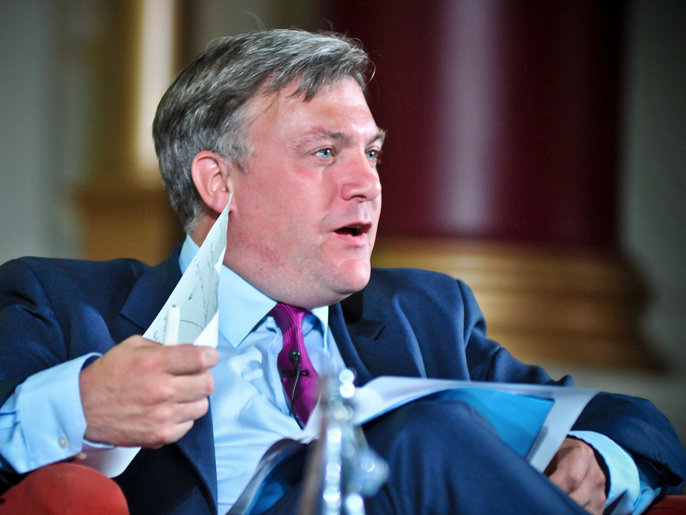
As he prepares to respond to next month’s budget, Ed Balls is in a fighting mood, find Robert Philpot and Adam Harrison
Shortly after Christmas Ed Balls gave an interview with the New Statesman which held out the prospect of a period of détente between the shadow chancellor and Nick Clegg. He described a ‘very friendly and warm’ conversation with the deputy prime minister, remarked that he could ‘understand totally’ why the Liberal Democrat leader had made the decision to go into government with the Conservatives in May 2010, and, in stark contrast to some of his previous remarks, hinted that he would be prepared to serve in a coalition with Clegg if Labour falls short of a majority in 2015.
Two months on, the season of goodwill appears to be over and a new cold war has set in. ‘I think that what was described by some as a “rapprochement” was my one and only conversation with Nick Clegg in the last 18 months,’ Balls explains. ‘And it was brief, unexpected, unplanned, spontaneous, and unorthodox.’ He continues: ‘He made some remarks over Christmas about personalities. I’m not going to get involved in playing personality politics, I have no personal animosity to Nick Clegg.’
He may not be keen on ‘personality politics’ but the shadow chancellor pulls no punches when talking about the party Clegg leads. In January, Balls said that, while he disagreed with the coalition’s decision to accelerate the outgoing Labour government’s deficit-reduction plans he, again, ‘understood totally’ Clegg’s decision to support ‘a credible deficit reduction plan, because it was necessary in 2010’. Now, though, the shadow chancellor’s tone has hardened once more: ‘I look at what the Liberal Democrats have done the last two or three years – these guys have not restrained the Conservatives; they have in many ways amplified and encouraged the Conservatives in things that they’ve done.’
While Balls maintains that ‘we’ll have to deal with the result that the electorate throw up’, the prospect clearly leaves him cold: ‘None of us want to be in coalition with the Liberal Democrats, partly because it’s hard to know what’s more unpopular at the moment – the Liberal Democrats or the idea of a coalition government.’ And his animosity towards the party suggests that he would have difficulty serving alongside them in government: ‘I’m afraid that the relish with which some of their spokespeople talk about some of the difficult decisions they’ve had to introduce, the relish with which they talk about the bedroom tax – I’m not going to let them off the hook. It’s one thing to break your promises in a manifesto to get into power, it’s another to do that on the backs of the poor and the most disadvantaged. That’s what they did and I don’t think people are going to forget that.’
Balls’ scathing attack on the Liberal Democrats is not the only red meat that he has thrown to Labour’s rank and file in recent weeks. In late January he announced to the Fabian Society’s annual conference that a Labour government would reintroduce the 50p top rate of tax axed by George Osborne last April. Although the party appeared confused after the announcement about whether the new rate would be a permanent feature of the tax system or a short-term measure, Balls’ speech, with its references to the ‘next parliament’ and suggestion that the 50p tax rate is a deficit-reduction measure, suggested the latter. So could the shadow chancellor envisage Labour returning the top rate at some point to 40p? He gives a hint that he could: ‘I’ve always said that I’d always tax rates were lower. For much of the last government, before the financial crisis, we didn’t have a 50p rate but in the next parliament, while we’re reducing the deficit, it’s fair and right to bring in the 50p rate.’
His pledge to reintroduce the 50p rate is in many ways the sugar coating for some rather harsh medicine that Balls knows he will have to administer as chancellor. ‘Deficit reduction is going to be a big challenge for the next Labour government and it’s really important that people in the Labour movement and more widely in the country know that we are going to balance the books, we are going to get the national debt falling, and I’ve said that I want to get the budget back in current balance before the end of the parliament and as soon as we can.’
The shadow chancellor recognises that none of this is likely to bring him much popularity with his own side. ‘If I don’t do some things which end up bringing some criticism then I’m not doing my job. That’s just the way it is,’ he suggests. Nonetheless, he does not shy away from spelling out the difficult path ahead: Labour, he says, will be ‘cutting public spending in the next parliament – that is very different from past Labour governments coming to power’. As chancellor, he insists, he will: keep the benefits cap, but ensure it properly reflects local housing costs; stick to the government’s spending plans for 2015-16; and remove winter fuel allowance for the richest five per cent of pensioners.
Balls suspects that Osborne agrees with him on this last measure but ‘he’s probably stopped from doing so by David Cameron who I think finds it harder to face up to these questions’. The shadow chancellor admits that his zero-based spending review has considered restricting other universal benefits received by pensioners such as free bus travel and TV licences. However, he believes that free bus travel is ‘materially different’ to both winter fuel allowance and free TV licences. ‘Free bus travel is something that people feel should be part of the recognition of ageing and still be able to have the liberty to travel and I don’t want to challenge that,’ he argues. But while Balls believes there is no principled case against means-testing free TV licences he believes that the amount raised by so doing, and the complexity of the system needed to administer it, make such a measure ‘not worth the candle’.
With the general election a little over a year away, Balls faces a conundrum. Many believe his analysis of the dangers of Osborne’s decision to cut spending so sharply in 2010 has been proved largely right. But while he is seen as right about the past, polls show that Cameron and Osborne continue to outpace the shadow chancellor and Ed Miliband as the best team for handling the economy. ‘I have to say if I had a pound for every person in the journalist community who’s slapped me on the back and said “you’ve been right the last three years but it’s not clear you’re getting the credit,” I’d be doing quite well by now. I thought, stop telling me and start writing it.’
Balls consoles himself with the fact that Labour leads the Tories in the polls on which party is best for jobs and living standards. Nonetheless, he recognises the party’s challenge: ‘we’ve got to show every day that … we are the people that will make the sums add up, that we will make the tough decisions.’ This refrain – ‘making the sums add up’ – is one that the shadow chancellor repeats throughout our conversation. But doesn’t the party’s future credibility on this score begin with an admission that, even before the financial crisis struck, Labour was failing to make the sums add up? Balls is adamant that this is not the case. ‘We should have been tougher on challenging the financial services community and the regulation of financial services. Grown-up politics is about admitting when you got things wrong. The mistake we made in that period was not about failing to get the national debt down because we did. It wasn’t failing to control public spending because we were very tough.’
Labour’s credibility in 1997 was built both on pledges to control spending and keep taxes down and on a determined effort to appear business-friendly. Over recent months, the party’s attacks on the energy companies, banks, housebuilders and pension companies suggest a rather different approach. ‘We can’t have business as usual,’ Balls responds. ‘We need to have reform and change and that means challenge … I have spoken to no chief executive in the last year who’s not thought that challenging the energy companies was an important part of the challenge of government. I speak to no chief executive in our country at the moment who thinks that such a concentrated banking system serves the long-term interests of our economy.’
But Balls is also keen to quash any notion that Labour can return to some of the anti-business instincts of its past. ‘For Labour to sort of lurch to a retro period of anti-business policy would take us back very many decades and Ed Miliband and I are absolutely clear, with Chuka Umunna, that we’re not going to do that,’ he says. ‘The issue of whether Labour was a party of the market economy was resolved, and we resolved it in the new Clause IV.’
For the shadow chancellor, though, it is the issue of Europe which will be key to winning business backing for Labour. ‘The most pro-business thing about Labour at the moment is that we are the only pro-European party of government,’ Balls argues. ‘What the Conservatives have done by putting party interest before national interest is deeply dangerous and actually if you sat around with a group of businesspeople and ask “what are you most worried about?”, they’re worried about a Conservative party allowing us to sleepwalk and drift away from Europe. It’s a massively dangerous proposition. Only Labour can save the country from that Conservative anti-Europeanism.’
If Labour does fail to win a majority next year, and the party ends up in coalition with the Liberal Democrats, it may well be that the prospect of the two parties salvaging Britain from such a fate is enough to thaw the icy disdain with which Balls, once again, appears to view Nick Clegg’s party.
———————————————-
Two things are certain: 1. If Labour go into coalition with the LibDems it will not be led by Nick Clegg but by a survivor of the massacre that 2015 will bring to that party; 2. talking about a 50% tax rate is meaningless when most top earners are also top tax avoiders. One of them admitted some years ago, when the rate of capital gains tax was increased, that they paid not more than 5% on any capital gain. Take Mitt Romney, millionaire Republican Presidential candidate in 2012 who was forced by circumstances to publish his tax returns. He was earning over a million dollars a year and paying 20% average tax over the previous years. Ed Balls may seek to justify the imposition of a 50% tax rate on taxable income over £150,000 a year but most of them will pay nothing like that. However, only the senior members of HMRC will know that as a tax return is the most secret document in the UK. It is probably easier to get atomic secrets than to access a millionaires tax return, as William Haigh found out about Lord Ashcroft, after 10 years.
Edward Michael is or shall be the power behind the throne of the next government. “Ed” Balls is a power to be reckoned with. Very similar to the never-heard-of-again [why?] Gordon Brown [whom I also had some great respect for vis his straightforward no-nonsense approach] and is easily misunderstood as he is a musician and that speaks volumes if not sheet-music loads [ask any Beethoven, Brahms or Bach – don’t bother me with the Mozarts and Puccinis — Life is too short to remonstrate].
This man and his able mind are key to the future f Britain.
Some people,Tone and flock, had maybe better wise-up to the fact that just because he aint a ‘SHOWMAN@BBC’ tis man can save LABOURs bacon – time and time again.
Show respect and give credit where credit is due.
Good Luck Edward Michael! Go show ’em, Lad.
PS Edward Michael does ot ‘do’ détente – he is 2too wise to to listen to old owls in France.
Believe that LABOUR can win and it shall.
Shilly-shallying around leave to the wimps in the mostly nether regions of this, the UNITED KINGDOM. Faint or feint-heart never won Fair Lady. Edward Michael puts his money where his mouth is – I like that, and so does 65% of the electorate.
PPS The above last para’ has my vote – Liberal thinking has been around for a very long time – ask any PhD Theologian
The LD (lost deposits) alliance is unlikely because the pro eussr LD is likely to get wiped out after their performance during this parliament, they had a chance of becoming a part of the political scene once more then blew it.