

Ukip’s victories in last month’s elections have changed the political landscape, writes Lewis Baston
The local and European elections were shocking and in many ways demoralising for Labour supporters. They were not a clear victory like the 2012 local elections were, and Labour’s vote slumped alarmingly in many areas that have been strongholds of the party for generations. Failing to win the popular vote in the European parliament election, and the narrow margin by which Labour led the Conservatives, were disappointments. Against this, there were some very good individual results in the local elections, and not just in London. What are the main features of the electoral landscape as the parties now face it?
The United Kingdom Independence party’s vote was very high across a swath of working-class England as well as its more traditional coastal and rural stamping grounds. As well as inheriting most of the votes of the British National party, it has whittled away at the Conservative minority in Labour heartland areas and taken a huge bite out of the Labour vote. The Ukip vote was high enough to start winning seats that had hitherto been reliably Labour, and also to come through the middle in more marginal wards. Rotherham was the most eye-catching case, and there are particular local problems there, but it was an extreme example of a general pattern.
We had been warned, in the 2008 local elections and the 2010 general election, but now we have suffered a severe punch in the gut from areas that have stuck with Labour even in our darkest periods like the 1980s and 1930s. Fortunately, the shadow cabinet will be under no illusions about quite how strong the Ukip vote was in white working-class areas of England. In Ed Miliband’s seat of Doncaster North it reached 34 per cent; it was not much lower in Yvette Cooper’s Normanton, Pontefract and Castleford (25 per cent), Rachel Reeves’ Leeds West (28 per cent) and Ed Balls’ Morley and Outwood (23 per cent). The problem is not just on the Yorkshire side of the Pennines, as Ukip reached 27 per cent in Bolton South-east (12 per cent in its mostly Asian ward, around 30 per cent in the rest), and 26 per cent in Wigan. Ukip picked off some wards in other authorities that have in the past been reliable Labour strongholds – its two wards in Derby were Labour at the recent nadir of 2008, and this is repeated in many councils.
It is tempting, with less than a year until the general election, to prioritise the marginals rather than winning ‘safe’ seats by larger margins over Ukip. In the short term, this may be inevitable – we do not have the time or resources to revitalise Labour everywhere that Ukip has exposed vulnerability. The risk of Ukip gaining parliamentary seats directly from Labour in 2015 is comparatively small, although there is every sign that Great Grimsby (where Ukip polled 35 per cent in the local elections) will be a serious contest. But it will have to be addressed at some point. Seats do not remain safe forever. But the national-level political response is even more urgent because the sort of people who deserted Labour in the heartlands are also represented in the marginals. Three of the four wards in Harlow that voted Ukip in 2014 had been Labour in 2011 and 2012. Ukip’s strongest results in Southampton were the 30 per cent shares it polled in working-class wards (throwing one to the Conservatives); it was weaker in middle-class wards, where Labour polled well. In Thurrock Ukip made strong gains, putting the contest for the second seat on Labour’s target list in turmoil.
Putting to one side, for the moment, the rise of Ukip or the collapse of the Liberal Democrats: What happened in the big contest between the parties capable of forming a national government? The answer, in a confusing election, was a bit comforting to an old-fashioned election analyst: a swing from the Conservatives to Labour since 2010 of about five per cent, with exceptions distributed fairly evenly on either side. This is why Labour managed a respectable haul of net gains in seats (up 338), although this was bulked out by having all of London’s councillors elected at once. This is equivalent to a small lead over the Conservatives, about 1-3 points, and that is what the national polls and the European election also tell us (Michael Ashcroft’s polling suggests, intriguingly, that parliamentary voting intentions are a bit more favourable for Labour). It is comparable with other ambiguous, close sets of local elections like 1991, 2003 and 2011, and therefore not terribly encouraging for the opposition. Outside London there has been a considerable swing back to the Conservatives since Labour’s high tide of 2012. Some results, particularly in the west Midlands, looked unpleasant for Labour in 2014 because the comparison with 2012 was so adverse. Ipswich can represent the general pattern, although the result there in 2011 was probably a flattering one for Labour.
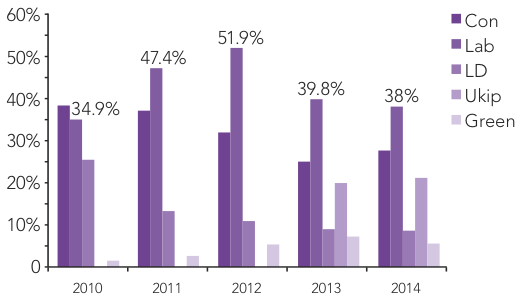
Share of the vote in Ipswich borough 2010-14:
A five per cent swing (and taking into account several cases like Birmingham and Wirral where Labour always does better in general elections than local elections even if they are on the same day) is enough to scrape a narrow majority or, if new Conservative MPs have an incumbency bonus (which Ashcroft’s polling suggests they may not, in contrast to past intakes of MPs), being the largest party in a hung parliament. The local detail in authorities containing Labour’s target seats suggests some ‘misses’ in the top target seats, either Conservative retentions or Ukip ahead but there are also a few long shots not featuring in the party’s list of 106 target seats where Labour was ahead in the 2014 local elections, which include Enfield Southgate and Reading East.
These were a truly catastrophic set of elections for the Liberal Democrats. In the local elections they were a bit ahead in some of the seats they will defend against the Conservatives, such as Cheadle, and Sutton and Cheam. But they were slaughtered by Labour in London, losing seats even in their most dug-in strongholds like Hornsey and Bermondsey, and were still well behind in Burnley and Manchester Withington. The European elections were a disaster, with the party reduced to one seat and running fifth in the popular vote behind the Greens. It was baffling for Labour to use the opportunity of a party election broadcast in this campaign to bash the Liberal Democrats. Labour does have to be wary of alienating former Liberal Democrats who have switched to it since 2010: while they are fairly strong in their determination to vote Labour in 2015, they still need some attention. But the priority must be to recover the ground lost to Ukip and to compete better with the Conservatives on the ‘choice of government’ issues.
The results in London stood out from the rest of Britain in that the Ukip surge simply did not happen. Labour made big gains in the local elections and even came convincingly top of the poll in the European parliament election. The swing since 2010 in the local elections was a point or two higher in London, although the difference was not vast, but the European result was exceptional. It would be idiotic to regard a 30 per cent share of the vote in south Yorkshire for a protest party like Ukip as being insignificant, but it would also be foolish to belittle the success of Labour’s campaigning among aspirant middle-class voters in London boroughs such as Hammersmith and Fulham.
Labour’s London success spilled out into some commuter areas, with similar swings in places such as Reading (11 per cent since 2010), Basingstoke (10 per cent) and Crawley (eight per cent) as in outer London boroughs like Ealing (10 per cent) and Enfield (eight per cent). However, this success did not extend out in the north and east.
Labour therefore seems to be doing reasonably well in areas where the economy is reviving, but suffering where there is still stagnation. This is not the least puzzling aspect of these elections. There might be something deeper going on in the way that people use the act of voting, particularly in midterm elections, as an emotional expression rather than a political choice. The answer cannot lie in carefully calibrated policy offers, or even – necessary though this may be – hard work on the ground. People did not vote Ukip because its policies are credible, or its candidates work harder; the opposite is true. Nor will any institutional reforms at European Union level make the remotest bit of difference. One may like to think of politics as a chess game, but the electorate seems to have decided to tip the board up and scatter the pieces rather than support one of the serious players.
———————————
Lewis Baston is a contributing editor to Progress and senior research fellow at Democratic Audit
———————————
The problem here is that you are ignoring the effect of immigration from Europe on working class areas such as the one I represent .
Lower paid people born in this country who can often trace their history back through generations of decent hard working people cannot get jobs at all or at the very least at a reasonable wage .
Contract engineering jobs in the 2 main factories are going to recent immigrants rather than very hardworking ,very able and skilled local people . The reason seems to be that the employers want everyone to speak the same language and a workforce unaware of their legal rights .Controlled totally by Foremen who speak their language .
At lowest pay levels , which is where British people with educational or physical disadvantages ; or a less ambition life style are employed traditionally ,employers now have a choice of well educated new arrivals more often than not with degrees . The result is that we have some very highly educated young European people working in my local filling station ,frustrated because they cannot get a job to suit their skills and experience at a middle class level , but taking jobs a local person would be happy to do .
Our Local McDonalds has some wonderful immigrant full-time workers ,taking full-time jobs normally taken by variously disadvantaged locals ,or those still in education as part time occupations .
So decent hard working people who were denied a say on immigration by successive governments get angry and vote UKIP .
My hardworking Labour colleague ,the best candidate for the area ,failed to win the seat in the May election .Everyone loses .
The UKIP voters in my ward are not racist , but you will make them racist if you continually ignore them , or call them such .
Ensure that immigrants are are paid the correct rate for the job and work in the right conditions .
Ensure immigrants get correct and equal opportunity in the middle class employment sector .
Lets have an even playing field for all . When the middle classes lose more jobs to lower paid immigrants we might find this problem taken seriously .
Lastly ,lets stand up against discrimination in all its forms ,no matter where it comes from and who the victims are , and make sure everyone , working or not , is treated fairly and with respect .
John Knowles makes some good points based on his local knowledge. However I find his suggested remedies only partly convincing. Put bluntly, Labour’s policy is for further uncontrolled immigration from the EU but with improvements in the treatment of immigrant workers. John reports on the position of well qualified immigrants doing jobs previously occupied by less qualified Brits and calls for a “level playing field ” for immigrants applying for “middle class jobs”. He suggests that the difficulties faced by less qualified locals would be reduced if immigrants were able to move into jobs more suited to their qualifications. Well, yes they might be, but at the cost of creating a new problem for middle class workers.
Quite simply, UKIP voters have recognized that uncontrolled EU immigration creates more problems than it solves.
What I remain unclear about & I said it the other day is: How come Labour MPs who represent areas where the traditional voters live have not had this on the party’s agenda before last Sunday’s UK defeat to Right Wing UKIP.
Seemingly too UKIP has ‘respectable-ised’ themselves- years ago it would have been a stigma for many to vote ‘Far Right’ especially the types of both urban working and middle class rural English chaps now voting for them. Yes indeed we have to ally fears about the East European migration, but we have also to put the economic case for the EU; the ideology against Europe has been too persistent especially from the tabloid press and some in the Tory Party. ( Incidentally the BBC may seemingly given UKIP disproportionate coverage pre- election) The funding for UKIP has been pernicious and its a pity the other Pro-European parties, business, the unions, and academia have not sought to combat this ideology with their own large pressure group reminding the voters of the consequences of leaving our 27 partners.
But in the end as so many in the FT have noted recently the anti-Europe thing is a bitterness about growing unemployment, the left behind areas, globalisation effects, low incomes and nasty inequality. Labour hopefully has more answers for theses issues than the centre Right or Far Right.
This quote from a 20 yr old in Newark (FT) says it all ” Jack is 20…feels mainstream politicians are ignoring problems of youth unemployment and student debt. In UKIP he hears the closest thing…to the voices of everyman” So how come this Jack who wants to go to uni. has not heard any of our shadow cabinet on the issues of youth or grants; as always our message is confused by the complex ambiguous, over educated voices of our shadow ministers who always take the defensive instead of the offensive.. Our polemic on the Tories and the UKIP is ineffectual our monitoring of BBC impartiality is weak( please come back Alastair Campbell); give me the days of the big beasts. We cannot even get through to future young university students.