
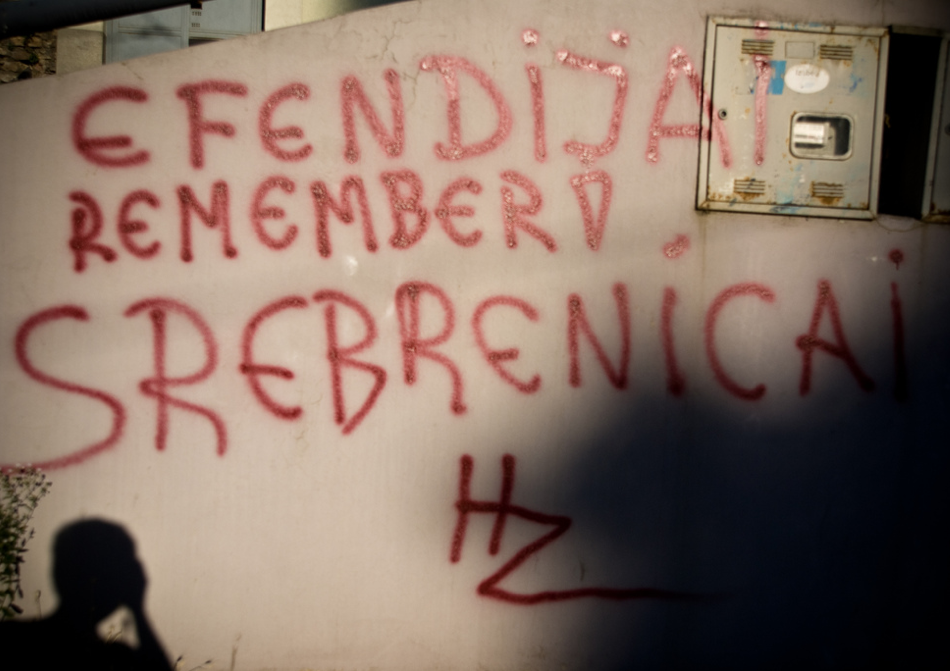
On 11 July 1995 a horror story began in the midst of a war. The evil of genocide would scar Europe once more.
The United Nations had declared a safe zone around the Bosnian town of Srebrenica and a small force of Dutch soldiers was deployed to the area under the United Nations Protection Force
The Bosnian Serb forces began to shell and advance on the town. Trapped and surrounded, the situation grew desperate. Air strikes were delayed because the Dutch commander had used the wrong form to request them and the Nato aircraft then had to refuel after having been in the sky waiting for clearance. Unable to stop the advance, later that day the Bosnian Serb General Ratko Mladić arrived in the town. Two days later the Dutch forces would concede to Serb demands that they expel the 5,000 refugees in their base.
The cascade of military and political failures would see 8,372 people lose their lives in the Srebrenica massacre. It remains the single largest mass murder in Europe since World War Two. Most of those killed were teenage and adult men, marched to fields or warehouses and executed. Women and children were separated and 23,000 of them were deported in 30 hours.
We should also remember the bravery of the 15,000 men who, unwilling to wait for the same fate, managed to escape from their captors and fled 55km across the mountains to Tuzla. Sadly many of them would not make it as Bosnian Serb forces ambushed and attacked them, sometimes using stolen UN uniforms to trick them into a sense of safety.
Fundamentally the United Nations had failed the people of Srebrenica. Kofi Annan wrote in 1999: ‘Through error, misjudgement and an inability to recognise the scope of the evil confronting us, we failed to do our part to help save the people of Srebrenica from the Serb campaign of mass murder.’ It serves as a chilling reminder that there is a price to pay for dithering and inaction.
Bill Clinton addressed the opening of the cemetery on 20 September 2003, stating ‘Srebrenica was the beginning of the end of genocide in Europe. It enabled me to secure Nato support for the bombing that led to the peace.’ Srebrenica was the costly wakeup call to the world that galvanised support for the Nato bombing campaign, Operation Deliberate Force, which brought the war to a close just over two months after the massacre.
Today the remains of 175 people will be taken to a final resting place in a quiet part of a country that was once ravaged by war. We cannot begin to imagine the pain of the families that were separated and the people who, 19 years later, still do not know what happened to their loved ones because of the mass graves. President Obama stated in 2010 ‘the name Srebrenica has since served as a stark reminder of the need for the world to respond resolutely in the face of evil.’ While we remember this terrible event – let us hold our leaders to that – and remain vigilant about the threat of genocide in the world today.
———————————
Jay Asher is a Progress member
———————————
Photo: Zack Lee