
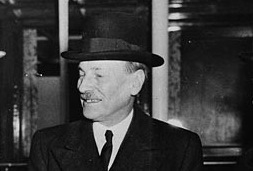
Recent weeks have marked the anniversary of Labour’s landslide general election victory of 1945. Though the election itself was held on 5 July, the logistical exercise of collecting and counting votes from service personnel all around the globe meant that the results were not formally declared until 26 July. The Labour party took 47.8 per cent of the vote, winning 393 seats; the Conservatives took 39.8 per cent of the vote and 213 seats. The Liberals’ nine per cent vote yielded only six seats.
Given the great success he achieved as prime minister, it is remarkable to consider that, as the results came in, Clement Attlee’s position as party leader was far from secure. At the end of May 1945, the then chair of the Labour party, Harold Laski, had written to Attlee to tell him to step down to enhance Labour’s chances of victory. Attlee, in his typically laconic way, said that he had ‘noted’ Laski’s view. Later, as Laski’s public pronouncements continued, Attlee delivered that great put-down: ‘a period of silence on your part would be most welcome’.
Herbert Morrison had also written to Attlee before the results were declared, telling him that he intended to stand against him for the leadership when the parliamentary party met for the first time after the election. This left Attlee in a difficult position once Labour’s victory was known. He could hardly go to the palace to be appointed prime minister if he then had to resign a few days later. On the other hand, if he did not go to the palace, it made the Labour party look incompetent before the government had even been formed: a victorious party offering no leader for the highest political office in the land.
The crucial meeting to resolve matters took place on the afternoon of 26 July at Transport House. Present were the party secretary Morgan Phillips, Attlee, Morrison, and Ernest Bevin. Morrison had to leave the room to speak to Stafford Cripps on the telephone: ironically, it seems, Cripps was ringing to support Morrison’s view of waiting for the parliamentary party to elect a new leader before a prime minister was appointed.
At this point, Ernest Bevin asked Phillips: ‘If I stood against Clem, should I win?’ Phillips said that he thought Bevin would, on a ‘split vote’ between the different candidates, with Morrison’s hat in the ring. Bevin turned to Attlee: ‘Clem, you go to the palace straight away’ (Alan Bullock, The Life and Times of Ernest Bevin, vol. 2, Minister of Labour 1940-1945).
Attlee later remarked that if you had a good dog like Ernest Bevin, there was no point in barking yourself. When Bevin was told of Morrison’s letter to Attlee, he rang him and told him in his typically direct way: ‘If you go on mucking about like this, you won’t be in the bloody government at all.’ Ernest Bevin’s view was that the party did not need any more ‘personal leadership’ like that of Ramsay MacDonald. What was needed was a leader ‘with a gift of holding a team of clever men together’ (Hugh Dalton, The Fateful Years: Memoirs, 1931-1945). In that judgment, Bevin was to be proved entirely right.
———————————
Nick Thomas-Symonds is the author of Attlee: A Life in Politics. He writes the Labour history column for Progress and tweets @NThomasSymonds
———————————
Photo: BiblioArchives