
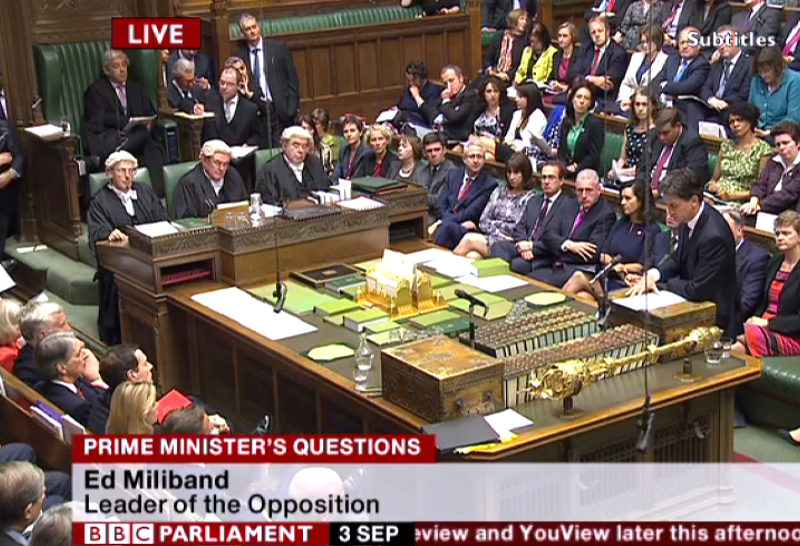
Both leaders were very keen to give lessons on statesmanship today, agreeing with each other on Isil and letting their members of parliament agree with each other on Scotland.
Nevertheless the event was not totally without tension.
There is always a competitive edge to what David Cameron says.
Ed Miliband made the situation in Iraq and Syria and the behaviour of the Islamic militants there the centrepiece of his questions to the prime minister.
‘This is a pattern of murderous behaviour by Isil of the innocent,’ declared Miliband. ‘Christians, Yezidis, Muslims, anyone who does not agree with their vile ideology. And I agree with what the prime minister says. Events like this must strengthen not weaken our resolve to defeat them and he can be sure of our full support in standing firm against them.’
It was strong and statesman-like and Miliband is excellent at these pronouncements. Cameron does not like it.
So Cameron came back saying what was going on was ‘utterly abhorrent and barbaric … These people need to understand we will not waver in our determination to defeat terrorism and this is not something that divides this house politically but something that everyone and I suspect the entirety of our country agrees with.’
Miliband then asked whether the prime minister was involving other states in solving the ‘humanitarian and security’ problem including Turkey, Saudi Arabia, Qatar and regional bodies especially the Arab league.
Cameron could not have been more pleased. He was so glad that the leader of the opposition agreed with what should happen – this ‘should not be seen as a western-led intervention.’ This was about helping people on the ground.
Miliband then asked about relocation powers and taking British citizenship away from fighters who wanted to come back to the United Kingdom. They were sly questions. Both are areas where the Tories disagree with the Lib Dems. Relocation powers were scrapped in the coalition.
When Cameron opened about the various ways of stripping Britons of their citizenship, Miliband seemed to agree saying:
‘We will look at the practicality and legality of any proposals he (Cameron) comes forward with.’
Cameron did not provide coherent foreign policy objectives, nor any original ideas for what I presume is old-fashioned treason – British citizens who want to do harm to their country.
He was pulled up on it by Lib Dem MP Martin Horwood (Cheltenham) who wanted a more consistent strategy in the Middle East and by Peter Hain (Neath) who was advocating an even less consistent strategy by suggesting Britain support President Bashar-Al Assad in Syria: ‘Isn’t the truth that Isil won’t be beaten without air strikes in Syria as well? And that that means engaging – however unpalatable – with the Assad regime and Iran as well as of course the Saudis: perhaps also a route to resolving the bitter and dangerous Shia, Sunni conflict in the region.’
England’s traditional enemy the turbulent Scots are providing a greater imminent threat to the constitution of the UK than Islamic militants.
The Scottish National party MPs in the House looked very happy as Tories stood up to defend the union.
Andrew Lansley, the former Tory health secretary remarked that England had given the NHS lots of money in Scotland and Edward Leigh, the Tory MP for Gainsborough warned of ‘a national humiliation of catastrophic proportions’ if Scots voted yes. Labour MP Lindsay Roy (Glenrothes) also warned of the dangers of Scotland defaulting on its share of national debt, which the first minister Alex Salmond has threatened to do if Scotland becomes independent.
The more the Tories defend the union, the better it is for the Scottish nationalists. Angus Robertson, the SNP MP for Moray, pushed the point by asking why Cameron had ‘run away’ from having a debate with Alex Salmond.
These constitutional issues and the greater issues of war and peace in Iraq and Syria masked an irritation and division in Tory ranks.
It was questions from Tory MPs on the European arrest warrant, and demands for a ‘visa-only system for all foreign nationals including from the EU,’ which gave the game away.
As prime minister’s questions ended, points of order were then raised by Tory MPs directed at the speaker and the controversial recruitment process that has been going on for the position of Commons clerk.
———————————
Sally Gimson is a journalist, a Labour councillor, and reviews PMQs on Progress
———————————