
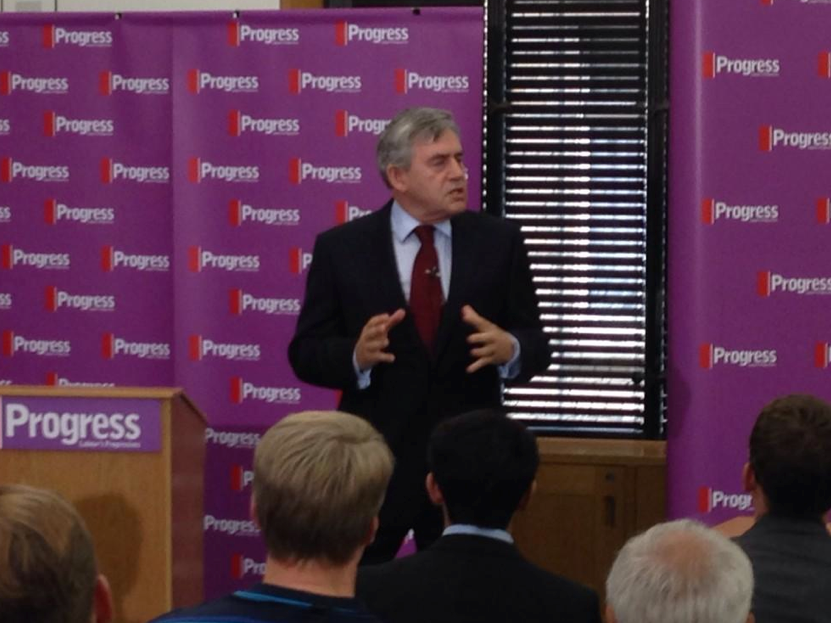
A stronger Scotland in a stronger UK: what is the case for forward together?
CHECK AGAINST DELIVERY
Many people believe that the referendum is about independence versus the status quo. But nothing could be further from the truth.
For a ‘No’ vote does not mean no change. A No vote will instead usher in further constitutional reforms. We should now be clear how far these reforms should go and recognise that not only the Labour Party but also the Liberal Democrats and the Conservatives are committed to them.
And I will show that the changes are fundamental and go right to the very heart of the British constitution
It may be true that throughout the first 15 years of Scottish devolution the defenders of the old Union comforted themselves with the belief that only Scotland had changed and that the British constitution remained unaffected.
Now no one can ignore the basic fact that the United Kingdom is being irreversibly transformed into the New Union of the twenty-first century.
It is no longer and will never again be the all-powerful centralised unitary state of the constitutional textbooks, based on the undivided sovereignty of Westminister.
And let be clear. The reason I am speaking in Westminster today, as well as speaking in Scotland, is that it is not only Scotland that must and will change: Westminster must and will change, London must and will change and the United kingdom must and will change.
Already with the Scottish Parliament, legislative assemblies in Wales and Northern Ireland and a high-powered London authority taking powers from the centre, Britain will never again be the unitary state we were taught about at school.
Nor will the old theory of an undivided Westminster sovereignty ever again conform to the new realities. In its own sphere of decision-making the Scottish Parliament holds full power and its decisions are not overruled by Westminster.
And the very idea of Parliamentary sovereignty as the sole basis of the constitution will no longer and never again hold sway because in practice if not in theory referendums, reflecting popular sovereignty, are now required before new and fundamental constitutional decisions are made.
So I want to champion the enduring and defining characteristic of our constitution which is not its unchanging nature but its adaptability and capacity to evolve based on what really unites us: a shared British commitment to values of liberty, fairness and social responsibility.
And what remains central to the relationship between England, Scotland, Wales and Northern Ireland is what arises from these values: the pooling and sharing of risks and resources across the UK that, alongside our shared UK defence and shared UK macroeconomic management, is at the heart of the modern Britain.
The principle we have developed of sharing across four nations means that no matter where you reside and irrespective of your nationality, every citizen of Scotland, England, Wales and Northern Ireland enjoys the dignity of not just the same equal civil and political rights, but also the same basic social and economic rights.
The Scots, English, Welsh and Northern Irish have equal rights to a UK-guaranteed pension; to assistance when unemployed, disabled or sick; to fully funded healthcare free at the point of need; and to minimum standards of protection at work, including a UK-wide minimum wage.
No other four nations in any part of the world share such profound civil, political, social and economic rights.
Whereas the European Union is a single market, the United Kingdom is a social market. And whereas Americans share equal civil and political rights, Scotland, England, Wales and Northern Ireland have gone further by sharing the same social and economic rights.
The impact of Britain’s achievement is powerful. The average income of a family in one of the poorest states in America, Mississippi, is about 60 per cent of a family in one of the richest states, New Hampshire. The average income of Bulgaria, the poorest country in the EU, is only 15 per cent of Holland, one of the richest. Yet the income of a typical Scot is now 96 per cent of that of the average citizen of England.
I have argued for some time that we need to draw up and agree a statement of national purpose which reflects this twenty-first century reality. We should state explicitly that:
‘The Union exists to provide security and opportunity for all by pooling and sharing our resources equitably for our defence, security and the social and economic welfare of every citizen.
I would personally also like to include a commitment to ‘the eradication of poverty and unemployment across the UK and to universal healthcare free at the point of need.’
Our future constitutional settlement should reflect the modern purpose of the Union. And powers should be devolved to the maximum extent possible consistent with this purpose, both within the UK and within Scotland.
The next stage of Scottish devolution
It should already be clear that in the event of a No vote the Scottish Parliament is already guaranteed more powers.
Labour, the Liberal Democrats and the Conservatives have all recently committed to delivering further powers to strengthen the Scottish Parliament. This will build on the powers already guaranteed through the Scotland Act 2012. There can be no doubt that a No vote does not mean no change.
Although the details of each of the parties’ proposals vary, a broad consensus has emerged in certain areas.
We already know that in the event of a No vote the Scotland Act 2012 – which implements the recommendations of the Calman Commission – will deliver the greatest transfer of financial powers to Scotland since the creation of the United Kingdom more than 300 years ago.
In particular, the Scotland Act will establish a new Scottish rate of income tax, devolve stamp duty land tax and create extensive borrowing powers for the Scottish Parliament such as the power to borrow up to £2.2 billion a year for capital purposes.
But the parties now also agree that there will be further devolution of tax powers, particularly in the sphere of income tax.
This will strengthen the ability of the Scottish Parliament to raise or lower taxes when overseeing the services it administers, enable it to increase public spending if this is in Scotland’s interests and make it more fully accountable to the Scottish people for what it does.
Attendance Allowance – a payment made to disabled or infirm OAPs – will also be devolved under each of the parties’ proposals. This will facilitate a more integrated approach to health and social care.
The parties similarly suggest that Housing Benefit should be devolved to the Scottish Parliament.The Bedroom Tax – which is being debated in Westminster today – will in Scotland’s case become a matter for the Scottish Parliament. Just as the powers previously agreed mean that no Poll Tax could ever again be imposed from London, under these proposals no Bedroom Tax could ever again be implemented in Scotland against the will of the Scottish people.
There will not just be greater devolution of social powers but economic powers too. No one should disparage as insubstantial the range of economic opportunities on offer. Each of the parties has plans to deliver considerably more economic and employment powers to the Scottish Parliament.
The devolution of tax powers allows greater flexibility in economic incentives that can help local businesses and job creation, as does the devolution of borrowing powers. But the radical devolution of power does not stop in Edinburgh. Labour has proposed that responsibility for delivery of the DWP Work Programme be devolved to Scottish local authorities to better reflect local labour market conditions, with the Scottish Parliament playing a partnership role and providing strategic oversight. And in apprenticeships and training too Labour advocates the devolution of Skill Development Scotland’s responsibilities to local authorities, to enable the planning and provision of skills and training to better match local job markets.
As well as these new powers for skills and employment, Labour has proposed that councils should be empowered to extend what is called Tax Incremental Funding to fund public sector investment in infrastructure, and to introduce initiatives such as incentives for tourism. This will give the Scottish Parliament and local authorities increased scope to influence economic development.
And the Labour Party believes that the Scottish Parliament should have more powers over economic infrastructure, extending existing powers over transport to include the Scottish railway system and the power to facilitate a ‘not for profit’ option.
Labour’s support for further devolution in employment means that we also recommend devolution of responsibility for the administration of employment tribunals and the establishment of a Scottish Health and Safety Executive.
But we do so with one central difference from any nationalist manifesto: in line with the will of the vast majority of people in Scotland, we will continue to have direct formal say in the UK currency and in UK macroeconomic decision-making through the UK Parliament and Bank of England.
Soon the division of powers will be set out in the constitution. It is now accepted that where conflicts about legislative powers arise, a resolution will not be imposed by Westminster under the old theory of Parliamentary sovereignty but will be adjudicated by the Supreme Court. There is also a mechanism for further constitutional change by agreement between Westminster and the Scottish Parliament in the form of an order in council under Section 30 of the Scotland Act. No one should doubt the constitutional novelty of what we are doing. The United Kingdom is moving as close to a federal state as is possible in a country where 85 per cent of the population comes from only one of its four constituent parts.
A timetable for change
I, like many others whose voices I believe will be heard louder in the coming days, believe that such changes are best achieved where possible by consensus.
I see it as my responsibility to work with others to ensure that the demand for a stronger Scottish Parliament is met as soon as possible.
Scotland must make its choice but Westminster must play its part too. So I can say today that I will personally seek to lead a debate on the floor of the House of Commons in the first week that Westminster returns after the referendum, with the specific aim of confirming the public and well-understood agreement on the process and timetable for further devolution.
I have already written to the Speaker of the House of Commons asking him to recognise the significance of this matter by setting aside time in the first days back for me to put the case. This way there can be doubt of the strength of the UK Parliament’s commitment to change and no going back on the promise of further legislation.
But let me be clear: this decision can and will be made in Scotland.
So this is not like the 1979 referendum when promises made were reneged upon. This is instead akin to 1997 after which Labour’s promise of a Scottish Parliament was immediately delivered, and to 2012 when the recommendations of the Calman Commission which started out with our government were then quickly enshrined in law with cross-party support and the agreement of the Scottish Parliament.
Historical significance
It is also important to stand back and take stock.
What does all this mean for the future of Scotland and the United Kingdom.
A debate raged in 2012 about whether there should be two questions and in effect three, rather than two, options on the referendum ballot paper: independence, the status quo or further devolution beyond the Scotland Act.
This debate has now been resolved but perhaps in a way that people then did not expect.
For the question facing voters in Scotland on September 18th is not Yes versus the status quo, but Yes versus more devolution.
The status quo is not now an option.
A No vote is a vote for further devolution.
What’s more, Scotland will not fade from the headlines after September 18th.
For we can now be sure of one thing: what’s happening in Scotland is changing the British constitution for good, as is the demand for change in Wales, London and the regions of England.
A once unitary state with a top-down constitution is being transformed into a constitutional partnership of equals that recognises the diversity of our country.
What’s happening may even have wider significance for cooperation between nations in future.
For we are showing how nations with distinctive traditions, histories and cultures can retain their strong identities while working together side by side in this new, global era.
It makes the model of cooperation and partnership between nations that comes from Scotland’s constitutional change within the UK a beacon for what can be achieved in an increasingly interconnected and interdependent world.
Two visions of Scotland’s future
So what does all this mean for voters on September 18th?
It should now be clearer than ever that there are two Scottish visions of Scotland’s future at stake in the referendum.
Ours is a patriotic vision for a stronger Scotland within a stronger United Kingdom.
We are proud of Scotland’s history, culture and contribution to the world.
We are proud too of our distinctive Scottish institutions from law and education to churches and civic organisations.
We are proud of the Scottish Parliament we created and are committed to further UK-wide constitutional change that secures greater powers for it.
But we are also proud that on vital issues affecting the Scottish people we pool and share our resources with our neighbours in the rest of the UK.
The nationalist case, by contrast, comes down to one proposition: they seek to break all constitutional connections with the UK.
That is what the referendum is about, whether we Scots wish to end forever and irreversibly those links with the rest of the UK.
September 18th is not a vote on whether Scotland is a nation. We are a proud nation and always will be.
It is not a vote on whether Scotland has its own parliament. We already have our own Parliament and will have whatever the result.
It is not now even a vote on whether or not more powers will be delivered to the Scottish Parliament. New powers are already pledged by all.
It is a vote about whether, on five vital areas of cooperation that matter to people in Scotland – the positive benefits from UK pensions, the UK funding of healthcare, UK defence, UK-linked jobs and the UK currency – we wish to sever all remaining political connections with our friends, neighbours and relatives in the rest of the UK.
Pensions, health care, defence, jobs and the currency are indeed five of the ‘positives’ that ensure Scotland benefits from being part of the UK.
The shared UK-wide funding of pensions means that with their greater needs because of poverty and disabilities, Scottish OAPs receive £425 million more each year from being part of the UK pension system than a division of resources based purely on population would provide. The continuing benefits of Scotland being part of the UK for private and public sector pensions will be set out by myself and others in even more detail next week.
Because of Scotland’s higher needs and the cost of providing services across one-third of the UK’s land area, we also benefit from an additional £1 billion from shared UK-wide funding of the NHS. I will also speak about this in detail next week.
Nationalists say that to achieve social justice we should leave Britain. I say that the pooling and sharing of risks, rewards and resources across 63 million people, rather than 5 million people, based on the principle of need, rather than ability to pay, offers a far stronger reason on social justice grounds alone for staying part of the UK.
This year we remember how we enlisted, fought and sacrificed as one in the First World War one hundred years ago, and in the Second World War too. Recent terrorist threats remind us of a basic truth that both in wartime and in peacetime we are stronger in defence and security as part of Britain.
Almost one million jobs in Scotland are linked to our membership of the UK and I will speak with new evidence of the importance of that on Monday.
And each side in the debate wants to keep the UK currency. But we believe that if we want to keep the UK currency, it is in the Scottish people’s interests that we are represented in the UK Parliament, Bank of England and Monetary Policy Committee where vital decisions affecting our lives – on interest rates, employment objectives, growth targets, anti-inflation policy and banking rescues – are made. If you want to stay in the UK currency, the logic is to stay in the UK.
The New Union
We believe that the people of Scotland can unite around what is not simply an economic arrangement but what I believe is a moral community: the shared commitment to pool and share our resources equitably to guarantee security and opportunity for all.
By voting No, Scotland can endorse a principle we believe in and helped implement. We can retain the benefits of this system of pooling and sharing resources across the UK, while securing further powers for the Scottish Parliament consistent with it.
In doing so, Scotland can lead the way towards a New Union whose basis is the recognition of difference, whose decision-making mechanism is power-sharing and whose form of government is a constitutional partnership of equals.
Scotland, England, Wales and Northern Ireland will then become what is closest to what most people want: a close association of member nations who have shown and continue to show a unique capacity to come together to share risks and resources for the common good of all our people.
———————————
Gordon Brown MP is a former prime minister
“every citizen of Scotland, England, Wales and Northern Ireland enjoys
the dignity of not just the same equal civil and political rights, but
also the same basic social and economic rights”
What a joke. My family is currently £35000 a year worse off than a similar family in Scotland due to the fact we are English. Care fees £17000pa FREE in Scotland. Tuition fees £9000 pa x 2. We’re not wealthy people, far from it.
Same political rights is an even sicker joke. No-one speaks for the English. And the English have been denied any say on England.
Whatever the result next week its pleasant to see democracy works. The sound and sage advice from Gordon Brown is welcome. I hope GB shall be around for a while yet to advise further over the next 5 years as Labour needs thinkers who show respect for the folk who vote for him.
Gordon Brown has no respect for anybody other than himself. He’s a typical Westminster divide-and-rule merchant. As for his commitment to ‘the eradication of poverty and unemployment across the United Kingdom and to universal healthcare free at the point of need’, he did nothing to make good on such a commitment during 13 years his shabby bigoted party spent in office. If you’re naïve enough to believe him, then hell mend ye.
Finally some positive devolution proposals from a Labour politician, but these are too little too late. Nothing less than full devolution of vast majority of tax and all benefits, including pensions will now do and pretending that devolving just housing benefit is enough really won’t do. What then happens to the rest of Universal Credit in Scotland? An offer of full devolution except for defence and the pound would be clear and would retain the things that there is most support for.
The argument that an independent Scotland can’t use the pound is complete nonsense. You can’t stop people using an internationally traded currency if they want to. An independent Scotland would lose a potential seat at the table when interest rates are being set, but even with a Scots rep at the table it is very unlikely that interest rates in the UK will be set in line with Scottish economic needs, unless these happen to be similar to the needs of the rest of the economy.
Cameron is an idiot for not allowing the third devomax option on the ballot paper. He thought he would be clever by only allowing full independence as a choice and in playing this “clever” political game he has led our country to the brink of dissolution and division. He will have to resign if “yes” wins but his political mind games will have left our country whose brilliance was so well demonstrated during the Olympics on the scrap heap.