
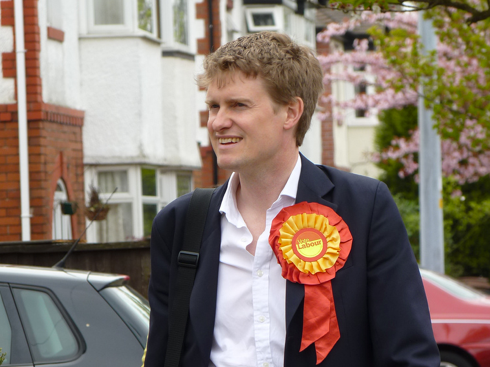
One way or another, a historical truism will be broken next May, Tristram Hunt tells Robert Philpot and Adam Harrison
For a brief moment, there is an air of professorial detachment as Tristram Hunt contemplates next May’s general election.
We are discussing the fact that, while it is extremely rare for a party to return to government after a single term in opposition – Harold Wilson managed it by the skin of his teeth in February 1974 – it is also the case that governing parties rarely increase their share of the vote once they gain power: since the war, only Wilson and Anthony Eden have pulled off that feat.
‘What’s so lovely,’ Hunt begins, ‘is that one historical truism is going to be broken relative to another. The great thing about history is that it teaches you not to judge history too much. That’s why we are in relatively uncharted territory and so something will give.’
Partisanship and the desire to remain ‘on message’ normally cloud the ability of most frontline politicians to take a step back, place their party’s position in a historical perspective and offer much by way of cool analysis. But Hunt, elected to parliament for Stoke-on-Trent Central in 2010 and promoted to shadow education secretary three years later, cannot escape the professional training which has made him one of the nation’s best-known historians.
That ability was on display last year when Hunt told the Guardian that, due to the nature of the coalition government, Labour was ‘the third most interesting party’ and needed to become ‘the most interesting party’ if it was to get into government. Does he think, with seven months to polling day, that the party yet passes the ‘interesting test’? ‘Oh, I think we’re becoming more and more interesting as May approaches,’ Hunt responds. ‘I think we’re seeing lots of interesting and attractive policies coming out.’ He recently attended a reception with communication industry specialists where he claims to have detected ‘a bit of the pre-1997 buzz again’.
Nonetheless, Hunt still seems anxious for Labour to spark a little more curiosity from the voters. He predicts, once the Scottish referendum is over, that the media focus will switch to the ‘Tory-Ukip bloodbath’. ‘That’s sort of fine, we don’t mind that and [being] regarded as the serious, sober party of government is absolutely right, but we have to be interesting, we have to have substantive policy ideas and people have to think we have a strong chance of implementing them, and then you become more and more interesting.’
The ‘pre-1997 buzz’ that Hunt speaks of has, however, not been accompanied by a pre-1997-style lead for Labour in the opinion polls. The shadow education secretary cautions against such expectations: ‘Thinking, as it were, in … 1996 terms, [that] we should be 15 points ahead or whatever, just doesn’t reflect the changing shape of politics today,’ he argues. ‘The postwar Tory-Labour obvious battle is now over. We’re entering a period of politics which is far more pluralist and yet we’ve got an electoral system which is very binary.’
Part of that new, more pluralist, politics is reflected in the rise of the United Kingdom Independence party. Although Hunt initially says he is ‘very hopeful’ that the Tories and Ukip will ‘spend three months taking chunks out of each other’, he accepts that Nigel Farage represents a threat to Labour, too. ‘We know Ukip takes three or four Tory votes [for] every Labour vote, but on the doorsteps of Stoke over the summer there was support out there … I think we see in some of those Kent marginal seats it is a new variability. Where we thought it would be a … Tory-Labour race you’ve now got very strong indices in terms of a Ukip vote … which is why I’ve always said we shouldn’t dismiss them as fruitcakes and racists and loonies and all the rest of it and engage with it.’
Hunt believes that his education brief is key to tackling the Ukip challenge and that there is ‘a strong, startling correlation between underperforming secondary schools and a high Ukip vote’. ‘The answer to the challenge of Ukip about the modern world, immigration, Europe and all the rest of it is to have as strong an education and schools system as possible,’ he suggests.
Given the centrality that Hunt ascribes to education some may find it strange that Labour’s leader has yet to make a major speech on schools and has barely mentioned the subject in any of his addresses to Labour party conference. The shadow education secretary is quick to dismiss any suggestion of neglect. ‘It’s a massive priority and Ed has made a large number of speeches on where he thinks we should be focusing our direction and efforts in terms of education policy, which is technical and vocational education.’ He notes that this year marks the 70th anniversary of Rab Butler’s landmark education act with its proposed creation of a tripartite divide between grammar, modern and technical schools. Technical schools – which, at their height, only ever managed to cater for two per cent of pupils – soon became the Cinderella of Britain’s education system. Last month, Hunt wrote that ‘whether it was the 1944 act itself or a failure of implementation, the consequences are still with us: a shocking inequality in provision between technical and academic education; confusion over vocational qualifications; and hopeless levels of youth apprenticeships.’
Ed Miliband’s focus, he argues, seeks to address this failure: ‘If you look at our plans for apprenticeships, if you look at our plans for further education colleges, if you look at our plans for vocational education reform, there’s a huge amount of effort there and Ed has rightly and unapologetically made that the centrepiece of his education reform, and I think that rights a historic wrong but it’s also forward-looking, [in terms of] the needs of the economy and the needs of all sorts of young people who aren’t catered for at the moment.’
While Labour may have to grapple with his legacy should it win next May, Michael Gove’s power over the nation’s schools was brought to an abrupt end in July when David Cameron demoted him to chief whip. Does Hunt believe that the prime minister’s decision to dispatch one of the few – albeit controversial – stars in his cabinet may turn out to be an own goal? He disagrees: ‘If you want transformation in education then you’ve got to take the profession with you and, yes, there’ll always be a bit of argy-bargy and give and take but if you’re describing teachers as “enemies of promise” and having strike after strike this is not actually a way to deliver an entire new curriculum, this isn’t actually a way to deliver examination reform. Actually it’s these people on the ground who are going to do it.’
In May Hunt suggested that Gove, for all his claims to admire Tony Blair, had learned the wrong lesson from the former prime minister’s suggestion that he wished he had gone ‘further, faster’ with public service reform when he first came to power. What, though, would have been the correct lesson to draw? ‘The correct lesson is to build consensus and to deliver sustainable reform. And it’s a balance … because you don’t want review after review, you don’t want meeting after meeting to build consensus in order to get there, you do need action.’ Hunt believes ‘the ferociousness with which he wanted to deliver free schools’ led to ‘a focus on quantity rather than quality’. How does Hunt think the former education secretary’s record will be judged? ‘I think on Gove’s terms it was sort of successful because he wanted to smash the system, he wanted this competitive, atomised system but the fact of the matter is that, under this government, the attainment gap between kids on free school meals and those not on free school meals has widened outside of London … If we’re feeling generous then Gove’s vision was to support the most disadvantaged – well, actually the policy is not working and has not worked.’
Gove may have attempted to present himself as the true bearer of the Blairite torch on education reform, but it is Hunt whose name is more commonly linked with the former prime minister, a recent Sunday Times profile suggesting that he reminded the interviewer of a certain ‘young, upcoming shadow cabinet minister’ he met in the early 1990s. Hunt laughs off such comparisons. ‘It’s mischief-making [but] you have to be flattered. I’m a great fan of Tony Blair and his time in office and his achievements so it’s always nice to be compared to Mr Tony.’ He pauses and, once again, there is that air of detachment. ‘Political commentators always want to go three or four steps down the line.’ What those three or four steps are is simply left hanging.
——————————–
Photo: Labour
Had I been a delegate at the Labour Party Conference today I would have started off “I am the first person in my family to get the opportunity to go to university”. I would have waited for polite applause and then said: “But I blew it. I made the mistake of passing the 11 Plus and going to a lousy rotten Grammar School. When I searched on Friends Reunited for some of my fellow pupils a few years ago I had to search two years after I‘d escaped, I mean left.”
Perhaps for that reason I value education more highly than many of my contemporaries who did not make my mistakes and did go to university.
As a school governor I have seen the approach academies take on improving the progress of pupils and we can learn from that. We must concentrate on the quality of teaching and the quality governors and be intolerant of poor standards in teaching and poor governance.
Mr Plato said something about never discouraging … anyone who continually makes progress, no matter how slow … the radical change needed to [our] universal education system is one which might encompass allowing the pupil to stay on at their school or college until they have satisfied any examiners they are competent to proceed to the workplace. Money for s&t in respect of any scholar should be provided free until the pupil is able to repay the State back. Tristram MP has already made positive inroads to changing education in his party speech iro 100,000 technical B apprenticeships over 2 years. This is the sort of bread-and-butter politics that voters and their 16 year old children relate warmly to. This MP Tristram has my vote. More strength to his elbow!