
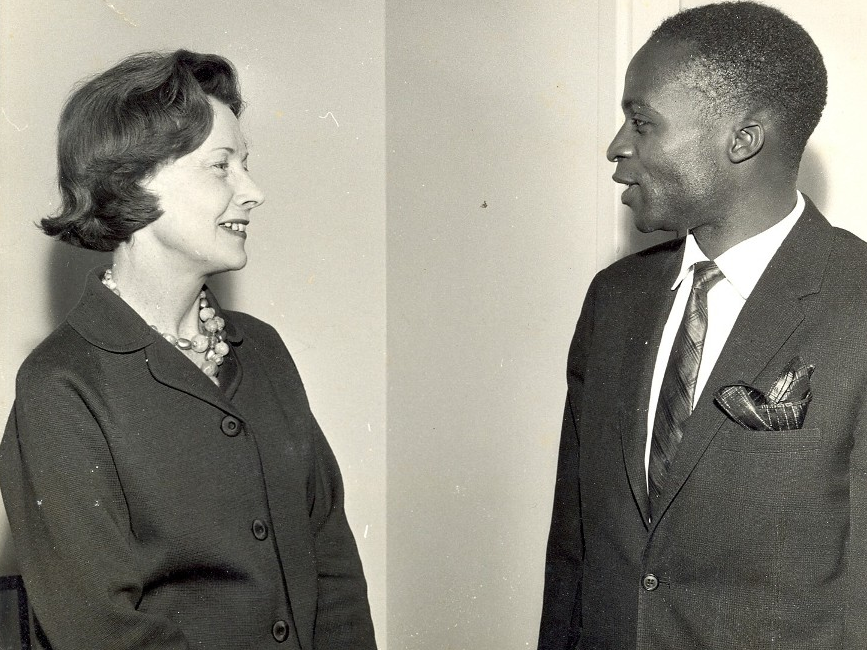
Barbara Castle could have been Britain’s first female prime minister. Born Barbara Betts in 1910 in Pontefract, her mother was a Labour councillor, her father a tax inspector. She later moved to Bradford, where she attended the girls’ grammar school, before attending St Hugh’s College, Oxford. In the late 1930s, with deep leftwing roots, she became a protégé of Stafford Cripps in the Socialist League. She wrote for Tribune, which had been founded in 1937, and came to know both Nye Bevan and Michael Foot. She was close to William Mellor, who edited Tribune for a time, before his death in 1942. In 1944, she married Ted Castle.
Castle was a fearless advocate in male-dominated arenas. She became member of parliament for Blackburn in 1945, one of only 24 female MPs elected that year. A Bevanite in the 1950s, she became president of the Anti-Apartheid Movement in 1961, and was appointed minister for overseas development when Harold Wilson narrowly won the 1964 general election. In 1965, she became minister of transport. Criticised because she did not herself drive, she nonetheless made the 70mph speed limit permanent, and introduced other safety measures such as insisting on new cars having pre-fitted seatbelts, and the breathalyser test to combat drink-driving.
In 1968, she was promoted again. Roy Jenkins, whose political stock was at a career-high as chancellor of the exchequer, had objected to Castle becoming first secretary of state and minister of economic affairs. Wilson had appointed George Brown to the Department of Economic Affairs in 1964, in order to weaken the power of the Treasury. Jenkins thought Castle would be too formidable a rival: ‘there could be no question of my allowing such a strong minister to reactivate the Department of Economic Affairs’ (Jenkins, A Life at the Centre ((London: Macmillan, 1991)), p249).
Castle instead became first secretary of state with the Department of Employment and Productivity. Her 1969 white paper In Place of Strife, with its insistence on pre-strike ballots and a ‘cooling-off’ period in industrial disputes, provoked great trade union opposition, led in cabinet by James Callaghan, and had to be dropped, leading to a compromise of a ‘binding and solemn’ agreement from the TUC. Yet her years as secretary of state finished with a triumph: the Equal Pay Act. Its short title was ‘to prevent discrimination, as regards terms and conditions of employment, between men and women’, and it reached the statute book on 29 May 1970, just under three weeks prior to Labour’s general election defeat the following month. When Labour returned to office in 1974, Wilson appointed her secretary of state for health and social security, but she was then sacked from the cabinet by her old opponent, Callaghan, when he became prime minister in 1976.
After retiring as an MP in 1979, she spent 10 years as a member of the European parliament, before becoming a member of the House of Lords in 1990, and published the fittingly titled autobiography, Fighting All the Way, in 1993. She worked tirelessly for pensioners, and made a final appearance at the 1999 Labour party conference, three years before her death in 2002, speaking against the tying of pensions to inflation (rather than the level of earnings) which that year had led to a 75p increase. To the end, she was a passionate campaigner for what she believed in.
———————————
Nick Thomas-Symonds writes the Labour history column for Progress and tweets @NThomasSymonds
———————————