
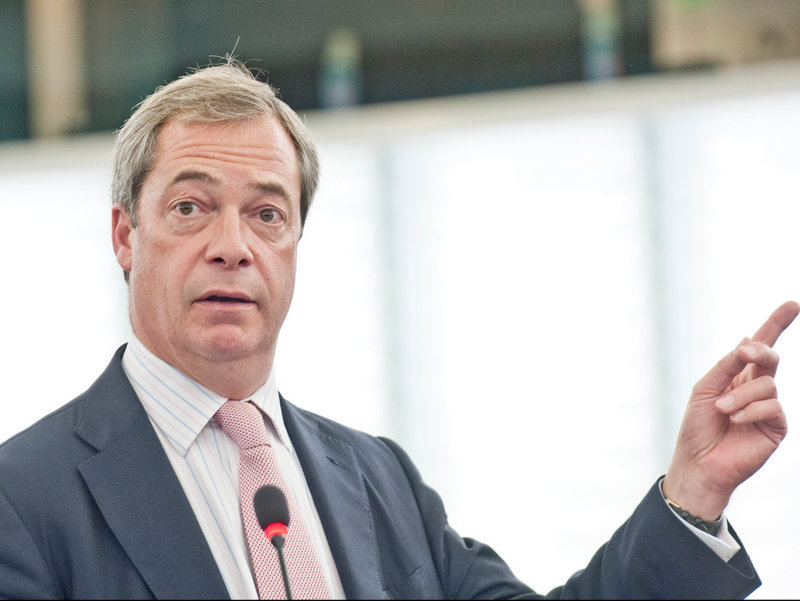
Nigel Farage is presiding over the Europeanisation of British politics
Political history is littered with ironies. Anthony Eden, who prided himself on his expertise in world affairs, was forced from office by his disastrous intervention in Suez. James Callaghan was renowned for his closeness to the trade unions. He was defeated in May 1979 largely as a result of the ‘winter of discontent’. Margaret Thatcher’s political persona was intimately connected to her sympathy for hard-pressed rate-payers. Yet her dogged determination to replace the rates with the politically toxic poll tax led to her defenestration by the Conservative party.
Another such irony may well become apparent on the morning of Friday 8 May. His party’s love of the Brussels gravy train notwithstanding, Nigel Farage has a well-documented distaste for all things continental. He will, however, probably have done more than any other individual to produce the European-style multiparty system that Westminster looks set to resemble a little more, if not completely, after the country votes this spring.
This will be a largely unintended consequence of the United Kingdom Independence party leader’s attempt to realign the political right. Others have long harboured the ambition to make Britain’s politics more akin to that of Germany, Sweden or Denmark – Italy has rarely been cited as an exemplar of what the United Kingdom is missing out on – with their greater array of parties represented in parliament.
But the House of Commons does not stand today on the brink of looking more like the Bundestag, Riksdag or Folketing than it does the United States’ House of Representatives thanks to the elegant writings of Roy Jenkins, several decades of Guardian editorials, or because the Social Democratic party ‘broke the political mould’ in the 1980s. Instead, it is largely the work of a man who believes the plot to tie Britain’s destiny closer to Europe’s is anything but blessed. Farage has kicked a giant hole in the Westminster wall which prevented Britain becoming a multiparty system and which Ukip and others now look set to walk through in 2015 and beyond.
For Labour this is discombobulating. In the wake of the 2010 election many in the party – along with much of the political punditocracy – saw in the Liberal Democrats’ apostasy an opportunity for a return to the Labour-Tory duopoly which characterised British politics in the quarter-century after the second world war.
But, as Ipsos MORI reported last month, an average of its 2014 polls suggested that, at 66 per cent, Labour and the Tories are heading for a record low combined share of the vote this May. Compare those figures to the eve of previous general elections: 1978 saw the two parties polling 91 per cent of the vote; 82 per cent in 1991; and 83 per cent in 1996.
Barely scoring double-digits, it is not the Liberal Democrats who look set to be the beneficiaries of these developments, but Ukip, the Scottish National party and the Greens who, polls suggest, may repeat their success in the European parliament elections and push Nick Clegg’s party into fifth place. The rise in support for the SNP and Greens is the most immediate threat to Labour: the former is putting in play seats in Scotland which Ed Miliband could quite reasonably have assumed were locked down long ago. The impact of the Greens is also threatening to Labour. While, as YouGov’s Peter Kellner has calculated, only one in five of their current supporters voted for Gordon Brown five years ago, compared to half who voted Liberal Democrat, Miliband’s 35 per cent strategy was premised on him holding all of Labour’s 2010 vote plus the vast majority of those who defected from Clegg when the coalition was formed.
Ukip, meanwhile, poses a clearer challenge to David Cameron than Labour: nearly half of its supporters backed the Tories in 2010, as against only 15 per cent who supported Labour. But, as last year’s local and European election results and by-elections in South Shields, Rotherham and Heywood and Middleton have shown, Farage also has the potential to do Labour damage in its northern heartlands. A string of strong second-place finishes there in May will put Ukip in pole position in 2020.
The bind Labour now finds itself in is one familiar to much of the European centre-left, where a divide between its traditional working-class ‘communitarian’ supporters and more middle-class ‘cosmopolitan’ vote has seen support splinter to both populist right and socially liberal left parties.
Faced with a similar multiparty challenge, there are important lessons Labour should learn. Where social democratic parties have shifted to the left to dampen the threat from the likes of the Greens, Die Linke, or Jean-Luc Mélenchon’s Left Front trouble has inevitably followed. Sometimes that has come in the form of immediate defeat, as in the case of the SPD in Germany in 2009 and 2013, or the Swedish social democrats in 2010 after their formation of a disastrous alliance with the Greens and Left party. On other occasions the centre-left has won either narrow, unsustainable victories or provoked deep disillusion following unrealised and unrealisable promises: Helle Thorning-Schmidt in 2011, François Hollande in 2012 and Stefan Löfven last autumn all exemplify these dangers.
There is, however, another way. Look at the most popular and successful governing European leaders today on both centre-left and centre-right: Matteo Renzi and Angela Merkel. Each shows the electoral and governing virtues of building a coalition of support from the centre out (rather than the right or left in) and pragmatism: a recognition that, as traditional loyalties decline, voters are searching for credible solutions rather than grandiose rhetoric, impractical visions or parties which cling to a dogmatic unwillingness to adopt new ideas. Both Renzi and French prime minister Manuel Valls also demonstrate that if voters are levelled with about future challenges – the existence of which they are well aware – and are offered leadership and a credible programme of reform, they might just follow.
———————————
Robert Philpot is a contributing editor to Progress
———————————