
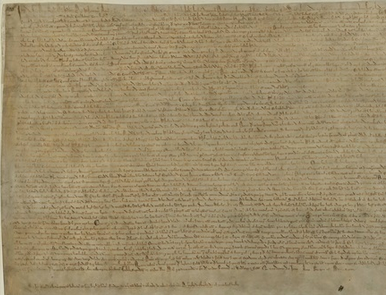
There are few documents which have had the impact of Magna Carta. For centuries it has formed the cornerstone of our constitution. And, while most of its clauses have been repealed – we are no longer required to remove fish weirs from the River Thames, for example – its symbolic power remains undiminished. The principle at its core, that no person is above the law and that every man and woman on these islands has a right to justice and a fair trial, is the bedrock of our legal system.
Speaking as a public lawyer, Magna Carta established and enshrined many of the core principles and beliefs that I hold dear. Just as the barons believed they were constraining the arbitrary exercise of power by King John, today we use judicial review to act as a check on the state’s power. However, as we mark its 800th anniversary we need to ensure that we safeguard and cement the values it enshrines for future generations.
Unfortunately these values are not safe under this government, and there are a number of worrying trends that need to be challenged before it is too late. The prime minister has pledged that a future Tory government would scrap the Human Rights Act and has spoken of withdrawing Britain from the European Convention on Human Rights. The convention was drafted by a number of gifted British lawyers and politicians, including Conservative members of parliament, in the wake of the horrors of the second world war. The Human Rights Act, introduced by Labour in 1998, allows individuals to enforce the convention in the British courts and bring claims relating to freedom of expression, assembly, religion and privacy.
The act and the law of judicial review developed by our courts over the last 50 years are the means by which we enshrine the principles of Magna Carta in law today and we should be proud of that. It is no accident that the British Library has chosen to display the Human Rights Act alongside the original copies of Magna Carta.
Yet withdrawal from the convention, as the Tories are proposing, would make the Britain the bedfellow of just two European countries – Belarus and Kazakhstan. This election then presents us with our own ‘Magna Carta moment’ and the opportunity to reflect how we protect our rights in the 21st century.
The Conservatives’ plans to repeal the Human Rights Act has been combined with this government’s far-reaching reform of judicial review that threatens the right we all have to hold our government and public authorities to account. No government likes to be challenged, but the right to do so is central to our democracy, and the protection of that right must be non-negotiable. No government is above the law. It is the sign of a mature and strong democracy that citizens are able to hold their government to account through the courts. British history has a long and proud tradition of great individuals and social movements, on the right and left, standing together and holding power to account. When the ability to do so is compromised or undermined it is a betrayal of that legacy.
Austerity has been used as a pretext to curb access to the law via cuts to legal aid and the introduction of tribunal fees. This needs to be halted. The right to legal representation is too important to be compromised in the name of short-term political calculations. It is a basic human right, and can never become a luxury service that only those with enough money can afford.
In light of the Scottish referendum and the devolutionary settlement across the United Kingdom, there is a greater need than ever to make sure that people, and young people in particular, are connected to what often feels like a distant political process. That is why as we mark the 800th anniversary we also need to ensure that children are taught not just about the history and the content of the Magna Carta, but also about the importance of its values and what they mean today.
As we approach the election we also need to be stronger not just protecting the Human Rights Act, judicial review and access to justice, but also in explaining them, and communicating why they are so essential to our nation’s history and who we are.
———————————
Sarah Sackman is parliamentary candidate for Finchley and Golders Green. She tweets @SarahSackman
———————————