
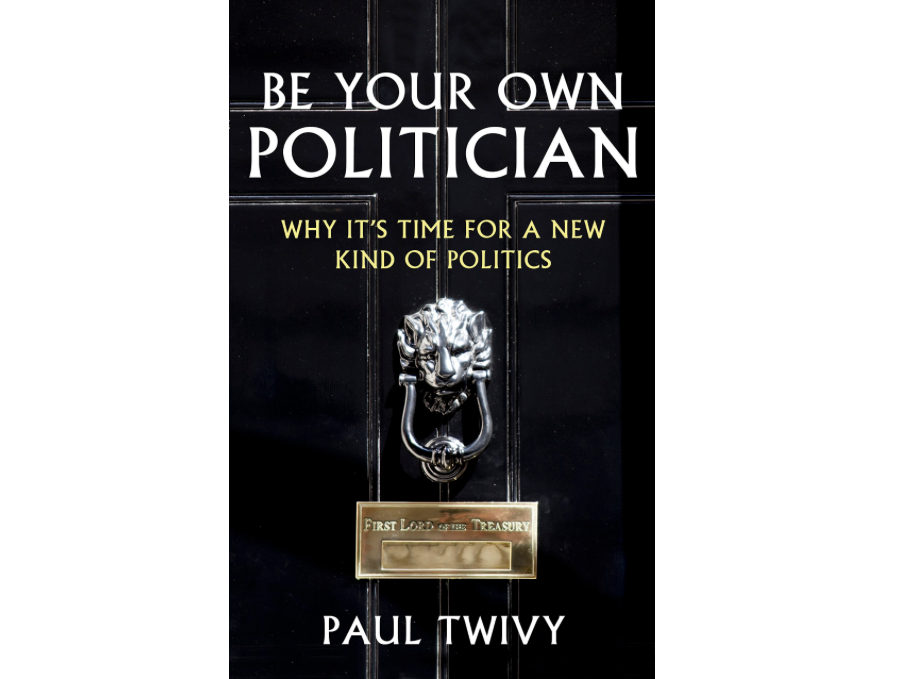
In Be Your Own Politician, Paul Twivy, co-founder of Comic Relief, Your Square Mile, Big Lunch and the Big Society Network, draws together two threads of thought. One is retrospective, examining his own work with the last three governments building capacity in civil society. This forms a very readable narrative of a Britain with a longstanding culture and tradition of giving and volunteerism. The second is progressive, asking how we might build a more active, engaged politics and relationship between citizen and politician.
The first thread takes us to the heart of No 10 and offers Twivy’s perspective on three prime ministers’ efforts to engage with civil society. He levels what appears to be the same criticism at both Tony Blair and David Cameron – the presumption that genuine, substantive civic action can be shaped by and through a top-down government programme and legislative agenda. For Blair, Twivy says, that exemplified itself through the concept of the ‘age of giving’ – as if it was not already part of British culture. Cameron, says Twivy, had the ill-fated ‘big society’. The author compellingly relates a conversation with Steve Hilton, then adviser to Cameron, where he and Hilton both agree on the citizens’ mutual, in which Twivy realises ‘faintly then, but clearly now, that a citizens’ mutual, with the ambitions we had could only be formed by a new brand of politics, of citizen power, that is anti-establishment and therefore anti-Tory: a new political party of democrats’. Be Your Own Politician is thus an apt title, hinting at Twivy’s developing dissatisfaction with the ability of representative politics to fully realise citizen empowerment.
As interesting as it is in its not entirely uncritical perspective on how British governments have worked with civil society initiatives, the book also leans towards a different, second strand of thought which preoccupies many: the question of how to build a deeper democracy where citizens feel that they have ownership over the political landscape and over political decision-making. It highlights the challenges presenting a political system that has weathered a number of storms, not least the ‘politics of disconnect’. As members of the public become increasingly politically engaged – interested in local, national and international issues, and increasingly articulate – they appear to find the established political structures, systems and frameworks in place increasingly irrelevant. Many of the points Twivy makes will be familiar to those interested in democracy and participation: that we need a new kind of politics with trust and empowerment at its core, we need not to take citizens, businesses and the not-for-profit sector for granted but to recognise they form part of a common endeavour, and we need to recognise that participation extends beyond voting.
Twivy raises the question of how the forging of this new politics can most effectively be done, suggesting that 650 ‘doers’ and ‘change agents’ from across civil society be elected into a parallel ‘people’s parliament’, a proposal which felt a little rushed. The book’s achilles heel is its size, affording insufficient room to breathe in a very short book for what is really an enormous political and philosophical project.
———————————
Reema Patel is a councillor in the London borough of Barnet and secretary of the Fabian Women’s Network
———————————
Be Your Own Politician: Why It’s Time for a New Kind of Politics
By Paul Twivy
BiteBack Publishing | 304pp | £9.99