
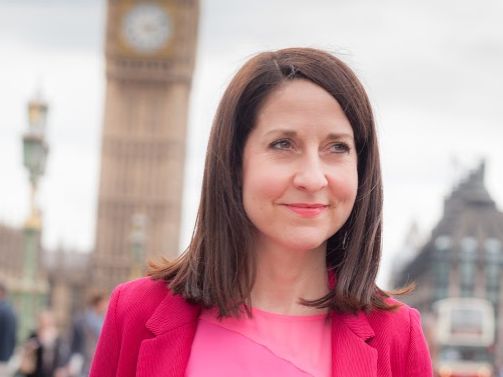
It is time for Labour’s first woman prime minister, argues Liz Kendall
Wearing a Hillary Clinton signature pantsuit, Liz Kendall strides into the room. We meet her ahead of a whistle stop she is taking to the marginal seats Labour was expecting to win last month and needs to win if it is to replace the Tories in government again. Appearing confident and determined, is she the woman to break the glass ceiling for Labour on this side of the Atlantic, we ask. ‘I might be biased, but I think it’s about time that Labour had our first woman leader and,’ she is keen to add, ‘prime minister’. Kendall, who used to work for Harriet Harman, is keenly aware that Margaret Beckett and her former boss have led the party. It is the job that too few Labour leaders have gone on to do that she is focused on. ‘I’m putting myself forward because I believe I have got the guts and courage Labour needs to change to win again. I have never been afraid of saying what I think. I want to bring people with me, but I am going to be clear about the direction of travel I think Labour needs to go in if we are going to win again.’
It is often said that Kendall’s lack of experience counts against her, so how would she beat the Tories in the chamber? ‘We’ll beat Cameron and the Conservatives when we show true leadership. I think leaders, good leaders, listen. They build a strong team. They debate and then they decide. I’ll be a person who says uncomfortable things to the Labour party, but that’s because we’ve got to change to regain people’s trust and win again in 2020.’
‘I am tough and decisive,’ she responds to the charge that she was a forthright negotiator in her special adviser days, ‘because I want to get the best results for Labour and the best results for people in this country. And I have always built strong teams. when I ran organisations before I became an MP and when I have been part of Labour’s health team.’
As something of an outsider in Ed Miliband’s shadow cabinet she has much to say about running an inclusive party. ‘No one should be afraid, ever, in the Labour party, of hearing different opinions.’ Chris Mullin’s diaries talk about how inclusive Tony Blair’s early governments were, but time, and feuding from No 11, changed this. The left of the party felt alienated as a consequence. Do they have anything to worry about under Kendall? ‘I think we have always been a broad church and we have had more in common that unites us than divides us. I will listen to all views, but I want to be clear: I will be decisive. We can’t have any fudge in our politics if we are going to change the party to win in 2020 and change the country.’
Changing the country for Kendall will only happen if we ‘appeal to [2015] Tory voters. That’s the only way we win. That does not mean we have to become Tories. One of our problems in the last parliament was that too many people felt we didn’t share their values of hard work, responsibility, taking care of yourself and your family and others … I believe those values are Labour’s values and the country’s values.’
While Tories actively relish and delight in snatching votes from their opponents, Labour sometimes appears to recoil from the task of switching voters from David Cameron’s party. ‘I think I’ll change that,’ Kendall responds, ‘because I grew up in Watford, an area which has been Labour, and was a marginal, and now has a stonking Tory majority. And my parents, and my friends and my family, many of whom still live there, want the same things as people who live in a Labour seat like Leicester. They want a good job that pays a decent wage; they want to live in a nice home that’s safe for their kids; they want great schools so that their children get the best shot at life; and they want to know that when they retire that they’ve actually got something to look forward to. What people in Watford want and what people in Leicester want, I believe, is the same.’
Before the election, the member of parliament for Leicester West and her parliamentary colleague and supporter Steve Reed authored a pamphlet for Progress, Let it go, that challenged Labour to break out of its centralising tendencies. Does Labour have to leave the 1945 inheritance behind? ‘We have to refind our roots as a party,’ she reflects. ‘Ordinary people coming together to help themselves and one another. My mission as Labour’s leader will be to put power into the hands of as many people as possible, over their public services but also on the economy. Because it is our cities, towns and county regions that are going to drive much of the growth we need to succeed as a country.’
How politics has to change is a big part of Kendall’s message. It starts with who Labour welcomes into parliament, she suggests. ‘If you’re a nurse or a teacher or a home care worker or you run your own small business you simply can’t spend 13 weeks trying to get selected and then two years doing the sort of intensity of campaigning that we need, unless you get that broader support. We’ve got to wake up to that otherwise we will become a party where only people who’ve got the money put themselves forward.’
I’ll be a person who says uncomfortable things to the Labour party, but that’s because we’ve got to change to regain people’s trust
‘We have too much inequality in this country already. Half of the growth that we have seen over the last parliament has come from London and the south-east’, Kendall says, as she attempts to square devolution with equity, and the battle against inequality. ‘We need much greater growth in all parts of the country. And too many kids don’t get an equal start in life. That means they play catch-up for the rest of their lives. The only way we’ll change that is if we make sure parents, families and communities are much more involved in their local services – that’s how we’ll tackle the inequality the country faces. We cannot simply pull a lever from Whitehall and solve all the problems in this country.’
The economy runs through Kendall’s pitch to become leader. How can Labour demonstrate economic credibility in future – do the ‘golden rules’ of the past not feel a little tired now? ‘It starts with strong public finances’, she responds. ‘We should balance the books and live within our means and get the debt down. Because, unless we do that, we won’t be able to invest in the schools and the hospitals people need. I think it’s wrong to be spending more on servicing our debt than educating our children. Sound public finances and people trusting you with their money and their taxes is the basic test of competence of any party that wants to be fit to govern.
‘We’ve got to show how we get a dynamic economy in every part of the country,’ she continues. ‘That means sorting out the real problems that we’ve got with skills, infrastructure. It means making sure we can compete with the rest of the world by improving our productivity. And it means being a confident, outward-looking country that uses our position in Europe to turbo-charge jobs and growth. That’s how we regain economic competence’. In no uncertain terms she points out that, ‘it won’t be easy. We will have to start as we mean to go on and set out our alternative to the Tories’ plans – not simply attack them for everything they are doing.’
‘I want a distinctive Labour pro, “Yes-to-Europe” campaign,’ says the leadership contender. And, reaching ’to the heart of a central disagreement between the candidates, she goes further. ‘But it would be a huge mistake to somehow boycott a wider “Yes” campaign. Why would we turn our backs on trade unionists who want a strong social Europe? Why would we turn our backs on businesses whose support we need to win again? And why would we turn our back on young people and the green movement who’ll be passionate about staying in Europe? We’ve got to go out early, strong and passionately for the benefits of Europe – and that’s what will happen under my leadership.’
Labour’s general election candidates ‘should be at the heart of this leadership campaign,’ says the would-be prime minister on the day she received support from the former parliamentary candidate for Nuneaton. Victoria Fowler’s result will be etched on the minds of so many who watched with horror in the early hours of 8 May as it became the first confirmation of the exit poll’s prediction. ‘We [now] need to support those candidates, many of whom have given up their jobs and their lives and been away from their families.’ Kendall continues, ‘I’ve spoken to several of them who feel they’ve simply been dropped after the election campaign. I want many of those candidates to stand again. But to do so they have got to know that their views and their voices have been heard.’
It is an ‘isolating experience being a candidate’, she concludes, something many who stand soon discover – and something which Kendall will no doubt be experiencing now like never before.
The headline “we need a woman as leader” is good, but NOT Kendall.
We need the ‘best person’ as leader, and believe that to be Liz Kendall.
The Labour party has every chance of winning the next election. Yes the new boundaries will make it more difficult but a landslide is not such a big deal as the press makes out. How can so called socialists be sitting down expecting Conservatives to win. They will fail to balance the books which will swing the balance of trust towards Labour. They will make more cuts than anyone expected thus erroding confidence even further.
It makes no difference that they promised cuts. The way they sold it did not prepare people for the cuts. We all know that Labour has been unfairly criticised for overspending. In exactly the same way the conservatives can be blamed for cutting. You cannot be a labour supporter and think that conservative cuts will work for a more prosperous Britain. I will bore you with why in later paragraphs.
The major reason that Labour lost was because they had the wrong leader. The leader must look the part. I am not talking about expensive suits etc. but an air of confidence and courage.
The leader was chosen for his labour credentials and that only wins the votes that the party has in the bag.
What is required is a leader who can win over all socially minded people. The majority of people are employees or unemployed, which means that Labour should win easily. They fail because too many employees believe that their bosses know best. But looking at the results of the last election a sizable section of socially minded people voted Green because the labour party was not selling the green part of their story even as well as the conservatives.
Another sizable chunk voted UKIP because they were on depressed wages caused by employers being able to get cheap labour from abroad. Another even bigger chunk did not vote at all because “Whats the point”.
A good deal of opinion is on the side of changing the voting system. Firstly that will not happen because whoever wins likes the power they have. Secondly there is some point in giving one party real power. At least the winners have no excuse for not succeeding. Thirdly coalitions are a charter for not being honest with the electorate as we have just seen.
The system will not change.
Personally I would like to see online voting and the government certainly has the power to use the electoral roll to verify online votes on anything and everything. The Labour party should start engaging people by instituting this as soon as possible. At the very least it might be able to call it the listening party. http://www.albumorganiser.co.uk/s/virtual.html#ws
The core of the whole thing.
Employers must pay a decent wage to employees so that they can have at least a basic living wage. As a former shopkeeper employing people on or near to a minimum wage I have no problem with this. If the government had raised the minimum wage then I would have been able to raise my prices to cover the cost because everyone else would have had to do the same. If you are not a business person you might ask what the point of having more wages is if you have to pay more for goods. The answer is that wages are a small piece of the cost of selling. Raising wages will have a very small impact on prices.
Will some businesses become unviable. Yes they will but then other employment may be short of staff and that is the way things work.
Is there a case for working credits? Most emphatically yes. Mothers with children who can squeeze in some working hours. Disadvantaged people for whatever reason need state support as well as wages. There is no hard and fast way of judging how much support a person needs but an employer will not take on a person who works at half the efficiency of another person without state help. That is fair. So society needs assessors who maybe work with doctors and psychologists to run that side of things. Also working mothers and fathers should get benefits in this regard.
The social ethic says that by giving all people a meaningful role in life we will have less health problems and less civil unrest and a smaller prison population. This will give us a more efficient society and therefore a more prosperous one. Believe it.
What about the army. I believe that society needs an army. Certain people need to be fighting. They need an army life. Without an army we will have arsonists and rioters for no good reason. Society needs to give all types of people a role. Conveniently we need an army.
Just something to bear in mind.
“coalitions are a charter for not being honest with the electorate as we have just seen”
I don’t agree.
We have had broken promises under single party government all my life. Including the one where Blair promised a vote on electoral reform!
In a coalition system a manifesto is a statement of what a party will stand for in government. It is all you can ask for. If your party is in government with 10% of the vote how can you hold them to every “promise”? All they can do is give a voice to that manifesto. This works fine in most Northern European countries, just watch Borgen if you want it illustrated ;=)!
Coalitions just equal a lot of people who who won the majority of the votes having to bow to a tiny number who did not. That is not democracy. Why should the party with the least votes have the biggest say.
I do not coalition and it just fractures the point people support a party. When people vote they ate voting for that party, not some fudge.
Majority is perhaps the wrong phrase to use, a larger minority having to working with a smaller one. After all in our system it is possible to win a majority of seats with less than a majority of the vote.
I didnt notice the LibDems having the biggest say in our last coalition.
No, they have learnt not to co-operate for at least two generations.
I think the LD’s were hoping for a deal with Labour this year, Clegg aside.
You are right for certain. They would have been dubbed the flip flop party.
The Germans have learned to live with PR but it took several elections for people to understand the implications.
I know politics is not a game but the analogy of learning to live with the rules applies. Whatever system you have has drawbacks. Our system is less democratic but it does allow the winner to take control. It also forces the winning party to stop arguing and go for their dream.
At the end of their term the people make a very crude and ill informed judgement.—- So maybe Margaret set in motion the banking crisis and many years later under Gordon it all crashed and Gordon got the blame.
The fact is the Tories are going back to their ways and I sincerely believe that they are going to make matters worse and labour must be ready with a “new” way.
This is not fair. It is the best way of winning. Elizabeth Gaskell explained 200 years ago how rulers and workers need to work together in “North and South”. The reality is that there is no new way. But we like to think there is.
Changes to the voting system are what the losers are always going to cry for.
Far more effective is for Labour to set up a voting system for the public at large so that at least the politicians can know what their members actually want. It would engage the public. see below
http://www.albumorganiser.co.uk/s/virtual.html#ws
Thing is, you wouldn’t get an Osborne or a Thatcher in position of such power with PR. The Northern Europeans have flourished with consistently centre based governments over decades…….
But then you wouldnt get a Corbyn either 😉
Actually Belgium is a complete mess. I lived there for two years and the level of corruption is bad. Their government is so dis functional as to be a national joke.
They feed off the EU, Diamond smuggling, all sorts of smuggling, sex and drugs.
The Tax collectors have it sussed though. They see money and they tax. For instance if you buy a yacht they tax you. No good saying you have no right. The tax man will just say You are not declaring where you got the money so we are charging you tax.
The legal system does not work either which means that complex cases get kicked through levels of courts for forty years. Like us only far worse.
That is why Belgians do not argue with tax collectors. They would spend a large fortune getting nowhere. The problem is that corruption is like cancer and it does affect the EU itself.
If businesses persuade us to vote yes to EU be wary. It means that they feel they see it as a vehicle for running roughshod over everyone (TTIP). What are the EU doing to Greece? Creating an anarchy? The EU does not work as a democracy because the majority of voters have no idea what they are doing. In effect our in out referendum is the only check on their behavior.
I think that European defence needs to be shared by the whole of Europe. Only the whole of Europe can make corporation tax (etc) effective. But they are not doing it. So unless they get a grip and stop being a lunch club for corporations they will fall apart.
Yep right because under the current system UKIP who got 4 million votes have 1 MP than the SDLP has 3 who got about 60,000 votes between them.
Or the SNP with 55 seats even though they got less votes than the Lib Dems who got 8MPs. Why should the party with least votes have the most say ? eh because that how the current system works where as under PR each party has a say according to how many votes it got. Imagine, results of elections depending on how many votes you got – I’ve even got a name for this system, it democracy.
Yet not a word on electoral reform…….
Good interview, solid answers, counters lots of the sere and misleading and scaremongering remarks some on the left have been trying to spread. It shows she is able to lead and is determine to set out a path for Labour to win in 2020.
From what I have seen she is the only candidate who is setting out why Labour lost and what is needs to do to really win. She may not have all the answers yet but neither do any of the other candidates. Yet she has the ability to take forward her leadership so she fines them,
Labour does need a female leader and potential PM, it is time to beak the mould and show a bolder vision. Lets also have Caroline Flint as Deputy so it can be a team the public will take note of and want to know more.
I know where my vote is going and it will be for Kendall and Flint.
Ideally A leader would only hold sway when there was no consensus. But the leader does need to open up the agenda. It is only natural that the leader will want answers which the public will buy.
I was quite shocked when Ed promised to freeze fuel prices. It lowered the tone and overshadowed the big picture. I like many people grew up in a house with one coal fire and a crackle radio. Do not try to tell me a single pensioner was impressed. (Just illustrating the dangers of an over opinionated leader).
They should sell what they have and yes I think Liz is clever enough not to be bullied into a silly promise and to have a full grasp of the party position. She will keep the public mind on the goal of more and not less equality and adequate services for all.
Liz Kendall + Caroline Flint are the pair that worry the Tories, because they talk so much sense…
http://www.newstatesman.com/politics/2015/07/liz-kendall-and-caroline-flint-are-team-fear-say-conservative-councillors
Liz is convincing and articulate candidate who certainly realises the size of the task facing Labour. She is however not saying very much about how Labour should respond to the party’s meltdown in Scotland. Nor are her views on the economy at all insightful. She seems to be echoing the mistaken notion much beloved by the Tories that deficits should be avoided at all costs. Labour lost because of a perceived lack of economic competence. She needs an economic advisor who actually understands the issues because nothing she has so far said convinces me she does!