
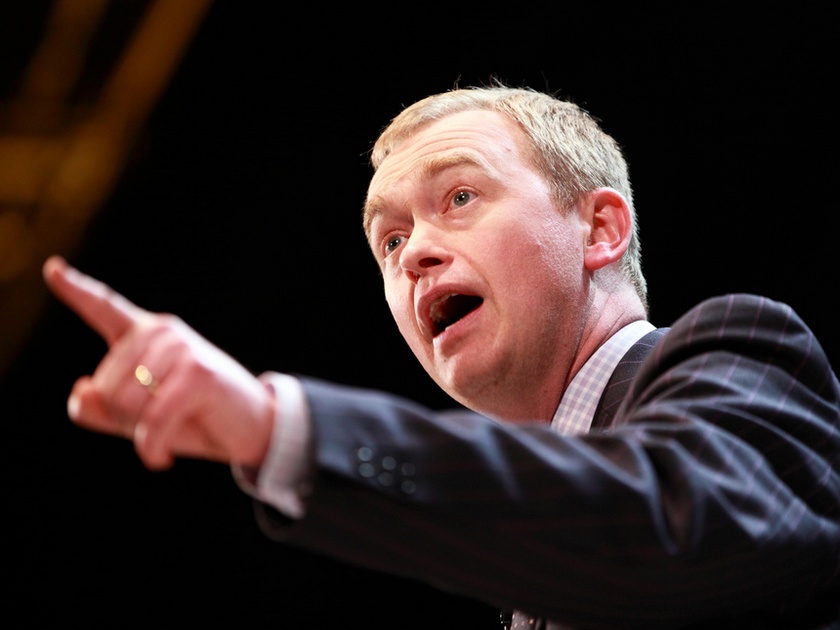
It is a cliché to say that being the leader of the opposition is the toughest job in politics. Perhaps it is time to revise that statement: the political and organisational challenges that will face the next one will be nothing like those facing the new Liberal Democrat leader, Tim Farron. The Liberal Democrats came as close as it is possible to come to political oblivion, reduced to a rump of just eight members of parliament and with their once-huge army of councillors decimated. So how should Labour respond to the election of Farron?
From the outset Labour should not assume the Liberal Democrats will disappear. They won’t. In the last three months 17,000 people have joined the Liberal Democrats. The history of the 20th century shows that even in the dark days of the 1950s and 1960s the Liberal party survived. Britain is a very different place to the heyday of the welfare state and organised labour: political allegiances and voting behaviour are much more fluid. The rise of the Scottish National party, the United Kingdom Independence party and the Green party shows that we are now in an era of multiparty politics. For Labour to put the genie back in the bottle requires fundamental changes in how we think, campaign and organise. It is not impossible but will require the kind of transformational change that the party embraced under Tony Blair’s early leadership.
A good starting place would be for the new Labour leader and Farron to develop a constructive working relationship. Both leaders have a shared objective: winning the European Union referendum. No one should be under any illusions what an incredibly tough battle the referendum campaign will be. To keep Britain in Europe, Labour and the Liberal Democrats must learn the lessons from the referendum campaigns: we need to pool expertise, resources and talent. With the future of United Kingdom at stake, this is no time for petty partisan politics: the public expect us to put the national interest first. Labour and Liberal Democrat politicians have successfully worked together in opposition before with impressive results: the Scottish constitution convention paved the way for the devolution of power to Scotland and Wales and incorporation of the European Convention on Human Rights into British law.
For anyone in the Labour party who thinks that tribalism is the way forward, they need to reflect hard about the aftermath of the 2010 general election. The mutual suspicion and personal antipathy which characterised Gordon Brown and Nick Clegg’s attitudes towards each other and their negotiating teams, resulted in the first Tory-led government for 18 years. The responsibility for putting the Tories into government lies firmly at the door of Clegg, Danny Alexander and David Laws – and they and their party have rightly paid a very heavy electoral price – but there were also too many senior Labour figures that were quite happy to walk away. As a consequence millions of people – the people Labour members are in politics to represent – have suffered poverty and hardship at the brutal end of the coalition government’s cuts. They will now have to endure five more years of low pay, job insecurity and reliance on foodbanks. It is not difficult to imagine that negotiations between Brown, Peter Mandelson and Andrew Adonis with Charles Kennedy, Ming Campbell and Vince Cable would have produced a different outcome, and much more importantly, a better government for the majority of the British people. Personal relationships matter in politics.
Labour now faces an electoral mountain to climb to win in 2020, made even harder by the huge Liberal Democrat losses. The voters of Bath, Cheltenham, Twickenham, North Devon and Yeovil are unlikely to be electing Labour MPs in just five years’ time, and it is hard to see the Liberal Democrats winning back these seats from the Tories. New Tory MPs are much more assiduous at working their constituencies than previous generations of Tory politicians.
So what should Labour’s political strategy be towards winning a majority in 2020? First, we need to develop a much more inclusive, broader political outlook that embraces devolution and sharing of power, locally, nationally and internationally; that takes environmental and quality of life issues as seriously as the future of the NHS and the welfare state; and is as interested in people who live in towns and villages in rural Britain as those who live in cities.
Since the mid-1970s millions of people have voted for the Liberal Democrats and their predecessor parties. Labour’s new leadership should think long and hard about how to attract support from current and former Liberal Democrat voters who in 2015 preferred the Tories to us. These voters associate Labour nationally with corporatism, profligate spending and a bossy centralised state that thinks it know best; and locally, with inefficiency, top-down control and producer interests. The Blair and Brown governments have huge achievements to their name, but there was too much central control from Whitehall. Labour’s renaissance in local government has been achieved because former and current Labour leaders such as Steve Reed, Nick Forbes and Joe Anderson knew that to win back people’s trust they need to change local Labour politics fundamentally.
Labour needs to be much more sceptical about state power. In 1994 Blair rewrote Labour’s constitution to put ‘power, wealth and opportunity’ in the hands of the many and not the few: in government too little attention was paid to devolving power and increasingly Blair became seen as an authoritarian leader. Everyone wants to live in a safe, secure country: to dismiss people in our own party and others for being ‘soft’ on crime and terrorism because they are concerned about civil liberties is intellectually lazy. The Stephen Lawrence and Hillsborough enquiries and the Rochdale, Rotherham and Jimmy Savile child sexual abuse scandals should make us stop and think very carefully about how institutions such as the Police, NHS, local government and the BBC can misuse power.
Many people vote for the Liberal Democrats and increasingly the Greens because they do not think Labour takes environmental issues seriously. As the party that introduced the first Climate Change Act with legally binding carbon reduction targets in the world we need to ask ourselves how we have got into this position! There are many Labour MPs and members who are passionate about the NHS, housing and education, but far fewer who take an active interest in environmental issues, the countryside and the quality of our public spaces. The shadow cabinet and the parliamentary Labour party need to embrace a much broader political agenda: simply talking about the NHS was tested to destruction in the last general election.
Second, we need to become a genuine ‘one nation’ party: Labour needs to be contesting every election, in every seat in every part of the country. We can no longer just right off huge parts of the country such as the south-west of England. We need to be supporting local Labour parties who have had Liberal Democrat MPs for decades: if we can win and increase our majority in Exeter, we ought in the years ahead to be able to mount a serious challenge in Bath. We should not shy away from competing on Liberal Democrat territory, but we should do so not by hating them, but by winning the argument and simply being better campaigners, advocates and elected representatives than they have been.
This approach will require fundamental change in how Labour organises and supports members and local parties across the country: we simply can no longer ignore our members and label constituency Labour parties in safe Tory seats as ‘not a priority’. There are five years to the next general election. Labour needs to fight and win the Europe referendum and the police and crime commissioner and European elections: the party machine has never quite got its head around the simple fact that every vote, in every seat counts. It needs to do so fast. For party staff, organisers and activists who do not see the point of venturing outside our safe and key seats, it is worth looking at a recent Policy Network report on the scale of demographic change in Britain. More people from minority ethnic communities and people with young children are moving out of cities for a better quality of life; polling data from 2015 shows that Labour outpolled the Tories among younger voters.
Labour’s approach to the Liberal Democrats should be to work with them on specific issues where it is in the national interest to do so, such as the EU referendum. But our top priority must be to become the voice and a resource for change in communities in every part of Britain. To do this we must have a political offer that appeals to a much broader mix of voters: one that embraces green issues, devolves decision-making, supports entrepreneurship and is more sceptical about state power. The Labour leader who transforms the Labour party so members in every community are supported to campaign and win elections across the whole of Great Britain will be the next Labour prime minister.
——————————
Sally Prentice is a councillor in the London borough of Lambeth. She tweets @SallyPrentice
——————————
A similar point was made by Pete Marland of Milton Keynes here: http://labourlist.org/2015/05/reaching-our-beyond-our-metropolitan-heartlands/ He wrote: “Our parliamentary party and centrally focussed apparatus misses the fact that in many places like Milton Keynes, we already do win elections.”
“The responsibility for putting the Tories into government lies firmly at the door of Clegg, Danny Alexander and David Laws”
Comforting though that might be, the facts are responsibility lies with Blair for not changing the electoral system, Brown for similarly flunking changing the voting system (something he planned to do then flunked like the election that never was) Brown had treated Nick Clegg with contempt until such time as he needed his votes after the 2010 election. (but hey Brown did that with most of his Cabinet !) and then there were all the Labour MPs ruling out a coalition – before the negotiations had even finished. Given that a Labour/Lib Dem coalition would not have had a majority, the ide a that it could have worked with 30-40 Labour MPs not voting for it was absurd.
The Conservatives made major policy concessions, and quickly; while, after three days of talking, Labour was too disorganised or divided even to table clear positions on tax, education spending, pensions or the deficit. And, on voting reform, Ed Balls was bluntly warning Lib Dems that Labour MPs might not vote for their own manifesto pledge to support a referendum on the Alternative Vote.
Labour was offering a weak coalition with a divided Labour Party; a coalition with no majority in the House of Commons, no clear policy platform and no guarantee of a referendum on voting reform.
I am no fan of Nick Clegg or David Laws or Danny Alexander and I would have like a coalition with Labour, but, the fault lies with the Labour Party, not the Lib Dems. If Labour spends the next five years daydreaming of a Labour majority Government or a coalition with the Lib Dem without embracing electoral now, then they will doom themselves to further years of opposition.