
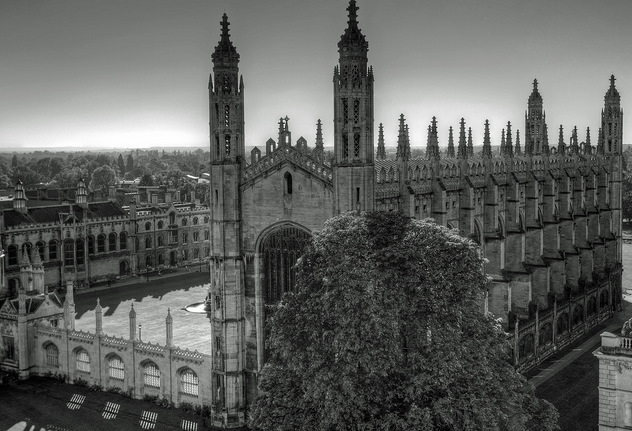
A primary school head in Cambridge recently told me that some of the kids were asking if Cambridge University really was the best in the world. It clearly excited them that their home university had such a reputation but they’d never visited it and didn’t know anything about it. It struck me that children at such a young age were so curious about university particularly at a school in a challenging catchment area.
Having spent a fair number of years hanging around in Cambridge colleges, I immediately understood what Stephen Twigg meant when he said on 5 January:
‘Although universities should do more, it is a cop-out to think it is all the fault of elitist dons blocking poor kids. State schools should be more ambitious for their pupils.’
I have never come across a don who wanted to stop poor kids getting into Cambridge, but there are plenty who won’t compromise academic entry standards for the sake of widening access. It’s not enough to simply demand that universities do more without addressing the issues lower down the education ladder in secondary and primary schools. There needs to be a very significant sea-change in the attitudes of state schools in preparing kids for university; getting them interested and excited about the idea of university at an early age will raise their aspirations and motivate them to work hard to overcome any disadvantages.
Of course, you can’t expect any child to succeed if they don’t get the highest quality teaching. The government’s focus on structural change is a diversion from the real issue of improving teaching quality and Stephen Twigg was right to highlight it.
And we can’t look at the problem of access without understanding the need to change attitudes in the home as well. There are far too many families where education is a low priority and that attitude is transmitted from generation to generation. I whole-heartedly believe in education for its own sake but for some we need to show convincingly that education is also a route to prosperity and preferable to a life on benefits.
There is also a false distinction between vocational and academic education. One does not preclude the other and there is no reason why children should not be equipped by schools to prosper both vocationally and academically. Working with young student entrepreneurs in Cambridge, I know that being academic is no barrier to enterprise and nor should following a vocational path stop any child from being academic as well. We need to see education as a mix and a continuum, not just something that you do in a particular way at a particular stage in life then stop.
If the secret to success in business is continuous improvement then the secret to success in life is continuous education. Academic or vocational training should be accessible to anyone at any age and I think that this kind of comprehensive, flexible, lifelong education policy is something Labour needs to develop if we’re to offer people a vision of personal progress and betterment in life. Perhaps a government and business supported lifelong ‘education trust fund’ for everyone could be the way forward.
And those curious primary school kids? I put them in touch with a Cambridge college and they were more than happy to arrange a visit. Ask me again in about 10 years how many of them got in.
—————————————————————————————
Tariq Sadiq is Labour group leader on Cambridgeshire county council
—————————————————————————————
How manyundergraduate places go to non EU students? Why does 60p of every £ go on student accommodation and not teaching? How can there be academic excellence in all of our universities?
Dons in elite universities are expert in perpetuating privilege. Challenging them with the more progressive practices of US Ivy League institutions can push them onto the back foot though (in my experience)
Umm, what evidence have you that Ivy League Universities are ‘more progressive’? A good argument has been made that the American university application system, which places strong emphasis on criteria other than academic results, was designed to keep the number of Jewish students in check. Although I don’t think anyone would argue that anti-Semitism is a motivating factor in American university admissions today, the system suffers from a complete lack of transparency. The British system is vastly more transparent and also less bewildering to the total outsider (there’s usually only one form to fill in, for instance, as opposed to the myriad that exist in the States).
Good comment. For ideas on what a lifelong learning policy might look like, try Learning Through Life, the report from an Inquiry funded by the National Institute for Adult Continuing education – see http://www.learningthroughlife.org.uk. Declaration of interest as a co-author!
Good piece – I live in Cambridge (and teach at its post 92 university) and in my experience most Cambridge academics really want to widen access, and colleges put effort into outreach.