
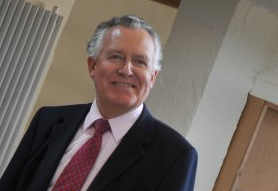
A straight-talking Peter Hain accuses the political class of cowardice on party funding and suggests Tony Blair could have won in 2010. By Adam Harrison and Richard Angell
Scattered throughout the pages of Peter Hain’s new autobiography is the constant refrain of the Nairobi-born MP as an outsider who occasionally steals his way into the inner circles of the political classes. His forays into political life are invariably mission-oriented – joining the anti-apartheid struggle, bringing devolution to Wales, securing power-sharing in Northern Ireland – but he is pragmatic and phlegmatic about what he has sought to achieve: ‘I have never been an all-or-nothing person but an all-or-something person, a phrase which I picked up from Alan Paton as a little boy.’
The heritage of his activism in South Africa is ever-present – both in the form of the Nelson Mandela picture hanging on the wall of his room overlooking the House of Commons to the sense of perspective he maintains about UK politics. When questioned about whether he would make representations to the Leveson Inquiry about his treatment at the hands of the media in the now long-forgotten news stories about his deputy leadership campaign expenses, his response is that he has had ‘trials, letter bombs, a close friend being executed … What happened to me is small beer really.’
Hain has a tendency to self-consciously downplay his work – ‘I was not right at the centre of government’ is a typical comment – but he is also ‘not immodest’ about the nuts-and-bolts role he tried to play in his early life like halting the 1970 England cricket tour, and later tackling some of the problems that confronted the Labour government. ‘If I personally hadn’t been there I don’t think those outcomes would have been the same.’ His memoir is of interest both for the predictable ‘he-said-she-said’ accounts of the New Labour years but also for the ins and outs of a minister’s work to resolve conflicting policies, personalities and political passions.
He is careful to avoid being typecast, but New Labour’s attempts to bring about practical change seem to have chimed more with him, and he is unforgiving of some of those identifying with ‘Old Labour’. ‘The left I think are just so completely on a different planet, including some of my friends,’ he says. ‘They have no idea how difficult it is to actually realise Labour’s vision in what is still a set of structures, an establishment, and a set of economic imperatives that you have constantly to kind of shape, work with, oppose, change. It’s hard work.’ He also reserves fire for the coalition junior partner: ‘The Lib Dems,’ he says, ‘just make me despair on every major issue – electoral reform, they bodged it; the boundary review, they lose proportionately more than anybody else. It is like one betrayal and defeat after everything they
stand for.’
Hain calls himself a ‘libertarian socialist’. This he defines as ‘giving people the maximum ability to control their own lives consistent with fairness, justice and equality. In other words, not having small cliques whether they are in big corporations or in nationalised industries running people’s lives, nor big brother councils or a big brother state.’ An aversion to concentrations of power enjoyed by insiders permeates his words, but Hain remains concerned with the broader sweep of Labour’s recent history: ‘The crucial change we began in the 1980s and 1990s, and that Tony then carried forward as New Labour, was to say Labour is not about the state, it is about using government as a vehicle to create a decent society and a society in which everybody has the opportunity to reach their potential.’
He believes much was achieved on this front during the party’s 13 years in power, but remains a critic of the party’s record vis-à-vis itself. The charge that the party became technocratic and uninspiring is common, and one which Hain partly concurs with. ‘I just felt that we became too managerial, we became too preoccupied with the business of government rather than the ends of government and that was, among many other things, the reason for our downfall.’ When pressed on whether creeping managerialism was a function of something inherent in the New Labour programme or of the fact of simply being in power so long, he concedes ‘it was not so much a fundamental flaw in the New Labour vision as … the sheer, grinding pressures of government.’
Nevertheless, he detected a growing apoliticisation. ‘I noticed particular ministers coming through the more junior ranks seemed less political. Their special advisers definitely were less political!’ Hain senses in particular Welsh special advisers to have been the least ‘political’ of all. He is reluctant to be drawn on why this is, but refers to the fact that ‘we’ve been in power in Wales a long time, from the beginning.’ Perhaps the implication is that insiderism breeds complacency.
He believes that New Labour ‘always downgraded the party and defined itself against the party’, and that too little recognition was given to the fact that ‘the party was just collapsing underneath us and our support was draining away, and yet we were just driving on.’ In spite of all this, had Blair remained in office, he believes ‘Tony could still have probably in the 2010 election got us to be the biggest party. Now that’s quite a big statement to make because he was an unpopular prime minister when he left, mainly because of Iraq, but I feel we lost our roots and our values.’ Key to a successful Labour party will be building both ‘a winning machine and a party that is capable both of sustaining power and sustaining support’.
How far will Refounding Labour, which he has led on under Ed Miliband, bring this about? Hain is clear that ‘If we’re going to win again the party has to change big time’, sloughing off old ways of doing things so it can both reform itself and also get ahead of the other parties. ‘We are in a completely different type of politics in which people don’t join any parties any more in the numbers that they did. We have benefited from a membership surge post-2010 but I’m not sure whether that’s continuing or could continue … The other parties are not going to succeed on this model either … If we can leapfrog them we’re in a much stronger position for the next election than people may suppose.’ Organisation is key, and Hain is passionate about reaching out to loyal voters through the Labour Supporters’ Network. ‘If the party is to build a new electoral coalition it will have to become a different type of animal altogether,’ he warns.
Despite recent mutterings about Ed Miliband’s leadership Hain remains a strong supporter: ‘What Ed is saying is striking a chord even with the sort of constituencies that might be naturally more inclined to the Tories. In that agenda is an enormous opportunity to reunite the 1994-7 coalition … if Ed is given a fair chance to do it.’ Some of Miliband’s main ideas, such as talking about the pressures on the ‘squeezed middle’ were issues Hain raised in his own bid for the deputy leadership and these now ‘funnily enough are becoming the natural currency’. Hain’s political standpoint was perhaps always likely to lead him to support the younger Miliband as a clearer critic of New Labour, but he reveals: ‘I was never approached by David and was and remain a big admirer of David.’
Having been stung by, and cleared of, allegations of financial impropriety following his campaign for the deputy leadership (the decision to stand for which he refers to in his book as ‘the biggest mistake of my political career’), Hain does not hold back in condemning the failure to extend public funding in politics. ‘I use the term “extending” deliberately because there is massive public funding for politics already and this is what is so hypocritical and so cowardly about the leadership of the political class beginning with the government and to some extent us in saying that the voters at a time of austerity won’t accept an extension of public funding. I think they will.’ Politicians ought to have been courageous enough to say ‘“you want politics cleaned up so that politicians are not in the position of having to solicit donations in order to conduct politics quite honourably, you’ve got to be prepared to fund it”,’ he argues. Hain sees enormous gain for relatively little pecuniary cost. ‘To be frank it’s small change, it’s pence in the great scheme of things.’
The failure to act is one that he lays firmly at the door of the government. ‘I don’t criticise the Labour leadership because who in the Labour leadership is going to argue for this publicly other than me when the government has said “No”.’ He identifies a deeply party political angle to this: ‘Of course, it suits the Tories to preserve the status quo which is reducing their opponents to pennies,’ and thinks a solution could have been found ‘if Cameron and Clegg had had the guts’ to proceed and ignore the press. ‘The Mail and The Sun would have bleated a bit but that would have been 24-hour kind of stuff and then we’d have got it through and politics would be a hell of a lot more healthy.’ The issue will surely boomerang back on the political class, he warns. ‘This is unfinished business – we’re going to have to return to this at some point.’
That is not all that is unfinished. Musing on the attempts of the Labour Coordinating Committee – of which he was a leading light – in the 1980s to move the party to an electable soft left position he remarks: ‘I still believe that is where the future of the party lies.’ Hain may never have got used to being an insider, but he gives no sense that he feels his own contribution to shaping Labour’s future is yet over.
I would srongly agree that Tony Blair been leader in 2010 the labour party would have had a greater chance of winning the election
What did for Labour in 2010 was the back-stabbing actions of Labour MPs like Diane Abbott who spent every media opportunity rubbishing the Labour leadership (both Blair and Brown).