
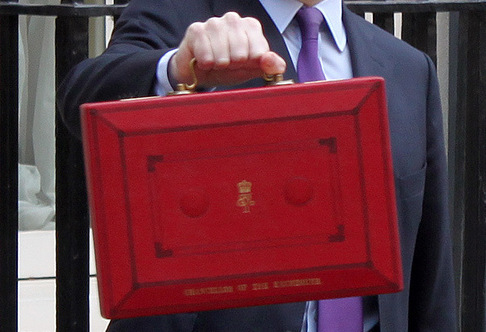
Is Labour prepared for another highly political budget from George Osborne?
One day above all reminds us who is in power, and who is in opposition, and that is budget day. On 21 March George Osborne will deliver his budget against a backdrop of rising borrowing, falling public investment, mounting unemployment and turmoil across the eurozone. Osborne, with his 2:1 in history, and a first in political thuggery, has only one course of action: this must be a political budget designed to help the Conservative party. The economy can sort itself out.
On the big questions of taxation and expenditure, his hands are manacled together. The Office for Budget Responsibility has revised down its forecasts for this year’s growth to 0.9 per cent, from the 1.7 per cent predicted in March, and for next year to 0.7 per cent. Growth is then expected to pick up to 2.1 per cent in 2013, 2.7 per cent in 2014, and three per cent in 2015 and 2016. The debt-to-GDP ratio, which is forecast to stand at 67 per cent this year, is set to peak at 78 per cent in 2014-15 and fall by the end of the next parliament. Over five years, the government will borrow £158bn more than Osborne promised. The welfare bill – the cost of failure – will continue to swell, matching spending on the NHS, and far outstripping investment in education, defence or transport. The chancellor will not have the space to scrap the 50p top rate of tax, at least not this year.
Thanks to lower interest rates, debt interest payments over the parliament will be less than predicted, giving Osborne an extra £22bn to play with. But, overall, the chancellor is locked in to the coalition government’s programme of cuts, and the reduction to the size of the state that the Tories crave.
So don’t expect this to be a budget of growth, jobs, skills, training and the transition to a post-carbon economy. Instead, it will have the simple aim of killing the Labour party. Osborne knows that if the economy is showing signs of recovery, the Tories’ pitch in 2015 will be: Britain’s getting better, don’t let Labour ruin it. If the economy is in recession, the pitch will be: Labour caused the recession, they can’t get Britain out of it. Either way, the Tories’ key wedge issue with Labour will be the economic record of the last Labour government, and the need for cuts.
In their recent Policy Network pamphlet, Cameron’s Trap, Gregg McClymont MP and Ben Jackson show how the Tories have played this game before, in the 1930s and 1980s. They argue that: ‘A debate about public spending and debt enables the Conservatives to rest their electoral appeal on a claim to relative rather than absolute economic competence. However bad things get, Cameron hopes to claim they would be worse under Labour.’
At the Progress political weekend last year, Jim Murphy, one of Labour’s smartest cookies, said that by the end of 2011 the party needed to have secured ‘a win on growth and a draw on the deficit’. It is clear that Labour is five-nil down on both scores. There are few signs that the public are buying into the ‘five-point plan’ on growth and jobs (despite its perfectly sensible proposals). They have also bought into the lie that Labour caused the deficit because of profligacy and Viv Nicholson-esque recklessness. Pointing to the new schools, hospitals and highest-ever levels of satisfaction with the NHS will do little good. The public are swift to blame, but slow to applaud.
On a series of politically motivated and skilfully laid elephant traps, notably the cap on benefits at £26,000 per household, Labour has fallen in headfirst. There is an accumulative picture being painted that Labour is against reform to the benefits system, schools, NHS, the democratic system and the police; but the picture of what Labour is in favour of lacks form, definition or colour. Being out of step with the public on the economy and on public services can never be compensated for by bashing bankers’ bonuses or rip-off energy firms.
Ed Miliband’s speech at the Oxo Tower in January was perhaps the most important he has made to date. It contained the vital insight that if Labour is elected with a majority in 2015 (unlikely on current opinion polling), then a Labour chancellor will have to continue the programme of cuts to public expenditure. Miliband made the point that the Brown-Blair era of rising public expenditure, paid for by economic growth, is over. Labour’s task, therefore, is to prove that Britain can be better without higher public spending: through reform and modernisation, not tax and spend.
Miliband’s attempts to map out the alternative is a harder sell than ‘more teachers and nurses’. Notions of fairness at the top and bottom of society, responsible capitalism, and taking on vested interests, play well in Toynbee-land. But in the real world, where the ‘squeezed middle’ have just cancelled their summer holidays and blame Gordon Brown for it, it has little appeal.
—————————————————————————————