
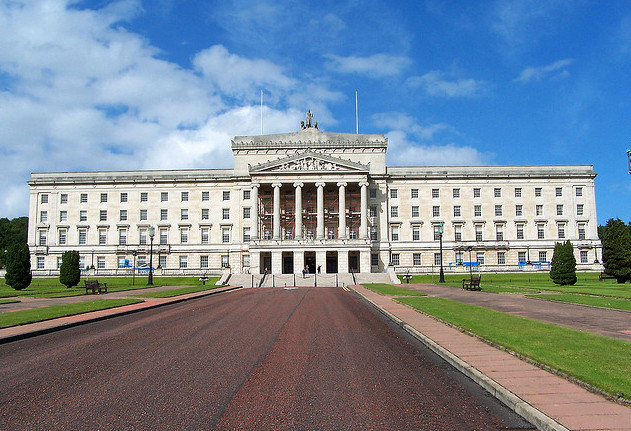
Northern Ireland is one of the biggest achievements of the last Labour government and it is easy to forget how controversial it used to be and the hard work that enabled Labour to play a constructive role.
Troops Out Now was always a minority pastime but the idea that the British could deliver reluctant Protestants into a united Ireland – with magical powers of reconciliation – was a lazy consensus and an emotional talisman.
Labour lacked credible policies until Tony Blair quickly cut the ground from underneath this romantic nonsense in 1994. He contradicted and then sacked the anti-partitionist Labour spokesman in favour of embracing bipartisanship and advancing John Major’s approach.
The whirlwind activism of the first Blair government then delivered the Belfast Agreement and finally the decommissioning of paramilitary weapons, which many had confidently said was impossible.
Relations with Ireland have also deepened. There is little appetite there for reunification and Ireland is working hard to make north-south co-operation work on both sides of the border, which scarcely exists for all practical purposes.
The new internal settlement is imperfect but Northern Ireland has had peace in the main for nearly two decades. The depth of the segregation is still awful with just 7 per cent of pupils at integrated schools and most Protestants and Catholics living apart in what is still dubbed a benign apartheid. Change is needed in Northern Ireland but violence has been stemmed.
Labour can be very proud of this. But it wasn’t all down to Blair. On his 90th birthday, I want to pay tribute to a man whose work prepared the intellectual ground for Labour.
His name is Bert Ward. He left school at 15, spent the second world war with the navy on north Atlantic convoys, supplying Malta and the invasion of Normandy, had a range of manual jobs in the shipyards, rail and steel before going to the LSE where he became a lecturer in the heady days of the late 1960s. He became an active communist, eventually heading the party’s commission on Ireland.
He originally shared the illusions of much of the left about the IRA and Irish nationalism. But experience is a great teacher and he came to recognise that the myths had to be challenged. He argued long and hard with republicans that there was no imperialist interest for Britain in Ireland.
If there were no imperial interest this shifted the debate into how republicans and the left should relate to the Protestant people of Northern Ireland. The other major myth was that Ireland had been unfairly partitioned and that peace would come if that injustice were undone. But Bert and others recognised that this misunderstood Protestants, would take much bloodshed to force them to change their minds and would hardly allow any united Ireland a peaceful start.
He decided to act on his new insights and in his early 60s took on the job of trying to organise a new approach. We met in the late 1980s and decided to establish a new cross-party peace group with Lady Jane Ewart-Biggs, whose husband was the British ambassador to Dublin and who had been murdered by the Provos. Conservative MP Peter Bottomley and my then employer Harry Barnes, a Labour MP, were also founders.
The group organised debates and film screenings in parliament – our screening of’ In the Name of the Father’ was especially raucous. We held vigils at the places where the IRA killed people in London.
We organised a ‘presence for peace’ at the annual Bloody Sunday march where a few of us stood by the side of the road with placards reading ‘No more Bloody Sundays. Mondays, Tuesdays, Wednesdays’ etc to say that all political violence should be opposed. We persuaded John Major to say that those killed at Bloody Sunday were not guilty and our call for an inquiry became the Saville inquiry.
We took tea in Dublin with President Mary Robinson, the main sponsor of the Peace Train Organisation after we had helped organise the London leg of the Peace Train which travelled from Belfast and Dublin to London. It proved that physical force republicans had no popular base.
Throughout, Bert produced a monthly digest of articles to make sure that politicians and diplomats understood the complexities of Northern Ireland.
His solidly revisionist thinking also had an impact on Labour. Bert used to take seaside walks in Redcar with Mo Mowlam who pointedly delivered her first speech as shadow secretary of state to New Dialogue in Middlesbrough.
We gave their leader David Trimble his first fringe meeting at the Labour conference, in association with the New Statesman. Although we were accused of being unionists or worse, we felt that if unionists didn’t have links with Labour and if Labour didn’t understand their concerns there would be no progress.
Labour’s policy of unity by consent masked divisions between those who emphasised unity and those who accepted consent. This ambiguity sowed distrust and illusions in Labour. A clearer and neutral stance on the border issue helped boost trust in Blair and Labour.
People like Bert, who had joined the Labour party, have always done great good for the labour movement. They are often unsung and unknown but help make us into a living and thinking movement rather than one that inertly incants dead dogma. Bert is a lesson for us all. Happy 90th birthday, comrade.
—————————————————————————————
Gary Kent used to focus on Northern Ireland and is now administrator of the all-party parliamentary group on the Kurdistan region. He writes here in a personal capacity.
—————————————————————————————
Photo: PPCC Antifa
Bert also had the sense to leave the Labour party some years ago. He is now quite frail, a widow and in a nursing home in Wilton, Nr Middlesbrough – he will be 94 this September. I am one of many people who owe him a great debt and I love him dearly.