
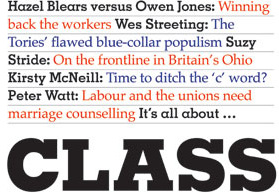
Britain may not have become a ‘classless society’ but most political parties have abandoned using broad social groups to develop campaign strategies, argues Hopi Sen
Last week, a friend of mine got the bus to his allotment. Another friend decided to visit a museum before going to the shops for some organic vegetables. Can you guess which class my friends belong to? It is possible that you can. According to a YouGov survey, getting the bus and having an allotment are clear signs that you are working class. Visiting museums and eating organic vegetables, on the other hand, are middle-class habits.
Of course, Britain’s class complexity extends well beyond vegetables and into politics. Almost 60 per cent of voters describe themselves as working class, according to a poll for Tory peer Michael Ashcroft. In total, 42 per cent of Tory voters and two-thirds of Labour voters said they were members of the working classes.
Surely, then, Britain is a broadly working-class country and Labour is a working-class party? Not quite. All the data suggests Britain has, in fact, become much more ‘classless’ in the last three decades. At the last general election, only 43 per cent of people were in the C2DE social group, the ‘bottom half’ of the social scale. That is down one-third since 1979. Meanwhile, the AB social group – professionals and managers – increased from 16 per cent of the population in 1978 to 27 per cent 30 years later.
This trend has been at work for decades. Fewer manual and unskilled jobs means a steady increase in the number of people in the AB and C1 social groups, which are defined by the occupation of the main earner in the household. This ‘shrinking of the C2DEs’ helps explain how, in 2010, Labour got more votes from ABC1s – the ‘top half’ of the social classification – than from C2DEs. That is the first time that has ever happened. Perhaps we are not a predominantly ‘working-class’ country or party after all?
Well, it depends what you mean by ‘working class’. Britain’s social structure is changing. In 1979 almost one-quarter of all jobs were in manufacturing. Now, it is less than 10 per cent. Today, there are almost five million more owner-occupiers than at the start of the 1980s. The proportion of families in social housing has nearly halved. Meanwhile, the private rented sector is growing rapidly. On top of that, the number of people in work with degrees has increased from one-quarter to one-third of the population in the last eight years alone. That trend will increase as younger people with degrees enter the labour market. All of that means that voters believe Britain is more classless than it used to be.
We can see this trend against ‘class’ in politics too, as the gap between the voting profiles of social groups has narrowed. This can manifest itself in surprising ways. As Ipsos MORI’s ‘How Britain votes’ data shows, between the 1997 and 2010 elections, the Conservatives gained 10 points among C2 and DE voters, bringing them back to the levels they enjoyed under Margaret Thatcher and John Major. However, they saw almost no gain at all among AB and C1 voters.
For Labour, the trend is even starker. In the 1980s, Labour’s support was sharply polarised, but by 2010, there was almost no difference between Labour’s support among AB, C1 and C2 voters. One way of thinking about the last election is this: C2 and DE voters treated Labour as if it was 1983, but the people’s party did better than in 1992 among ABs and C1s.
So is ‘class’ now irrelevant to politics? No. For one thing, huge electoral differences remain. Look at a rough measure of ‘likelihood’ to vote Labour – the Labour share of vote in each social group compared to our national vote share – and you see that Labour’s support among DE voters is consistently higher than any other social group. Until 2010, you saw a similar trend among C2 voters.
Nor are social groups the whole story. The way we judge each other’s class, and how we feel about our own, relies on much more than just our occupation. As Britain becomes less and less of a manual labour nation, does occupation really define class interest any more? Have we become less ‘working class’, or just more white collar?
In all likelihood, it is a little of both. Ask yourself what class you are, and your answer might depend on what school you went to or what house you grew up in. It might involve what sports you like, what newspaper you read, how you feel about your job. Perhaps, following George Bernard Shaw’s Pygmalion, your class depends on your accent. Almost half of us have told YouGov we can tell someone’s class by the way they speak.
But for social scientists and market researchers, it is impossible to categorise people by their accent, so pollsters have to use their occupation to define our social grade. These classifications are useful, but they can also confuse. When you hear someone say ‘Labour lost votes among C2DE voters after 1997’, do you mentally exclude people in Newcastle who work in a call centre? Do you instinctively put John Prescott and David Cameron in the same social group?
If Britain’s occupational and industrial profile is changing, then our feeling about class may be changing with it. Perhaps more people who identify as ‘working class’ are cropping up in ‘middle class’ social categories, and bringing their identities with them? At the same time, the shifting nature of work and education seems to be steadily breaking down the sharp ‘old’ class divides of occupation, yet replacing them with new ones.
Let’s take a look at voting by house tenure, for example. We know that the social rented sector has declined, and the number of owner-occupiers has increased over the last 30 years. As that has happened, so Labour’s support among owner-occupiers has become increasingly important according to the Ipsos MORI data. Disturbingly, the biggest decline in Labour support was among neither group. Instead, Labour’s vote fell fastest among private sector tenants. This group is now roughly the same size as the social rented sector, and is growing rapidly.
This complex picture is repeated when we look at another classically ‘class’ divide: newspaper readership. Readers of most papers have shown the same general trend in voting intention over the last 20 years. The two big exceptions? ‘Middle-class’ Guardian readers, who turned against Labour and towards the Liberal Democrats between 1997 and 2005, and ‘working-class’ Sun readers, who swang sharply Conservative in 2010. Compare this with the Mirror and the Times, respectively, and you see very different trends.
Perhaps in reflection to this sort of class complexity, most political parties have abandoned broad social groups for developing campaign strategies. Instead, they use lifestyle data to focus on much smaller groups of voters, each defined by complex correlations of income, social status, property and education. Describe each group and it feels as if you sketch a micro-class of British society, from bus-going allotment owners to museum-visiting organic veg lovers, but instead of crude stereotypes, these target groups are based on observed data. Each has an identifiable political tendency, and as these groups change in size and electoral importance, so do the coalitions that each political party must build.
So are we seeing a growth in mortgage-paying, state school-going, Guardian-reading city-dwellers? Or a surge in Sun-reading small traders in new towns? Either way, political parties will need to respond to these shifts.
However we structure our electoral coalitions, one fact remains. The old straightforward blue- and white-collar class divide may have been shattered, but what has arrived instead is not a simple, classless society. In Britain such a thing is probably impossible. Instead, we can see a host of parental, cultural, educational, income and housing influences, which create a shifting kaleidoscope of class. So perhaps it is time to put away our obsession with voting blocks, with ABs and DEs, and start trying to build with much smaller bricks.
—————————————————————————————
Hopi Sen is a contributing editor to Progress