
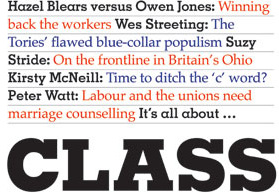
Confusing ‘working class’ with ‘trade unionist’ distracts us from the real ways we can attack class-based injustice, writes Kirsty McNeill
I once had a boss who used to spend his nights in the underpasses of London helping rough sleepers. After several years doing one of the most dangerous charity jobs in Britain, he got promoted to manage a housing service and I was thrilled to join both his team and the workplace union on the same day. It was not until my third or fourth shop meeting that I realised that the steward’s dark references to ‘management’ and ‘the bosses’ (always plural) meant this guy, the unsung hero of the streets whose lifetime earnings will likely be lower than every union official any average member of the public could name.
What class is he? And what class were his team, made up of assorted graduates, former local government officers and part-time students? Britain is still an intolerably stratified society, where kids from unskilled families are five times more likely to die in an accident than children with professional parents. That grotesque and lethal inequality should inspire the same fury about class that Tory MP Aidan Burley did about the Olympics or George Galloway did about rape, but class inequality is not best remedied by forcing people to identify with just three class groupings which are so wide they obscure much more than they reveal.
What class are the three million adults aged 20-34 who find buying or renting a flat so beyond their means they are still living at home with their parents? Or the 10,270 graduates that the Higher Education Statistics Authority reports as working as ‘labourers, couriers, office juniors, hospital porters, waiters, bar staff, cleaners, road sweepers and school dinner servers’? Theirs is a generation battered by double-dip recession, stagnating wages, spiraling housing costs and sustained uncertainty about the future, but are they the people Labour had in mind when Ed Miliband tasked Jon Trickett with recruiting the next generation of working-class MPs?
There has been a lot of chatter about the control of the political square by the political class but surprisingly little clarity about who counts as working class ‘enough’ to fill the spaces I assume these concerned politicos are offering to vacate. Do we mean people who did not go to university, regardless of their subsequent pay? Or people who work with their hands, even if their trade gives them a higher and steadier income than the desk-bound bank clerk who lives in constant fear for her job? Do we mean the women we have trained at the Labour Women’s Network, including from the railways, the NHS and the lower rungs of local government, even if they would be more likely to introduce themselves as ‘working mums’ than ‘working class’? Do we mean anybody who went to a comprehensive even if on becoming an MP they become a double-home owner and the beneficiary of a salary more than twice the national average?
Some of my colleagues in the union movement seem clear what Miliband meant – or ought to have. My own union, Unite, has produced a much-debated political strategy aimed at ‘winning working people for Labour, and Labour for working people’. Some of the more hysterical reactions about a union ‘takeover’ of the party somewhat miss the point that our affiliated unions are the Labour party and that without the union link we risk becoming the parliamentary wing of a London thinktank. But the more fruitful conversation is one within the union movement, about what we really mean when we say that we are committed to ‘ending the discrimination against potential MPs from working-class backgrounds … by identifying potential parliamentary candidates from within the trade union movement’.
The conflation here of ‘working class’ and ‘the trade union movement’ implies that all working-class people (worth having) are trade unionists, and all trade unionists (worth having) are working class. The first half of that formulation will cost the Labour party: of 23 million people working in the private sector, only 2.5 million are union members (out of a total of 6.4 million members across the country), meaning this formulation is writing off thousands of potential Labour candidates currently serving at your chemist, answering the calls at your insurance company, or pulling pints in your local pub. The second half will cost the labour movement: Britain’s voluntary sector employs over a million people and many will be professionals we could otherwise recruit but who find talk of ‘fighting back’ bizarre when their manager is not an exploitative fatcat but an activist devoted to the very social justice trade unions were created to deliver.
The labour movement, like the Labour party, is only going to grow by focusing less on what we label people and more on what we do for them. Most voters, whether ‘working class’, ‘squeezed middle’ or ‘hard-working families’, care more about who best secures their interests than who best defines their status. That does not mean a retreat from class politics, it means recognising that its modern manifestation is less about totting up the number of Labour MPs from Oxbridge and more about winning the necessary battles on redistribution and regulation to ensure you are as likely to get care in the surgery, dignity in the workplace, learning in the classroom and safety on the street in Coatbridge as Knightsbridge.
That 173 people were killed last year just doing their jobs should be as central to Labour’s story as our love of sure start and pride in civil partnerships, and we, as a union movement, face an enormous opportunity to put jobs and justice at the centre of Labour politics once again. The chance is before us, but we will only seize it by acknowledging that, however comforting we find it to use the ‘c’ word, not all of the people we are fighting for will be prepared to say it back.
—————————————————————————————
Kirsty McNeill is the founder of Themba Consulting and was previously head of external affairs at 10 Downing Street
We canot get away from class politics nor should we the ruling class will never stop their war on the working class. Look who’s paying for the bankers speculation. Not them no it’s us the working class. If you depend on wages to make ends meet your probabaly working class.
they are not “the ruling class” though are they – this is a democracy ! Once Labour is back in
Government ,which is looking more and more likely – greater legislation must be passed to stop profit skimming ,tax evasion and all the other abuses perpetrated by the rich to curtail their powers to LOOK like the ruling class ?