
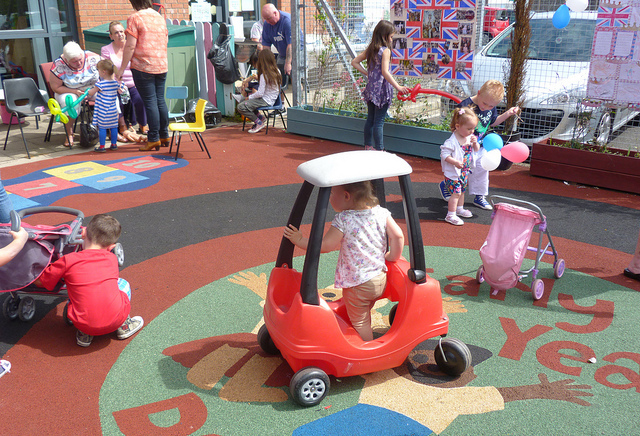
In the last few months it has become clear that childcare is going up the political and policy agenda. Both the coalition government and the Labour party have launched commissions to gather evidence and consider the options for their future offer and several influential thinktanks including IPPR and the Resolution Foundation are dedicating considerable brain power to answering some of the big questions about where we go from here.
And they are big questions. That childcare is a struggle for many families to afford; still not in plentiful enough supply in some areas; and not able to meet the needs of a changing labour market; is a matter of considerable consensus. What to do about it is not.
The Purple Papers chapter on the ‘Care Crunch’ is a further very useful contribution to this debate. It makes the case powerfully for an extension of the free childcare entitlement currently enjoyed by three- and four-year-olds and some two-year-olds, to 25 hours a week for all children aged one to five. The paper estimates that this would require an additional £7bn per year of investment. An ambitious proposal.
As one of the leading advocates for more investment in childcare over the last 30 years 4Children strongly supports the scale and ambition of this vision. The evidence is clear that high quality childcare is good for children’s outcomes – particularly for the most disadvantaged children. Indeed, since Labour introduced free childcare for three and four year olds the attainment gap between disadvantaged five-year-olds and their more affluent counterparts has narrowed from 37 per cent in 2007 to 31 per cent in 2011. Affordable and available childcare also allows more parents, particularly women, to continue to work – raising family incomes.
Winning the argument for such a significant increase in resources for childcare will clearly be a challenge – particularly in these constrained financial times – but these are arguments 4Children believes we can win over the long term. But in order to do so we will need to be really clear about how extra resources would be used to achieve the best outcomes for children and families.
So, this would mean a childcare offer that does four key things.
First, an expanded free entitlement would need to be delivered in such a way that it more effectively supported parental employment. This means, flexibility for parents about how and when they use the hours and a real choice of local providers.
Second, such considerable public investment must be used as a more effective lever to drive innovation, quality improvement and diversity particularly in poorer areas. We need to consider whether public money could be used to share the risk with providers of setting up new provision in deprived communities and to provide childcare outside the traditional 8am to 6pm hours.
Third, taxpayers, parents and providers would rightly demand clarity about how such significant resources were being used. Currently there is real variation between local authorities on the amount of their education funding they spend on preschool learning – from 3.5 per cent to nearly 10 per cent. This raises concerns for many about whether enough of the money is getting to the frontline in some areas. So there would need to be new levels of transparency and accountability about how the money allocated is spent on the ground. And potential for better value for money sought from a rationalisation of the various funding streams.
Finally, we need to ensure that those who benefit most would be able access an expanded offer. Currently take up of free childcare is significantly lower for disadvantaged families – with 13 per cent of poorer parents not taking up any of their free hours. To justify a seismic shift in resources of the kind the Purple Papers advocate there would need to be a new outcomes framework by which success would be judged, which would move away from counting childcare places and instead measure the outcomes that were being achieved for children and families.
It is increasingly clear that no political party will be able to go into the next election without putting their childcare offer at the centre of their manifesto. This means that we have a window of opportunity to influence and shape what that looks like and to press for the most ambitious plan possible. 4Children will be playing our part and we hope that readers of the Purple Papers will too.
—————————————————————————————
Claire McCarthy is director of public affairs at 4Children
—————————————————————————————
In philosophycal terms the argument is already won on the issue!
But in practical terms, how many children in one family will be entitled to free care? Those parent who have two children and pay taxes by working hard and also looking after their children – should they be paying (through their tax) for those who may chose to have five children and will not be able to go to work (no chance for paying tax) will be funded under this proposed philosophy. How can we create some fairness in favour of those who work hard and act responsibly?
This debate is part of the discussion. When we go on knocking the doors to beg votes for Labour we can not avoid these questions. The care system need to be fair for all and only then we can sell this policy on the door step. We need to be practical socialists and supportive of working class where work is appriciated. Otherwise we are handing the power to Tories on plate for the next election.