
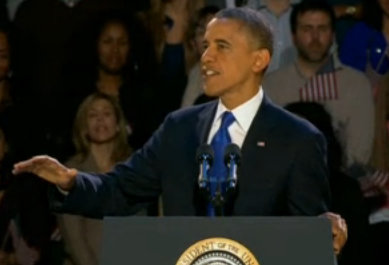
However narrow the popular vote margin, Barack Obama’s re-election yesterday was a remarkable feat. He joins Bill Clinton as only the second Democrat president since Franklin Roosevelt to win a second term. And he won that second term against an economic backdrop more akin to that which faced Roosevelt than Clinton.
In the electoral college, Obama appears on course to lose only two states – Indiana and North Carolina – that he carried four years ago, and to have swept (albeit by reduced margins) the critical battleground states that decide the outcome of presidential elections. His coalition may be somewhat narrower than it was in 2008, but the president has confounded those who believed it was a one-off which had come into being simply as a result of enthusiasm at the prospect of electing the nation’s first African-American chief executive and the weaknesses of the Republican party after George W Bush’s failed presidency.
Indeed, by the usual metrics which govern incumbent presidents’ re-election bids – the rates of unemployment and economic growth – one might have expected Obama to have joined the hardly illustrious one-term presidents’ club of Gerald Ford, Jimmy Carter, and George HW Bush.
But that would fail to take account of the context in which Obama has attempted to govern and the real achievements of his first term. The legacy bequeathed him by Bush – an economy tottering on the precipice, two seemingly intractable conflicts in the wider Middle East, and the obstructionism of his Republican opponents in Congress – ensured that, despite the public goodwill which greeted his election four years ago, Obama was dealt possibly the most difficult hand facing any incoming president since 1932. Nonetheless, the president finished his first term with employment rising, slow but steady growth and some really legislative achievements to his name, most notably the introduction of universal healthcare and the reregulation of Wall Street’s ‘casino capitalism’.
The fact that American remains a deeply divided nation, reflected in both the two-point margin of Obama’s popular vote win and the prospect of continuing gridlock between Obama and a divided Congress means that we should, however, temper the kind of heady talk of ‘progressive moments’ which accompanied the president’s victory in 2008. Indeed, broadly speaking, Obama’s two victories remain the exception to a rule which has seen centre-right parties reap greater electoral rewards from the legacy of the financial crisis than their centre-left opponents.
For both Labour and the Conservatives there are, of course, lessons that can be learned from the results. David Cameron will comfort himself that, even when presiding over a sluggish economy, Obama bucked the trend which has seen most incumbent governments – whatever their political hue – lose their bids for re-election in these difficult economic times. Moreover, the prime minister can soothe nervous Tory backbenchers with the message that, just as the president could recover from ‘midterm’ blues, so can they. The Conservatives’ current unpopularity, in fact, comes nowhere near matching that which two years ago led the Democrats to the worst midterm election defeat for any party since 1938.
Ed Miliband, on the other hand, can point to the re-election of a centre-left soulmate whose approach to economic policy – the emphasis on spending and growth over the cutting and austerity – more closely mirrors his own. And while the prime minister may see a silver lining in the fact that voters appear to have accepted Obama’s belief that it will take ‘more than a few years’ to escape the country’s economic plight, the president’s emphasis on the long-term stagnation of wages and living standards facing America’s ‘squeezed middle’ is much more familiar terrain for the Labour leader. Exit polls indicate that while 43 per cent of American voters believed Obama’s policies would favour the middle class, only one-third thought the same of Romney and more than half thought the Republican candidate’s would favour the rich.
There are, however, some other lessons which should give both Cameron and Miliband pause for thought. The first concerns the limits of negative campaigning. The prime minister will no doubt note with interest that, faced with a difficult economic record to defend, the Democrats went early and heavy in their attempts to paint a decidedly unflattering portrait of Mitt Romney’s record and character. While the final result may appear to justify the electoral utility of such a strategy, it is not without dangers. Tim Montgomerie, editor of ConservativeHome, has, for instance, warned of ‘the danger of demonising your opponent and that opponent then confounding the caricature in the election debates’.
At the same time, Romney’s attempt to make the election simply a referendum on Obama’s economic performance – rather than a choice between two competing alternatives – should be a warning for Labour. ‘One more heave’ and assuming that any concrete commitments are simply a hostage to fortune and that relentless attacks on the Tories are plausible routes back to power, have been dealt a fatal blow by the Republican’s defeat. As the shadow foreign secretary, Douglas Alexander, warned in Progress last month: ‘Labour wins when we offer a politics of building and not just blaming … Even in the face of a government is disarray, victory can never be presumed, but it can be earned.’
The second concerns the importance of the centre-ground. While Romney managed to narrow the race in its final month by donning the mantle of ‘Moderate Mitt’, his pandering to the Republicans’ conservative base and Tea party contingent during the primary season was not easily forgotten and ultimately cost him dear. Obama won lop-sided majorities among women, young, Hispanic and African-American voters, who massively rejected a candidate whose party has strayed too far from the American mainstream. The Republicans’ chance to capture the Senate from the Democrats was lost thanks to the party’s nomination of hard-right candidates in a number of seats they should have won.
The Republicans’ failure to recapture the White House in a year when it was supposedly theirs for the taking should thus be particularly instructive for those Tories who believe that their best chance of securing the parliamentary majority which has eluded them since 1992 rests with a return to more ‘traditional’ Conservative policies and concerns. The reverse is, in fact, true: it is – as the likes of Michael Ashcroft recognise – the party’s failure to modernise and reach out beyond their core supporters to new voters which is at the root of the Tories’ ongoing dilemma. And while the analogies are not perfect, Conservatives who advocate a return to the ‘blue-collar populism’ of the Thatcher years are likely to be as disappointed as those Republicans who believed that Romney could eschew newly emerging demographic groups and simply court white working-class ‘Reagan Democrats’ in Midwestern states such as Pennsylvania, Michigan and Ohio. As the Republican senator, Lindsey Graham, bluntly commented as the polls were closing: ‘If we lose this election there is only one explanation: demographics. If I hear anybody say it was because Romney wasn’t conservative enough, I’m going to go nuts. We’re not losing 95 per cent of African Americans and two-third of Hispanics because we’re not being hard-ass enough.’
The centre-ground lesson should be cautionary for Labour, too. Obama’s successful mobilisation of the core Democrat constituencies – urban liberals, the young, and minorities – ultimately prevailed only because the president was also able to keep on board enough of the suburbanites who Clinton detached from their Republican moorings in the 1990s. Tellingly, the president won 57 per cent to 41 per cent among self-described moderates.
Clinton’s prominent role in the campaign – and the messages he chose to deliver on Obama’s behalf – was also an interesting one. While the relatively strong performance of the US economy in contrast to Britain’s vindicates the president’s emphasis on policies which will stimulate growth, the perception that he was less concerned with a long-term plan to reduce the deficit (failing to embrace, for instance, the report of the bipartisan Simpson-Bowles commission which he had himself established) proved politically difficult. So too was the perception – rooted more in the president’s language at times than his policies – that he was unsympathetic to the concerns of business.
Like Obama wishes to, Clinton raised taxes on the very rich to cut the deficit in the 1990s. But the former president’s reputation for fiscal responsibility, his credibility with the business community and his continuing appeal to white working-class voters proved a valuable shield against Republican attacks which Obama had, perhaps, done too little to insulate himself from. Critically, Clinton was able to use his reputation and credibility to expose the ‘voodoo economics’ which underlay Romney’s pledge to cut taxes and increase defence spending all while apparently balancing the budget.
While the British and American political cycles are only imperfectly aligned, Britain’s postwar consensus found an echo in the moderate Republicanism of Dwight Eisenhower in the 1950s; the New Right’s rise in the late 1970s was mirrored on both sides of the Atlantic and presaged the election victories of Ronald Reagan and Margaret Thatcher in the 1980s; and the New Democrat politics of Clinton helped shape the rise of New Labour in the 1990s. The Conservatives have reason to be relieved that Obama has won. But it is to Labour’s values and politics that the president is far closer. If it takes the right lessons from his victory, the party will be a step closer to putting those cycles back in sync.
—————————————————————————————
Robert Philpot is director of Progress
And yet Socialist Alternative got 27% of the vote in Washington, as I understand it………there is a chronic lack of a democracy in the 2 party system (USA & UK)