
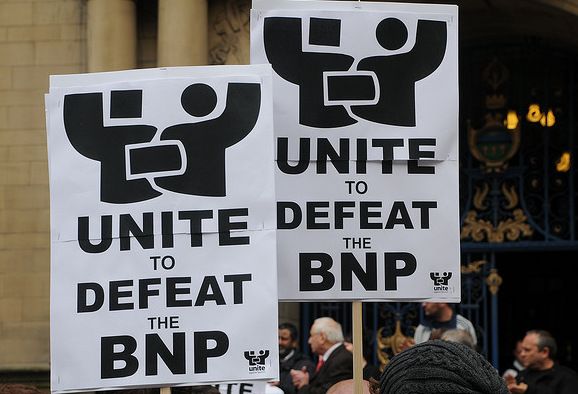
The far-right has splintered but do not ignore the potential for a resurgence, warns Rob Ford
Across Europe, conditions for the far-right appear better than ever. An ongoing financial crisis, lingering public concern over immigration, low levels of public trust in political institutions, and fraying bonds between citizens and the main parties have all – in their own ways – carved a favourable landscape for populist extremists. In Britain, these wider trends have also been joined by more specific opportunities for the far-right: the eruption of a parliamentary expenses scandal in 2009; the apparent dismissal, as embodied by Gordon Brown’s encounter with Gillian Duffy, of public anxiety over immigration by the incumbent government at the 2010 general election; and the emergence of local tensions – especially in northern England – over issues such as the alleged ‘grooming’ or sexual exploitation of young, white girls.
A quick look at recent survey data shows the clear potential for a successful far-right insurgency in Britain. Levels of public concern over immigration may have fallen recently but they remain higher than in many countries that have much more successful far-right movements. For example, the most recent Eurobarometer survey, which gauges public opinion across the 27 European Union member states, revealed that only Britons ranked immigration as one of the top three issues facing their country. Another recent nationally representative survey by the Extremis Project also pointed to significant sympathy for ideas close to the far-right agenda: 66 per cent would be more likely to vote for a party that stood up to political and business elites; 55 per cent would be more likely to vote for a party that prioritised British values over other cultures; 41 per cent would be more likely to vote for a party that promised to stop all immigration into the country; and 37 per cent would be more likely to back a party that promised to reduce the number of Muslims in British society. To be blunt: the potential is there.
Yet the story of the British far-right remains one of a movement that has consistently failed to realise its electoral potential. While the British National party became the most successful far-right party in Britain’s electoral history it ultimately proved unable to translate disparate gains in local and European elections into a truly significant advance. The party never took control of a single local council and rarely managed to re-elect councillors who proved to be incompetent at handling the bread and butter issues of local government. This inability to take full advantage of the wider context became strikingly clear at the 2012 local elections. The result was disastrous for the BNP: Nick Griffin’s party won less than 26,000 votes, down nearly 90 per cent from its 2008 peak. Nor was this due to poor candidate placement: the party targeted areas that were once considered relative ‘strongholds’. Yet this focus on areas of prior strength such as Amber Valley, Barnsley, Burnley, Epping Forest, Pendle, Rotherham, Salford and Thurrock produced only disappointment: only 26 BNP candidates surpassed 10 per cent of the vote, and only six surpassed 20 per cent. The downward trend was also evident at the London mayoral election, where the number of first preference votes going to the BNP was lower than at any of its previous forays. The BNP was pushed into seventh place and failed even to match its performance in 2000, a time when the party leadership was ambivalent about actually contesting elections.
But, importantly, it was against the backdrop of the BNP’s electoral collapse that two key developments began to take shape. The first was the emergence of the English Defence League in 2009, which eschewed electioneering in favour of rallying a base of supporters around a far more confrontational ‘march-and-grow’ strategy. The EDL initially sought to distance itself from the toxicity of the BNP by claiming links to Jewish and Sikh communities, and stressing that it was really only concerned with the threat from violent, radical Islamists. This narrative, however, quickly unravelled, as the EDL soon became a stable for a diverse coalition of football hooligans, disgruntled far-right extremists and disaffected youth. Furthermore, research soon revealed that it was immigration – more so than Islam – that was the guiding concern for its footsoldiers, while a survey by the Extremis Project also revealed how the EDL had failed to develop a national profile: 42 per cent of the national sample had heard of the EDL but were unsure what it stood for, while a further 25 per cent had never heard of the group. The picture is one of a movement that has struggled to communicate its message, and which, like the BNP, is seen as a pariah player in British politics: 85 per cent of those who are aware of the EDL and what it stands for said they would never consider joining, while 75 per cent view the EDL as a racist organisation.
The second key development has been the broader fragmentation of the far-right. As the BNP withdrew from elections and returned to its traditional focus on provocative rallies and demonstrations, it met a growing number of new far-right formations which include but are not limited to: British Freedom, Britain First, England First, the Britannica party, Democratic Nationalists, the Infidels, the Scottish and Welsh Defence Leagues, a revived Combat 18 and, most recently, the True Brits, headed by defecting BNP European parliament member Andrew Brons. This process of fragmentation was evident at the 2012 elections, which, beyond the BNP, were contested by a total of 149 candidates from other far-right groups. Most lack resources but many also share a belief that the ballot strategy has failed to deliver.
So, where is the British far-right heading? Overall, the movement will be more unpredictable, chaotic and diverse than during the heyday of the BNP. In many respects it was easier to track the movement and the threat it presents when there was one, dominant organisation that was at least participating in the conventional political process. But beyond this, and over the next few years, we will likely see one of two scenarios play out.
The first is of Griffin and the BNP reviving their electoral fortunes. This is not as unlikely as it appeared earlier this year. The EDL continues to splinter: most of its senior leadership were recently arrested, other far-right rivals lack public recognition, economic conditions remain stagnant, and persistently high immigration remains a concern for many voters. To underscore the importance of the last point, at the 2010 general election the BNP polled most strongly in areas that saw the largest increases in unemployment since 2005. Add to this Griffin’s stubborn persistence, which is anchored in four decades of involvement with the far-right, and the fact that the BNP is now solvent and could still revive its fortunes in by-elections and, importantly, the 2014 European parliamentary elections, which are often used by British voters as an opportunity to voice discontent with the political establishment. It may therefore be too soon to write off the BNP – the overall political environment remains favourable, and it has a number of opportunities to begin reversing its electoral fortunes.
The other and more worrying scenario is that, collectively, the far-right simply gives up on elections and invests more seriously in fomenting community tensions through combative activities, and by targeting highly emotional issues like child exploitation. If this occurs and escalates then we may find ourselves having to revise our approach to the far-right, which has long interpreted its ‘threat’ simply by its number of votes. It is possible that the far-right will cause more problems for British democracy if there is not a viable and visible far-right party competing in the electoral process, as citizens who would otherwise have an outlet for their grievances at the ballot box are suddenly left on the outside, with no obvious home and looking towards direct action to express their beliefs. Either way, what appears strikingly clear is that the far-right in Britain is very much engaged in a process of evolution, and has not yet decided on its final destination.
—————————————————————————————
Rob Ford is a lecturer in politics at the University of Manchester and is co-author with Matthew Goodwin of the forthcoming publication Voting for Extremists
—————————————————————————————
Two things here
Progress – on a number of occasions – has expressed ‘concern’ about immigration, but, try as I might, I can’t find *anything* policy or strategywise on their website. Could someone let me know what Progress’s thoughts – if any – are on addressing this issue?
Secondly, a great deal of the former BNP vote has gone to UKIP, judging by electoral results. Because UKIP are not active in the capital in any meaningful sense, they tend to be ignored, but I can tell you from East Anglia that they beat the Fib Dems in Stevenage in almost all wards at the last elections, and they run a Town Council in rural Cambridgeshire – Ramsey Town Council. Their support derives from base level anti-EU feeling, fueled almost solely by an antipathy to immigration. I’ve barely met a single UKIP voter who could name a single policy outside of pulling out of the EU and stopping immigration (actually, they are an appallingly retro party, backing corporal punishment and a return to selection in education, together with some very rightwing economic theory).
I’m just an enthusiastic member of the public so please explain if a ‘rightwing economic theory’ is one; that aims to protect its national interest and doesnt write cheques with other peoples money? And, which of any UK political party welcomes people that want to see self-governance, controls at borders, an end to middle-england being taxed disproportionately while being stuffed by unchecked welfare demands? Shouldn’t an academic like Mr Ford be more cognisant with politics than suggesting racism only exists in UKIP supporters? Does he have a cultural hang-up somewhere?
Reading the UKIP manifesto reads like something from the right wing of the Conservative Party – the usual lazy cliches around ‘magic money trees’, and indeed ‘writing cheques with other peoples money’. Apparently that’s alright when the money is being spent on the ‘right’ things. The rest of the post above is an unfettered cliche ridden, sub-Daily Mail, UKIP diatribe not worthy of any serious analysis – I think UKIP would find the same challenges exist in the securing of the UK’s borders, and the same results that would emanate from political and economic isolationism they so loudly espouse. Racism exists everywhere – but there are proportionately more racists and bigots on the moderate to far right.
What if right-centrists like myself feel terribly let down by lefties – already failing at collecting enough tax while working in HMRC – for willingly opening borders to all-comers but dont actually earn enough to proportionately pay enough tax to fund their own welfare demands – let those foreign nationals invited here with open arms by David Miliband + Gordon Brown. Two positively disgraceful politicians that also supported an illegal war that had no exist strategy. Boy, the left have screwed us over.
Have you any proof that your allegations that migrants from the A10 states actually don’t support themselves in terms of welfare or are you relying on 2nd or 3rd hand data from dubious sources – the Daily Mail, or another political party for your viewpoint ?
The over-representative numbers of minority groups in prison and the truly monstrous requirement for 10,000 translators providing 163 languages to courts isn’t the best indicator that Immigrants are an elite net-positive contributor to the UK.
The proportion of youths in custody from minority ethnic communities rose from 39% to 42% – meaning they are more than 4-5 times over-represented in prison – a disproportionate occupation at Her Majesty’s Pleasure.
It’s an absolute disaster allowing this macho, aggressive culture unable to back down from anything challenging their ‘human rights’ and end up knifing / getting knifed / shot etc.
If anyone else over-represented their presence to this extent there’d be a public enquiry.
“Secondly, a great deal of the former BNP vote has gone to UKIP” – That’s one way to read it. But you might just as validly say that they’re returned to the Labour fold. Many white working class voter in traditional Labour areas turned to the BNP when Labour where in government, just as many Tory voters are turning to UKIP now that the Tories are in government.