
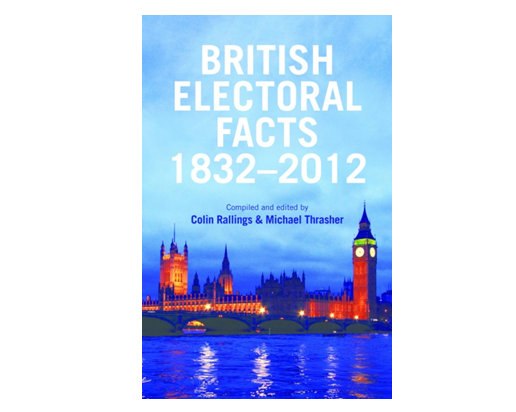
Is there a friend or loved one in your life who is irretrievably addicted to elections? Who can match constituencies and MPs off the top of their head? Who has memorised factoids from by-elections gone by? Who reminds the uninitiated of a strange Peter Snow-Rainman hybrid? If so, breathe out. Relax. For their next birthday, you can buy them British Electoral Facts 1832-2012 by Colin Rallings and Michael Thrasher.
Before Wikipedia, such reference works were necessary to convey present historical information, which this book does – the national results of every general election since Grey’s Reform Act are set out in the first section. However, what makes this work stand out is the sheer quantity and diversity of data: elections are sliced, diced and neatly presented, a dizzying multitude of nerdish delights. Finding the national vote share of the Labour party in the 1923 general election (29.7 per cent) is something the psephological ingénue can Google in an instant. But for the answers sought by the true electoral aficionado – the percentage of the combined main two- or three-party vote, the average number of votes per seat won, the number of lost deposits, the total number of spoiled ballots (broken down by reason, naturally), or even the weather on election day – only a book like this will do.
Even as a hardened devotee of election-related trivia, I found new information to pique my interest. I did not know, for example, that in 1918 19- and 20-year-old men were given the vote if they were serving in the armed forces (the voting age was 21 for men in the general population). Nor did I know that in 1978 a by-election in Hamilton was held on a Wednesday (rather than the more typical Thursday) so as not to clash with an England World Cup fixture, or that the most recent general election in which there were uncontested seats was 1951. I am particularly indebted to the authors for enlightening me as to the reason for the disqualification of the successful Liberal candidate J Holdsworth in Wakefield in 1841, who was barred from being declared duly elected because he was the returning officer.
If – like me – you cannot live without such a rich source of psephological fun in your life, hurry out and buy this book without delay. If – like my girlfriend – you live with such a person, it may be wise to practise your feigned interest face.
———————————————————
David Green is a management consultant and former Labour party organiser
———————————————————
British Electoral Facts 1832-2012
Colin Rallings and Michael Thrasher
Biteback Publishing | 310pp | £35