
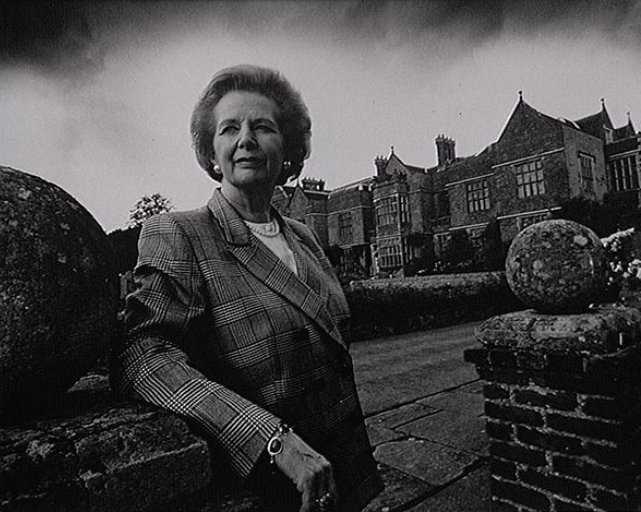
In death as in life, it seems, Margaret Thatcher divides the country which she led for longer than any of her 20th century predecessors. Anyone who lived through her time in office understands why: mass unemployment, the miners’ strike, inner-city riots, section 28. This was not, as her successor recognised on the day he became prime minister ‘a country at ease with itself’.
None of which excuses the tasteless and disrespectful way in which some people have chosen to celebrate the passing of the former prime minister. Nor should it blind us to the fact that the Britain to which she promised to bring ‘harmony’ in 1979 was itself not without discord. The 1970s may, as the historian Dominic Sandbrook has rightly noted, have had a somewhat unfair press (in their different ways, the rise in the number of working women, package holidays and home-ownership reflected the realisation of the new freedoms and affluence that the 1960s had promised), but it should be remembered that the ‘winter of discontent’ which brought the Tories to power was simply the final episode in a wave of industrial unrest which had pockmarked the decade, and brought down another government just four years previously.
In the debate about Thatcher’s legacy there is, at times, an underlying suggestion that hers was a project imposed on an unwilling country. This is, of course, nonsense: large numbers of people voted, protested and marched against Thatcher’s policies, but an even greater number voted to return her party to power on three successive occasions.
And this, in turn, leads us into rather more uncomfortable territory: Labour’s own responsibility for the Conservatives’ 18 years in power. As has been said often over the past few days, Thatcher was lucky in her opponents: whether it was the Argentinian junta that fatally miscalculated Britain’s resolve and ability to take back the Falkland Islands or Arthur Scargill’s pig-headed refusal to call a national ballot before the miners went on strike in 1984, thus splintering and weakening the strike and leaving a legacy of bitterness and division in many former mining communities.
But Thatcher’s greatest luck was to be found in her opponents across the chamber of the House of Commons. It used to be said of the US Democratic party that when it assembled a firing squad, it formed a circle. No better description can be found for Labour’s conduct after its defeat in 1979. This was not a robust exchange of views between left and right, parliamentary party and grassroots about why the voters had rejected it; it was vicious, internecine warfare. In 1979, the party’s MPs found themselves penned into seats in the corner of the conference floor as if at a show trial as delegates denounced the Labour government that had been defeated four months previously and jeered and pointed at those who represented the party in parliament. In her memoirs, the then former Labour cabinet minister Shirley Williams recalls being spat at by delegates as she prepared to address a rally of the Campaign for a Labour Victory (the centre-right pressure group founded to support Hugh Gaitskell’s leadership) at the Labour party conference in 1980. And at a local level, hard-left entryists intimidated and drove out long-standing party members.
In the face of tactics, much of Labour’s high command simply covered their eyes: the National Executive Committee even refused to allow a damning report by the party’s national agent, Reg Underhill, into the threat posed by Militant Tendency (the Trotskyite group which was attempting to capture Labour from within) to be published.
It is within this context that the disastrous decision of Labour MPs to opt for Michael Foot rather than Denis Healey as party leader in 1980 should be seen. Foot was a brilliant and learned man, beloved by much of the party, but he was utterly ill-suited to the role to which he had been elected. As Healey, who served loyally as his deputy, later wrote, Foot ‘simply did not look like a potential prime minister; he had failed to command public respect as leader of the opposition’. But for many MPs, Foot, unlike the more rumbustious and confrontational Healey, offered the prospect of pouring a soothing balm over the party’s wounds. In reality, he could not even paper over the cracks: three months after his election 14 Labour MPs, later joined by another 14 of their colleagues, defected to form the new Social Democratic party. On the eve of the 1983 election, with polls showing that 49 per cent of the electorate would be more likely to vote Labour were Healey to become leader, Foot considered and rejected pleas by a number of his colleagues to step aside.
On top of division and weak leadership, Labour offered a manifesto in 1983 which was famously dubbed ‘the longest suicide note in history’ by Gerald Kaufman: unilateral nuclear disarmament, further nationalisation, and a pledge for ‘immediate and unconditional withdrawal’ from the European Economic Community – Britain’s membership of which 67 per cent of the country had endorsed just eight years previously in the referendum called by Harold Wilson.
But, in many ways, Thatcher’s victories in the 1980s were sown in the challenges Labour refused to confront and the aspirations it failed to meet in the previous decade. Two in particular stand out. First, the sale of council houses from which the Conservatives were able to reap rich electoral dividends in the 1980s. Despite Labour’s opposition to the sell-off (which cost it dearly politically), this had been a policy which the party had itself advocated in its 1959 manifesto when it pledged that ‘every tenant … will have a chance first to buy from the council the house he lives in’. The policy was considered again in the 1970s and the reasons for its rejection do Labour little credit. As Bernard Donoughue, head of the No 10 policy unit under Wilson and Jim Callaghan in the 1970s, describes in his memoirs, the former was excited by the plans presented to him in late 1975. Wilson’s press secretary, Joe Haines, had contributed greatly to them, and advocated a ‘life-leasehold’ scheme which would not have caused a serious long-term depletion in the overall social housing stock. Donoughue, moreover, advocated that the plans should be permissive: local councils would not be forced to sell council houses, although they would, of course, ‘be naturally influenced by demand expressed through the local ballot box’.
But while Wilson correctly suggested that his policy unit’s plans could prove ‘an historic document’, the proposals were resisted by the environment secretary, Tony Crosland, on the basis that they would alienate party activists in the run-up to the local elections the following May. ‘My point,’ Donoughue wrote later, ‘was that while it would certainly alienate a few local activists, it would also attract many times that number of local voters – and it was anyway right to do it in principle’. After Wilson’s retirement, Crosland’s successor, Peter Shore, continued to oppose and, in the end, succeeded in effectively blocking the proposals. ‘The leftwing reactionaries in the party had won,’ suggested Donoughue, although, years later, Shore would admit that he ‘totally misjudged the policy of selling council houses. It had a dramatic effect’. Crucially, however, Donoughue, saw the issue of council house sales reflected a much wider problem: ‘our Labour government was trapped in the outdated prejudices and undemocratic structures of its own party organisation. Because of this, we failed to appreciate and respond to the changing priorities and aspirations of our own supporters.’
Second, and just as disastrously for Labour’s prospects, was the party’s decision to abandon Barbara Castle’s In Place of Strife trade union reforms in 1969, which would have introduced strike ballots and barred secondary picketing. Faced with the implacable opposition of the trade unions and Callaghan, their most senior ally in the cabinet; losing support among traditionally loyal and moderate members of the parliamentary Labour party; and, in the end, abandoned even by those like Roy Jenkins who had originally supported the bill, Wilson was left with only the figleaf of the unions’ ‘solemn and binding’ pledge that they would work to restrain unofficial industrial action to cover his humiliating climbdown.
But as his biographer Philip Zeigler wrote, ‘If the reform of the unions was not undertaken by a friendly Labour government, Wilson always maintained, then it would fall to the hostile Tories. The defeat of Harold Wilson made inevitable the eventual triumph of Margaret Thatcher.’ A decade later, on the eve of the winter of discontent in September 1978, MORI found that 80 per cent of the public – and 73 of their own members – agreed that ‘trade unions have too much power in Britain today’, and 63 per cent of voters (including 60 per cent of trade unionists) agreed that ‘the Labour party should not be so closely linked to the trade unions’.
Unsurprisingly, in the general election the following spring, Labour won only half the trade unionists’ vote, while the Tories won one-third. Labour’s vote fell furthest among skilled and unskilled workers. And these results were not, as some on the left maintained at the time, simply a reflection of anger at the Callaghan government’s policies. In 1987, the Conservatives won a third term with the support of 30 per cent of trade union members and 36 per cent of the working-class vote (compared to Labour’s 48 per cent) – the Tories’ largest postwar share. The Tories led Labour among working-class homeowners by 12 per cent. Labour had, once again, found itself out of touch with its own natural supporters.
It is an axiom of politics that oppositions don’t win elections, governments lose them. It is not detract at all from Margaret Thatcher’s considerable political skills and popular appeal to suggest that, during her time in power, that axiom was, in part, reversed.
—————————————————————————————
Robert Philpot is director of Progress
—————————————————————————————
Which faction of the Labour Party wants to break with the trade unions ? Ah, that’ll be Progress…
apart form Luke akehurst who doesn’t and even so, the trade unions their the ones who were repsonsible for Labour losing elections weren’t they?
Yes John, Yes they were. Just like in 1979. Why not include the Trots as well ?
Ok after the winter of discontent, it s trots as well
I’m not sure how or why you’ve interpreted ‘We believe Labour should seek to strengthen the link with the unions. Mending it, not ending it, should be our goal’ (Progress Editorial, March 2013) as a desire to break with the trade unions.
This article seems to want to say that Labour caused Thatcherism because of disunity and mistakes, then tell me in a modern context what this article adds to the solidarity of the socialist movement?
Weeeell, it doesn’t, it just underscores Progress’s viewpoint that only a realignment of Labour to a tough on immigration, non-trade union linked, neo-liberal economiced, grammar school supporting line will win elections. Oh, and purgeing the left out of the the party
I think you might want to read Progress’ editorials in March on the union link and April on immigration. They directly contradict the views you ascribe to us. I’d also be interested to see your evidence that we support grammar schools; we categorically do not. And it wasn’t Progress who called for anyone to be purged from the party, although, if I remember correctly, a union general secretary last year did suggest we should be ‘effectively outlawed’.
Yes – the RIGHT of Labour was responsible for Thatcherism. Callaghan cause the breakdown of “In place of Strife.” He went to the IMF with Healey, unnecessarily, which forced neoliberalism on us before Thatcher. Keynes had taught us that we could simply create our own money or run a deficit to cover difficult times. Utter incompetence.
The RIGHT then unleashed a row with the Unions and the left. The RIGHT then split the party vote with the formation of the SDP. 1983 was a split left vote – the Tory vote went down. The RIGHT caused this.
Then in 1997, when Labour could have cured all ills, The RIGHT in the name of Blair and Brown continued Thatcherism to the hilt. Light touch regulation, PFI, selling 480,000 council homes, a privatising health, keeping taxes for the rich low, trebling the gap between rich and poor.
DON’T YOU DARE BLAME THE LEFT. IT IS THE RIGHT WHO ALLOWED, AND INDULGED IN THATCHERISM.
Your contention that Labour ‘privatised health’ when we were in power is simply untrue. By the time Labour left office, waiting times were at record lows and public satisfaction with the NHS at record levels. It really does nothing to further debate about Labour’s record (good and bad) to bandy about such emotive terms and, I’m afraid, suggesting – as you appear to do – that Labour simply continued Thatcherism and nothing good came of its time in office has unfortunate echoes of those who greeted Labour’s return to opposition in 1979 in a similar manner with disastrous consequences for the party and, ultimately, the country.
OK, accept this, I was refering to PFI on services and buildings. I stand by everything else I said.
2nd reply. Unfortunate echos means nothing to me. I am passionately Labour. My objective is to see Labour being real Labour, for the sake of the people and the country.
Did you know that Paul Craig Roberts, who was an architect of free market fundamentalism in Reagans administration, has just written a book which shows his change of heart because of its catastrophic failings?
The right of Labour has been wrong. The left may have gone to far, but they did not cause Thatcherism, this was the right falling for the free market. The free market has led to capitalist chronism, corrupt banks, and greedy monoplies. Joseph Stiglitz said even the rich will regret this in the end.
We need to look at what was good about the legacy of the left, alla Attlee and Bevan, have sensible collective bargaining, and combine it with a healthier form of capitalism.
As someone who lived through the period of the pre-Thatcher government, Michael Foot’s leadership, the terrible strife between left and right within the party, what Robert Philpot says is not only based on a terrible reality but necessary to state. People may honestly disagree with New Labour – or Ed Miliband – but not by papering over the truths of the past. There are always “if’s” on politics, futile to debate, but it is not impossible to see that Thatcher would not have come to power had things been otherwise. And certainly without the fragmented, suicidally inclined Labour party and Scargill’s arrogance (a mirror of Thatcher) should might not have contined in power.
Militancy Tendency, obdurate unions, Foot’s leadership, fantasy manifestoes, General Galltieri, Labour in Liverpool – Thatcher could have stayed in bed and she still might have stayed in power.
How terribly sad that some of the comments here are far more keen to engage in in-fighting (not even honest disagreement) by making up what they believe Progress stands for than seeking a constructive way foward – and all to disguise the facts of the past that they refuse to recognise.