
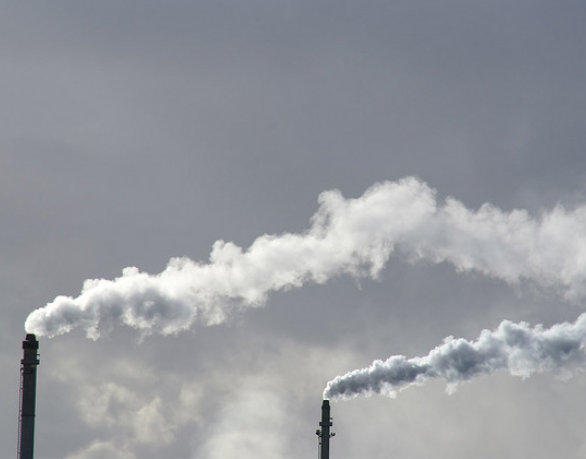
While Westminster gazed at its collective navel after the local elections and the Queen’s speech last week, the concentration of carbon dioxide in our atmosphere quietly exceeded the symbolic figure of 400 parts per million.
It has become unfashionable to talk about climate change. The prevailing wisdom is that the next election will be won on the economy. The carbon milestone barely registered on the political agenda. This is a missed opportunity for Labour: if there was ever a One Nation issue that will affect all Britons, regardless of wealth or location, it is climate change.
Indeed, we are already suffering the consequences. The winter of 2012-13 lasted into mid-April. Food production is becoming increasingly unreliable. The makers of Weetabix, a British food institution, have had to restrict or halt production of some product lines because a catastrophic harvest last year means they simply do not have enough British wheat to continue.
Even the US government, hardly renowned as the most progressive force for climate action, is concerned by the trend. Two weeks ago scientists briefed senior White House officials that the Arctic will be ice-free in summer within two years, rather than the end of the century as previously thought. This will have an unknown but likely negative impact on world food production with all the war, famine and pestilence that brings. And it will begin at the start of the next British parliamentary term, not in 2100.
Given the apocalyptic near-term scenarios, how we mitigate and adapt to climate change should be a hot-button political issue in its own right. But it also complements the growth agenda almost completely. The climate debate has so far focused on increasing the proportion of renewables in our energy mix and encouraging sustainable growth. However, due to the Sword of Damocles hanging above our agricultural sector, the risk of flooding in lowland areas and the high number of UK population centres on the coast, Labour can plausibly make the case for investment so that a One Nation Britain is also a climate change-proof Britain.
Mary Creagh is already pushing for more to be done on flood defences. This is a good start. But Labour should also offer broader leadership on climate change and in doing so reclaim the issue from the Liberal Democrats and Greens. Coalition inaction and dysfunction has given Labour an opportunity to drive the agenda. Adaptation strategies can be framed in the same way as housebuilding: something that the political class has neglected for far too long, but which are now necessary to safeguard our future and create jobs to get the economy moving. Acting now will save a lot more money in the long run.
We should also put climate change at the forefront of a One Nation foreign policy. Under Labour, Britain led the world with the Stern review and consensus building ahead of numerous climate summits. The coalition chose instead to place trade at the centre of UK diplomacy and treat climate change as a domestic issue. We should pledge to return Britain to its rightful role as a thought-leader and convening power at the centre of international efforts.
In 2006, Al Gore famously used the metaphor of a frog in boiling water to warn of the perils of inaction. The frog, oblivious to incremental temperature changes, stays in the water until boiling point before being rescued. At the time, our own boiling point seemed a long way off. As we move past the 400 parts per million figure, we now know this is not the case. We owe it to the British people to make sure that short-term political imperatives do not distract us from the vital task of safeguarding our way of life.
—————————————————————————–
Greg Falconer is a political risk consultant and Progress contributor. He tweets at @gregfalconer
—————————————————————————–
“If there was ever a One Nation issue that will affect all Britons…” writes Greg Falconer.
Hey Greg, this isn’t a competition as to which issue is more One Nation than the next.
The way we develop policy with the numerically smallest minority in the UK is also a One Nation issue that affects us all. Whether that minority is an ethnic group or a gaggle of bankers.