

On 27 June, music fans were heading to Glastonbury and sports fans were glued to their TV sets as Roger Federer crashed out of Wimbledon. But political nerds were glued to a fascinating set of council by-elections. You weren’t? Well that’s OK because, like Flash bathroom cleaner, I’ve done the hard work, so you don’t have to.
They took place in very different parts of the country – Plymouth, Tyneside and Dartford – and they give some useful pointers for national politics. The news is not at all bad for Labour, but Tories will not feel so happy. Of course, they have to be taken with a pinch of local salt but, unlike opinion polls, they do give a glimpse into what people think of when they are in the privacy of the polling booth. And they remove the problem of assessing the likelihood of people voting: if you vote in council by-elections, you vote in general elections.
Here are the results, alongside the results of the last time the seat was contested.
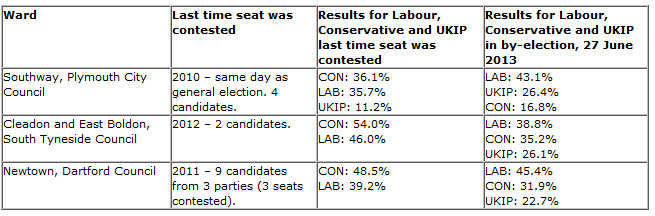
They hint at five things, in descending order of importance:
1. It’s the Tories, stupid
Every one of these seats was a Labour gain from the Conservatives as a result of UKIP standing for the first time or improving their performance. This is the Tory nightmare scenario, in that Labour doesn’t have to improve its vote share by much to reap a massive dividend in seats.
And taking seats off the Tories is exactly what we need to do if we are to get a majority. For every Labour-Lib Dem fight in places like Hornsey and Wood Green, there are many more seats like Enfield North which are straight Tory-Labour fights.
These diverse councils show how, in much of the country, the Lib Dems are virtually non-existent. There is not a single Lib Dem councillor in any of them, and they are not unusual. Because our media and political analysis is so London-centric, where the Lib Dems are over-represented, we forget that they are not a truly national party. The 2015 election will be won in Enfield, not Hornsey.
2. UKIP are dangerous to us, but deadly to the Tories
Have no doubt – UKIP take votes off us. Under the alternative vote, there would have been a surprising number of UKIP-first-Labour-seconders. In South Tyneside, our vote dropped even though we won, as some of our voters switched to UKIP when they had a chance to vote for them.
However, let’s not lose the wood for the trees. Clearly, most of UKIP’s voters are disaffected Tories, and the party is undoubtedly most dangerous to the Tories. In each ward, even after a ‘UKIP surge’ which took some votes off us, UKIP finished at least 15 per cent behind Labour. Yet in each, their intervention meant that the Tory candidate lost. The message is clear – don’t ignore UKIP’s impact on our voters, but be ready to take advantage of their bigger impact on Tory voters.
3. We must win, even if others fail
It will not be enough in 2015 for us to tread water and let UKIP undercut the Tories, pushing us into power. To win, we will have to increase our vote share, giving us our own mandate to govern. That’s what we did in two of these seats, where our vote went up at the same time as UKIP undermined the Tories.
4. UKIP might have hit their glass ceiling
UKIP’s vote share has been remarkably consistent during this year. They gained an estimated 22 per cent of the popular vote in May’s local elections and that figure of around a quarter of the vote was similar wherever they gained council seats. These by-elections back that up. Can UKIP break that glass ceiling?
5. TUSC are irrelevant
Most of us in local government have encountered the Trade Union and Socialist Coalition, often when they picket council meetings and denounce Labour councillors as class traitors. That can delude us into thinking that they represent a significant political force. They do not. In these by-elections, they stood only in Plymouth, gaining a fairly typical 22 votes. Any significant movement to appease 22 voters does not make much political sense.
There is a long way to go until May 2015 and UKIP could have shrivelled to nothing or could be in a position to enter the Commons; either is possible. These results and others like them provide pointers for what might happen. Real elections always give a potentially more valuable insight than opinion polls: taking a penalty in a competitive game is always more difficult than in a friendly. Plymouth, Tyneside and Dartmouth suggest that, even when UKIP don’t win, they can still determine who does – food for thought for 2015.
—————————————————————————————
Mark Rusling is a Labour and Cooperative councillor in the London borough of Waltham Forest and writes the Changing to Survive column
—————————————————————————————
Photo: Earls37a
Do you mean Dartmouth or Dartford?
Good to see Labour still on a predicted 90 parliamentary seat lead with some of the lowest Lib Dems scores at 6%. But you will not see that reported in today’s weekend Tory press or the BBC which seems to also ignore the Observer reports on increasing UK child morality compared to our European neighbours and these frightening reports of no senior child doctors around at weekends as desperate parents present ill children. Shocking.