
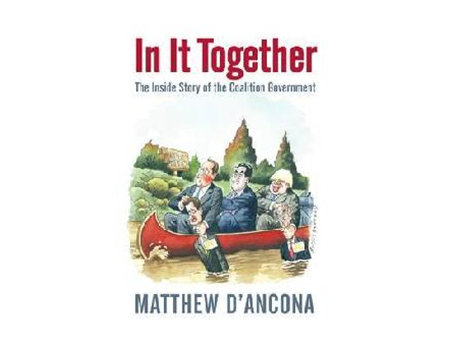
What Labour can learn from the coalition
What are the lessons for a future Labour government from Matthew D’Ancona’s entertaining account of the first three years of this government, In It Together? First and foremost, from the moment of its formation, the coalition successfully communicated a reason for its existence which transcended the need simply to form a government: ‘clearing up the economic mess’. Any government, even if formed by one party, is a coalition and it needs a unifying message and vision.
However, the account of the fiasco of the health reforms provides some important lessons. Their policy in government was at odds with the message that they had campaigned on – that they would protect the NHS and avoid reorganisation – and their strategy of detoxifying the Tory brand. They thus lost support and credibility.
The myriad events and speed of government put all plans under pressure. So Labour needs to win on the policies and priorities that we are going to govern on. And if there are issues – let us say, economic competence, where we are in the process of ‘detoxification’ – we must not trim the message or promise things we cannot deliver. Moreover, Nick Clegg’s U-turn on tuition fees shows how reneging on a key pledge, or even something the electorate thinks you have ‘signed up to’, can fundamentally undermine trust in you and your programme.
D’Ancona convincingly describes the Tory preparations for coalition in the weeks before the election. But there had been a failure to really think through the party’s defining ideas in opposition.
Steve Hilton’s ‘big society’ was supposedly the driving theme of David Cameron’s approach. But the ideas were insufficiently clear or focused to avoid becoming bogged down by the processes and machinery of government. Radicalism was blunted and big ideas failed to turn into delivery.
There is much in the book about personal relationships. I am not that interested in the social lives of the Notting Hill set, but I am intrigued that there was more in common socially and politically between leading Tories and Liberal Democrats than there was with either set of their backbenchers. Where these relationships worked well, for example, between Cameron and Clegg, seemingly irreconcilable differences were ‘glossed over’ and compromises found. Where they failed, for example, between George Osborne and Iain Duncan Smith, there were problems in delivery and policy development.
We have had all the lessons we need about the destructive nature of poisonous relationships between senior politicians, but this could be a useful reminder of the strength of comradeship in delivering results.
For both coalition partners, the more difficult relationships were with their own parties. The coalition had forced a more moderate, centrist approach, but backbenchers and party activists were unconvinced. What did not work, however, was trying to pacify the Conservative party by veering right. Eurosceptics were not bought off by promises of a referendum. And if you do something genuinely modernising, like equal marriage, do not dilute it by apologising for it. You lose the credit and do not win over the doubters.
Hilton advised Cameron to act as if he only had one term, and the coalition certainly set off with a flurry of activity. If Labour wins in 2015, it will be a great achievement, but also a break from recent precedent. We should be ready to act as if we only have one term too.
———————————————————
Jacqui Smith is a former home secretary and a contributing editor to Progress
“Steve Hilton’s ‘big society’ was supposedly the driving theme of David Cameron’s approach. But the ideas were insufficiently clear or focused to avoid becoming bogged down by the processes and machinery of government.”
Wrong Jacqui, IMHO.
The ‘big society’ theme died not through lack of focus or the Whitehall bog, but because the theme was never in Cameron’s DNA.
He was never sufficiently committed to the big society for its policy expressions to take precedence over the 40 years of conventional economic (neo-liberal) thinking with which he was imbued during his education and then his training under Lamont and Howard.
He was never sufficiently committed to the idea for him to be able to overcome Thatcher and her acolytes. He would have needed to have the moral fibre of John Major, the man who forced Thatcher out of Number 10.
He was never able to muster the intellectual energy of Tony Blair that he would have needed to think outside the conventional economics box and actually construct a big society. He was intellectually lazy.
He and most of his party have capitulated to a dogma espoused by the Tea Party that equates the mixed economy and social co-operation with communism. His new best friend in Europe is not Merkel but Erdogan, the voice of Turkish islamic fundamentalism who has just joined the Tory’s grouping in the EU.
Maybe, Jacqui, you are thinking all this when you write that the big society was ‘supposedly’ what used to drive Cameron.
But it needs to be spelt out if One Nation Labour is to win in 2015 and if One Nation Labour in government is itself not to be at risk of failing to deliver its own driving theme.
I am very worried about the term one Nation Labour, what dose it mean this frase was by the Macmillon Goverment, when he used the word one Nation Conservative.
My other worry is why we never seem to rebut the Coalition Goverment that have mess the economy which is used as a mantra, every time they are on the media and the more it is said the public would beleive it.
Hi Roderick: Miliband has borrowed the phrase “One Nation” from a Victorian Tory called Disraeli who was reflecting the anger that many people felt at the inequalities of those days. The country was divided into two nations: the haves and the have-nots.
I think, for Miliband, the phrase means even more. It includes the idea that we are all part of one nation, wherever we or our parents or grandparents came from or whatever our religion may be. It includes the idea that in our society we all need each other and we are all responsible for each other.
Perhaps you are worried that the phrase has been borrowed from a Tory. That would be a problem if Labour were using the phrase as a peg on which to hang Tory policies. No chance of that from Miliband! For him it’s a peg from which to hang not just economic policy but also cultural and social policy. If it’s just a peg, then, I can’t see a problem in using it.
What’s more there is still a strand of thinking in the Tory Party (going back at least as far as Macmillan, as you rightly say) that is against extreme inequality and they call themselves One Nation Tories. Labour needs to appeal to them to switch their votes. So it needs to use language that they can understand more easily.
Your second point – that Labour does not sufficiently rebut the claim that it made a mess of the economy – is a good one too.
The quick simple answer is that people will vote in 2015 on what the Coalition has done since 2010 – not on what someone else did in the previous decade or more.
The long answer is that, since the housing bubble and banking crash of 2008, the world economy has changed direction from less regulation by government to more regulation. It had to change. The Labour government started the change after the crash. But before the crash, Labour politicians could not – or, in some cases, did not want to – change. They were not sufficiently wise before the event. Nor were the Tories or LibDems – they wanted still less regulation. So Labour can be blamed for listening only to conventional economists who claimed that less regulation marked the end of economic crashes. But we must all be blamed: we all wanted it to be true. The difference today is that the Coalition thinks it can turn the clock back to before 2008 and carry on deregulating. The Coalition has not learnt the lesson: Miliband has. What he has not done is to find a quick simple way of explaining all this in general terms. But his pledge to “reset the energy market” during an energy price freeze is an easy-to-understand policy that proves he has turned his back on those conventional economists.