
I used to think of it as the ‘two o’clock awkward’: that moment in conversation, usually late at night, often in the junior common room or someone’s room, when I realised that the person I was talking to had a completely different background and outlook to mine.
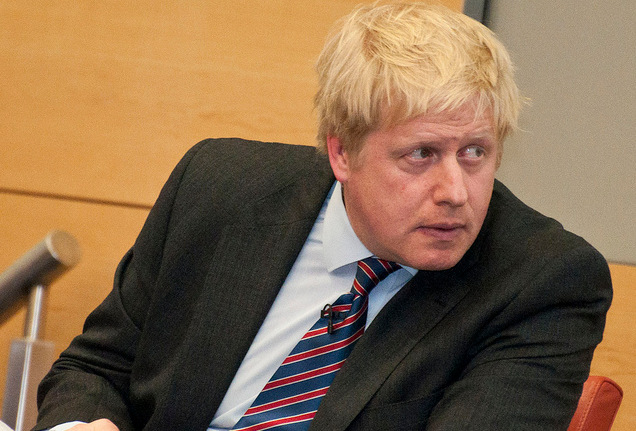
Boris Johnson’s speech to the Centre for Policy Studies was effectively the two o’clock awkward with a bigger audience, a reminder that the mayor of London, for all he might don the mask of a sophisticated cosmopolitan, is from that class of Tories who grew up in a household where they never talked about money, policy or feelings.
These are the kind of households where it is very easy to believe that all your good fortune is the result of effort or ardour, the kind of household that can make it possible for David Cameron to tell Fraser Nelson with a straight face that it wasn’t his family’s wealth, but its personal warmth, that made such a difference to his life: as if no young person currently outside of employment, education or training had a loving mother.
These are the kind of households in which it would be pure pleasure to live in. I would love to believe that I got into Oxford because I was astonishingly bright or singularly able, but the honest truth is this: I got into Oxford because I had a mother who worked incredibly hard and gave me incredible advantages, I went to a good local school because of Tony Blair, had free access to all manner of culturally improving things because of Chris Smith, and could get around a diverse and brilliant city because of Ken Livingstone. I can’t even claim credit for choosing history: that was the fault of an excellent teacher called Brodie Cross, who leant me a copy of AJP Taylor’s English History 1914-1945.
There are, however, any number of people who carry on into adulthood the reassuring delusion that they are the most special of snowflakes, and the modern Conservative party largely exists to coddle and to comfort them. So Boris is half-right: any conversation about social inequality needs to begin with the basic fact that some people simply aren’t very bright, but that conversation should cheer the left, not the right.
Not being born bright, like a cocaine habit or a tendency for petty vandalism, is an insurmountable obstacle for the poor and a mere speed bump for the rich. At my secondary school, some were destined for the scrapheap, while at my university, people every bit as untalented were headed for the City. If you do not have any capital behind you, you have to be clever, hard-working – and lucky. If you have capital, you do not need to be clever or hardworking, because you are already lucky.
So Boris is right: any conversation about inequality needs to start with the fact that some people are born brilliant and other people are about as sharp as a marble. But it’s a conversation that should cheer progressives, not conservatives. If someone can go from sniffing coke and smashing up restaurants to working at the heart of government, that suggests that any number of potentially useful people are currently being detained at great expense in prison or eking out a fairly miserable life on minimum wage or jobseeker’s allowance.
So be encouraged, not angered, by the sheer number of Oxford undergraduates who had fewer functioning brain cells than fingers; because if money and time are all it takes to turn vegetable matter into lawyers at middling firms and nebulous ‘consultants’, then what might the next Labour government achieve? Take heart from Boris Johnson: the less able are always with us, but there is nothing to suggest they might not make a perfectly decent living in financial services, the law or the Conservative party.
———————————————————
Stephen Bush is a contributing editor to Progress, writes a weekly column for Progress, the Tuesday review, and tweets @stephenkb
———————————————————