

Somewhere in Labour headquarters, someone should be poring over Michael Ashcroft’s polling with a thoughtful look. Not because pessimism should be the default setting for an election strategist, but because, although Ashcroft’s most recent polling highlights many strategic problems for the Conservative party, the detail isn’t entirely reassuring for the Labour party either.
Labour supporters will be pleased to hear Ashcroft’s conclusion that, to win an overall majority, the Tories need ‘the votes of everyone who supported them last time, plus practically everyone who is even prepared to think about doing so next time.’ That sounds like a tall order, and, as these voters to are a mix of dissatisfied Ukip voters, unsure former Labour and Liberal Democrat voters and people who find the whole business of politics near irrelevant to their lives, it is a tall order.
What’s more, while the Tories are more trusted on the economy, on leadership, on tough decisions and as individual politicians, Labour is more in touch, more likely to share your values, make your family better off, and more likely to have our hearts in the right place (I sometimes wonder if many voters take this question rather literally).
It’s this which means Labour is ‘obstinately ahead’ and which is causing frustration among Tory strategists.
So can we relax a little bit, sure that our values and our focus on the cost of living will make it impossible for the Tories to progress? I don’t think so.
Dig into the details of the Ashcroft polling, and you can see there is a slice of Labour support, perhaps 10 per cent to a fifth of our total support which might be vulnerable to Tory messages, if the Tories can rid themselves of their ‘for the few’ image as the economy recovers. This group could easily be the difference between victory and defeat.
Take a look at what current Labour supporters say when asked if Labour or the Tories are better on certain key issues:
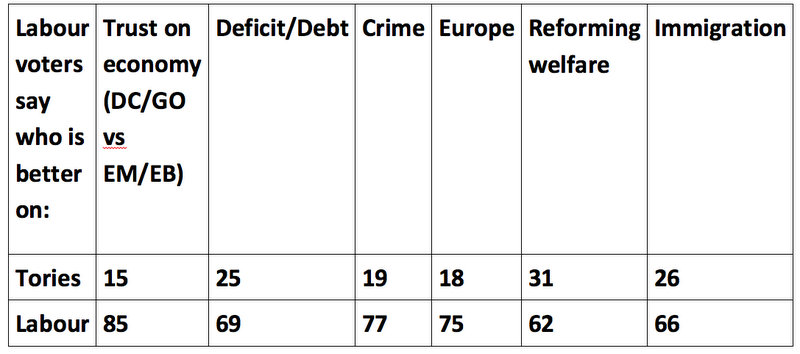
On some pretty major issues, such as welfare and the deficit, a substantial chunk of Labour supporters rate the Tories as better than Labour. Other than on the NHS, it hard to see many Tory voters returning this favour. Now, caution is needed here. It would be too easy to look at these numbers and assume the worst. It’s crucial to remember that these people are still voting Labour, and they’re doing so for a reason.
Labour’s supporters overwhelmingly rate the party as the best for fairness, for making their family better off, on the NHS and schools. It would be a huge mistake to ignore those strengths, or to pretend they are insignificant. They’re not. They’re vital. But if you were looking for vulnerabilities among Labour support, these are some obvious ones.
Another area to keep an eye on is views on the party leaders. While only one per cent of Tory voters think Ed Miliband would make the best prime minister, 14 per cent of today’s Labour voters think David Cameron would make the best prime minister.
Further, while eight per cent of Labour voters say they’re satisfied with Cameron as prime minister, and another 13 per cent say that, though they’re not, they’d prefer him in No 10 to Labour’s leader.
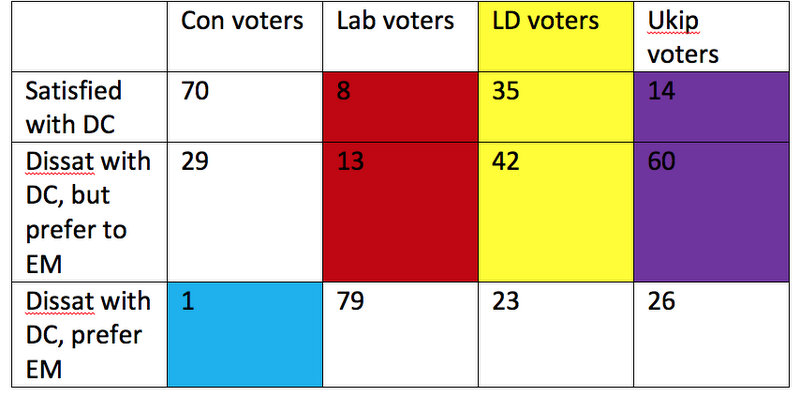
While some of this is no doubt simply due to familiarity, Cameron comfortably outperforms his party among almost all voter groups, which suggests that the Tories would be well advised to make the general election as personal as possible.
Just as importantly as Labour’s more vulnerable voters, those prime minister preferences suggest it may be easier for the Tories to expand their support over the coming year than many currently assume.
Here are the views of Liberal Democrat (first table below) and Ukip voters (second table below) on who they think is best on some key issues.
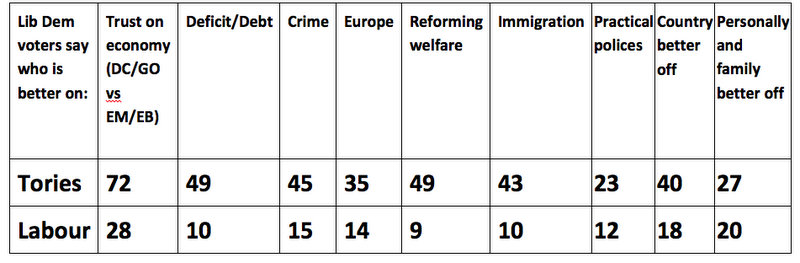
Now, among current Liberal Democrats, Labour is ahead on education and the NHS, and crucially on the cost of living (C 14, L 21), but the sense is that they tend to be more supportive of the Tories than Labour if forced to choose. Again, among the remaining Liberal Democrats, there are some pretty big Tory leads.
Indeed, even when offered the choice of Nick Clegg, 37 per cent of current Liberal Democrat voters still said Cameron would make the best prime minister. Twelve per cent said Ed Miliband.
Interestingly, 2010 Liberal Democrats were equally divided between Miliband and Cameron, which shows that most Labour sympathetic Liberal Democrats have defected to us already.
Among Ukip voters, the figures are even starker – only when it comes to the NHS, being on your side and understanding your problems do the Conservatives fail to score huge majorities over Labour.
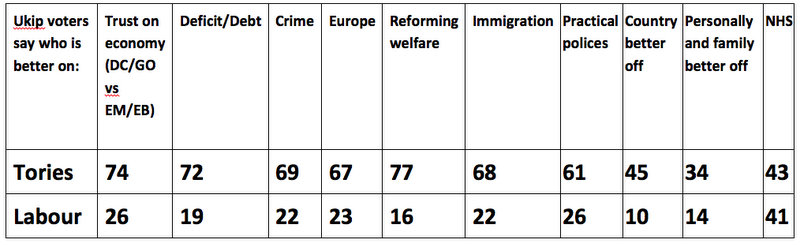
Naturally, Ukip supporters are dismissive of David Cameron’s party for meaningful and real issues. They think he’s out of touch, unconcerned with their priorities and not interested in their lives. However, it is at least possible to see how such voters could be squeezed, especially as fully 60 per cent of current Ukip supporters say, while they’re dissatisfied with Cameron, they prefer him to the Labour leader, and Cameron enjoys a three-to-one lead as best prime minister among Ukip voters.
The Tories face huge challenges. That much is clear. The attacks on them as being out of touch, uninterested in the lives of ordinary people, and standing for the few not the many reverberate with voters. They can’t ignore those weaknesses if they want to win. Equally, though, Labour should be aware that there are voters who have concerns about us too. Nothing is yet settled.
———————————————————
Hopi Sen is a Labour blogger who writes here, is a contributing editor to Progress, and writes a fortnightly column for ProgressOnline here
———————————————————
Photo: Louisa Thomson
‘The Prize is the outcome of the 2015 GE is Winning!’ – says Ashcroft. His dubiously engineered and collated project-blueprint statistics are unreliable and biased in the extreme. I agreed with my hero TB when he said in circa 2005 that statistics were as reliable as a leper’s left toenail [my words] i.e., not always reliable. Statistician-collators are very suspect as to their impartiality and honesty and the impartiality and veracity of the interviewer and reliability and sobriety of the interviewee are variables. Ashcroft and and his pie[in-the-sky]chart likens the upcoming 2015 GE to an egg & spoon or sack-race for school kids. Maybe the comparison between a kid’s school sports day event and the race of MPs to be 1st over the line at GEs is a good one. [at GEs sometimes its: READY,START!, STEADY] Kiddies’ school sport’s day events are not dissimilar to General Election day – a lot of people end up with egg on their faces and knees & elbows bruised and battered due to being over-prepped or under-trained. A a GE is not a sporting competition and no awards, medals or Silver Cups are handed out for coming in 2nd or 3rd. First or nothing. I used to like being in the Blue riband Team, then the Yellow Team and am now happy to be in the RED team. I may end up in the Green Team yet, who knows? Whichever team ‘s armband I wear shall, to a large degree, depend on my Captain’s leadership qualities – and listening to opposition colours Capt’ crock-of- **** statistics won’t help me decide; Words and inspiring deeds from my RED Team Captain will instil confidence before the race starts.
Not quite sure myself which Team I am running with these days as my Team Captain is quietely considering mixing the tean colours thereby creating a splodgey hue -mixing of colours- you ever tried mixing Yellow, Red and Green on your palette? You get a krap colour not unlike dog poo. My Captain vacillates on certain issues arising from a bit of mud on the track – but being a good Captain he will ensure the track is safe, and fit for purpose, or him and his people will fall flat on their faces. This is what a good Captain does – i.e., look after his Team players and their back room supporters. My Red Captain says he may bring in some wizened Scots sports’ relic for advice but I don’t follow soccer [footie sorry], and these advices may or may not boost our Red Teams chances and may even alienate some rugby and cricket fans who are currently in the BLUE armband team. This makes me worried as the Blue Team seem to have some excellent young bucks on their advisor’s benches who have a lorra-lorra dosh, Cilla and the Blue Team have some BIG heavyweight-moneybags-backers. Solid Gold not plated.
We in the RED team will be okay on the flat races, its the trickier egg & spoon and sack races we may trip up.
Statistics lie, Tony Blair was right. And madam Fatlady has yet to sing so keep on truckin’, Ed, and watch your back. My RED armband is firmly in place.