
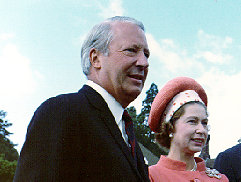
It was the year Abba’s Waterloo won the Eurovision song contest; Suzi Quatro, Alvin Stardust and the Osmonds topped the charts; and Jon Pertwee made his final appearance as Doctor Who. If the popular culture of 40 years ago seems somewhat alien, the politics appears at first positively archaic. The monochrome images of February 1974 – millions of homes still only had a black and white set – are of a country gripped by industrial turmoil.
Late the previous year, the miners had demanded a 35 per cent pay increase, in clear defiance of the Conservative government’s anti-inflation wage policy. Fearing that the massive oil price increases of October 1973 were already placing his government’s efforts to bring down inflation in mortal danger, prime minister Ted Heath resisted the miners’ claim. Rebuffed, the National Union of Miners ordered an overtime ban. The government responded by declaring a state of emergency. Newspaper advertisements requested drivers to ‘leave your car at home this weekend’. On new year’s eve, the government’s three-day week to preserve coal stocks and reduce the risk of power cuts came into force.
With inflation and unemployment soaring and an emergency budget in December 1973 introducing swingeing cuts in public expenditure, an atmosphere of chaos and foreboding ensued: one cabinet minister reportedly told friends over dinner that the country was on the same course as the Weimar republic, while the editor of the Financial Times predicted a rightwing authoritarian government would soon be in power. And, as Dominic Sandbrook’s history of the period recalls, ‘in Essex a rural vicar earned brief notoriety by telling his local paper that thanks to the unions’ selfishness, the old and infirm might be “dying or starvation within the next year or two”.’ His call for union militants to be jailed or shot ensured him a slot on Radio 4’s World at One.
This, then, was how the curtain rose on 1974 – a time when governments attempted to control inflation by introducing wage policies, prime ministers negotiated with union leaders in Downing Street, and, when the former asked the latter what they wanted, one of their number felt able to respond: ‘The end of your government.’
Politically, 1974 was, as I recount in the latest issue of Total Politics magazine, an extraordinary year. For only the second time in the 20th century, the country went to the polls twice in one year. Then, as in 1910, the question ‘Who governs?’ precipitated the initial election. In 1910, it was the power of the peers that the electorate was asked to decide. Forty years ago this month, it was that of the unions which Heath put before the country.
Despite the fact that polls suggested that the onset of the dispute had seen the Tories pull ahead of Labour in the polls for the first time in two years and majorities disapproved of the miners’ action, Heath, resisted calling an early election. As Sandbrook notes, to Heath it ‘smacked of cynical self-interest’; while his grassroots activists and aides ‘wanted him to rally the country against the miners, he shrank from the idea,’ finding it offensive to his ‘one nation’ principles. But the miners decision to call an all-out strike forced his hand and election day was set for 28 February.
This would be the third time that Heath and Harold Wilson had jousted at the polls. To date, each had beaten, and lost to, the other. On this occasion, however, Heath, supposedly playing the stronger hand, was no match for Wilson. Despite the strike being the cause of the election, the Tory leader proved reluctant to mobilise the country against the miners. Wilson was thus released from the choice of having to support the miners and risk being painted as a fermenter of the chaos into which the country had slipped, or oppose them and face charges of betrayal from within Labour’s own ranks. Instead, the Labour leader, in the words of Ben Pimlott’s biography, depicted himself as ‘a Labour Baldwin – a long-established national leader whom the voters could trust’. Aided by the three-day week, which largely prevented power cuts, Wilson deftly turned the focus of the campaign away from the miners’ strike to the government’s poor economic record, painting Heath as ‘Mr Rising Price’.
Despite polls indicating that the Tories would win comfortably, Wilson managed to fight them to a virtual draw: when the results was counted, Heath led by 0.7 per cent in the popular vote, while Labour, by four seats, was the largest party. The country had its first hung parliament since 1929, and one of only five in the 20th century. For a few days, the country witnessed a situation similar, albeit by no means identical, to that of May 2010. Wilson assumed that, as the leader of the largest party, the Queen would call upon him to form a government. Heath, however, believed that as the incumbent prime minister he had the right to first see whether he could form a government. Although toying with threats to issue ‘a denunciation of constitutional impropriety’, Wilson stayed his hand while Heath tried, in vain, to negotiate a coalition deal with Liberal leader Jeremy Thorpe, talks which foundered on Tory unwillingness to grant electoral reform, and the reluctance of many Liberals to support a government headed by the Conservative leader.
Back in Downing Street, Wilson swiftly settled with the miners and prepared for another election, determined to win a majority. Eight months later, with Labour eight points ahead in the polls and his own personal approval rating double that of Heath, the prime minister sought to end the stalemate by calling an election for 10 October, and appealing to families who wanted ‘a bit of peace and quiet’ to back him. The emphasis, records Wilson’s official biographer, Philip Ziegler, was ‘on the Social Contract and Labour as the only force that could bind Britain in unity and social harmony’.
Believing an association with ‘confrontation’ had cost him the election six months previously, Heath sought to portray himself as the guardian of ‘national unity’. All this talk of consensus and coalition produced what the Economist termed ‘the election that never was’.
While few had doubts that Wilson would remain in Downing Street – the BBC exit polls at first predicted a Labour majority of 150 – another hung parliament was only narrowly avoided: Labour gained 18 seats and crossed the finishing line with just three seats to spare.
But, archaic as the politics of 1974 may seem, in many ways they shaped the politics of today. At Heath’s final cabinet meeting, only one minister, Margaret Thatcher, praised the prime minister, paying tribute to the ‘wonderful experience of team loyalty’ they had shared over the previous four years. Less than a year later, she challenged, and defeated, Heath for the leadership of the Conservative party. For her, the search for consensus was ‘the process of abandoning all beliefs, principles, values, and policies in search of something in which no one believes’. Ten years later, she would avenge his defeat at the hands of the miners. While Heath blanched at the prospects of dividing the nation and rallying support against the strikers, Thatcher had no such compunctions, deeming them ‘the enemy within’.
Heath’s premiership affected the psychology of the Tory party in other ways, too, making the U-turn and a perception of weakness the gravest of political sins. The disdain in which David Cameron is held by many in the party and its media supporters stems less from his alleged liberalism, but more from the fact that, by leading them into a coalition, he has had – at least with the Liberal Democrats – to practise the arts of compromise and conciliation which Thatcher set her face against.
Labour may have eked out a narrow win, but it would be 23 years before the party won another general election. ‘The winter of discontent’ exposed the hollowness of the ‘social contract’ it had trumpeted in 1974. The cruel realities of the oil price shock and ‘stagflation’ which defied Keynesian economics were soon impressed on Labour by the IMF – and that impression of economic incompetence would take two decades to erase.
And, under the influence of Tony Benn, Labour had already begun the journey to the left that would come close to destroying it in the 1980s. In 1974, Wilson largely ignored the manifesto – its most radical ever, it promised ‘a fundamental and irreversible shift in the balance of power and wealth in favour of working people and their families’ – which the Bennites had foisted upon him. Wilson’s tactics may have helped ensure victory, but ignoring the hard left was to have near-devastating consequences after Labour lost power in 1979. It would take a decade before Labour had a leader who recognised this. The long-term impact, moreover, was to ensure the re-election of Thatcher in 1983 and 1987.
1974 also marked the birth of Britain’s modern party system. Throughout the postwar years, the Liberals and smaller parties won, on average, only seven per cent of the vote with Labour and the Conservatives winning the support of nine out of 10 voters. The Liberal vote has fluctuated since but it has, thus far, never fallen back to the single figures the party polled prior to 1974. Since 1974, the Conservative and Labour parties have found only three leaders – Margaret Thatcher, John Major and Tony Blair – with sufficient appeal beyond their party to avoid the kind of deadlock Britain experienced in 1974 and 2010 and win a parliamentary majority. Next year, we will find out if either party has chosen a fourth.
———————————————————
Robert Philpot is director of Progress. He tweets @Robert_Philpot
———————————————————
Thanks for this,there’s a lesson, winning by default because the Tories collapse with less that 40% of the vote! and having a few hard left wingers draw up a manifesto! that’s unworkable!only to have the Tories !return to power 5 years later and them being in power for 18 years, is a situation, we might see next year as well as 1974′
ye of little faith
What did history teach us, the left in the shape of Bevan swung the party away from the centre, and labour lost in 51′ and 55′, then totally ignoring it we did the same in 1974′ and 18 years in opposition followed, but maybe a third time of doing this, wouldn’t see us out of power for a generation again, Heh!?