
This month’s Progress Magazine interview with Jon Cruddas, which Progress members will be avidly reading over the toast and marmalade, sees the Labour policy chief make an argument for boldness as a defining characteristic of One Nation Labour. Cruddas argues, as he has for several years, that ‘we need a bold, imaginative, transformative offer’ in the next manifesto.
The recent letter from several thinktank directors and policy advisers, including Progress’ Robert Philpot, makes clear Cruddas is not alone. If there is one thing that unites the labour movement, it is a desire to be bold.
Proof? In 2010 Peter Mandelson said that the great recession required a government with a ‘bold mindset’ and told the FT that to win power, Ed Miliband needed to show ‘boldness and political artistry’, while Mandelson’s close friend and steadfast political ally Len McCluskey has often said, to borrow a phrase, that Ed Miliband is at his best when at his boldest.
This unanimity suggests the first problem with boldness as a political value. Boldness can mean pretty much what you want it to mean. It can be shorthand for energy, brio and panache. It can mean an overturning of outdated traditions or asserting the value of those traditions. It can be code for spending money, or for telling uncomfortable ‘truths’ about not spending money. Nigel Farage is bold. Tony Blair was bold (I knew I’d stolen that line from somewhere). Margaret Thatcher was bold. Tony Benn was bolder than most.
So is boldness therefore a universal good, a standard to which everyone should aspire, whatever their ideological bent?
No. It is not.
Because the most crucial political virtue is carefulness, not boldness, and the current absence of rational timidity from the modern political virtues is a crying shame.
By rational timidity, I do not mean indecision, or irresolution.
I mean fear, timere, the Latin root of timidity.
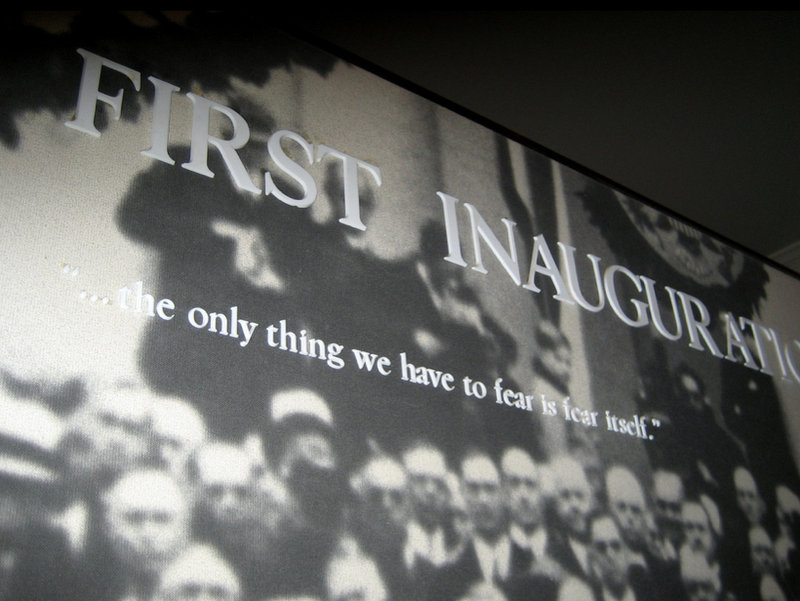
Fear gets a bad press in politics. Franklin Roosevelt is largely to blame.
It is time to ‘speak the truth, the whole truth, frankly and boldly’, he told America in his first inaugural address – ‘The only thing we have to fear is fear itself.’ Ever since, fearfulness has been disdained as a political virtue.
Yet, reading Roosevelt again, something strikes me. In his inaugural address, Roosevelt carefully details every single threat that America faced, every risk, every danger. He names each fear, grants its scale and significance. He does this because only once this is done that can Roosevelt define a plan of action that is able to vanquish the demons America faced.
Roosevelt is not dismissing his fears – he is describing them, addressing them, confessing them.
Perhaps we forget why Roosevelt told Americans not to fear their fear. He did not ask America to not have fears, but not to be afraid of those fears, to not allow a rational concern to be left unaddressed until it becomes ‘nameless, unreasoning, unjustified terror which paralyses needed efforts to convert retreat into advance’.
Instead, by recognising the real threats we face, we can treat them rationally and coolly, and take the correct action in response, even if this is, at first, to retreat.
Often modern political rhetoric forgets this. We are told to be bold, but not asked to confront what we must be bold about, or why it matters.
We value boldness as a good in itself, unrelated to any specific challenge or fear. The solution is always and everywhere the same: constant forward motion. This leaves our bravery and radicalism untethered and meaningless. It is like a knight armouring for battle against a foe that he claims is entirely insignificant. If that is the case, why the chainmail, the shield and the sword?
When I hear politicians talking about boldness today, I get the feeling much of their claimed love of bravery is just whistling in the darkness, a way to ignore real fears, to convince ourselves that our dangers aren’t real, or important, or hard to overcome. But they are. So the happy tune being whistled seems inadequate to the threats being carefully ignored.
Perhaps that is why, when boldness is proposed as a solution, the actual policy produced is usually vague or very narrowly focused, dissolving into jargon or attacks on small, manageable targets (Footnote: The exception to this, in fairness, lies with the ideologues of left and right, who always know who the enemy is, blame them for everything, and know that if only given enough tools victory is certain. Perhaps this is why such certainty appeals today. The boldness of the crusader at least resolves into a real plan of action, even if it is later found to be disastrous)
Instead, I think, to justify a great effort, forward action, equal to the challenges ahead, we first have to admit what we fear.
On the centre-left, that might be that we will have to govern without the comfort of distributing growth.
It might be that we fear that the next decade will see government struggling to deal with the pressures of deficit reduction, increasing business investment and supporting public services.
It might be that we fear the next decade will be one of high personal debt, low growth and tight incomes.
It might be that we fear that to turn this around we will be forced to ask for further sacrifice from those whose support we most hold dear, and who we exist to serve. We might fear that they will hate us for it.
These are not irrational fears. They are real, and valid, and important.
It is only by addressing all of them directly that we will be able to assess our resources, be clear about our priorities and set forward a plan of action equal to the challenges ahead.
That plan might, or might not appear ‘bold’.
It might even appear to be a concession to timidity, to our fears.
It could be seen to be a retreat, perhaps. A ‘narrowing of the offer’, to use the awful phrase.
Yet a narrowing can also be a spear-point aimed directly at the greatest threat. To advance, it can be better to focus your efforts on what is essential.
Certainly, to create the right plan to meet our fears we first have to address them directly, not ignore them, or seek to minimise them.
In that case, then, what we need most is not further talk of boldness, which is already everywhere and often empty, but a careful honest, direct enumeration of our fears, and from this the development of a precise, gradual, practical path to overcoming each in turn.
It is time to recognise and accept the value of fear. We will not overcome our problems without it.
———————————
Hopi Sen is a Labour blogger who writes here, is a contributing editor to Progress, and writes a fortnightly column for ProgressOnline here
———————————
No matter there has to be a ‘narrative’ about inequality, about more risk to all those being made redundant including middle classes or getting seriously ill , about youth, about people unable to buy houses, about unmarried or non-working women with young kids not getting child care soon and so on… There has to something which focuses on the attacks on our social integration but which is not the Tory/UKIP of hate of the other. The British are not stupid that’s why so few voted Tory in 2010; its about their estimate of risks. The one nation theme is good because it can unite most groups. It counters the hate D/Mail propaganda that seeks to isolate Labour as not us. Blair won because he knew there had to be wide electoral appeal but he did not ape Thatcher or Major and pointed to the damage they had done to the UK; rampant individualism only works for a few for only some of the people. Denmark captures a society ( the happiest people seemingly in Europe and beyond) at ease with itself because they know there society is supportive, progressive and liberating.
“Fear no evil, for God did not give us a spirit of timidity but of love and self-discipline”
Since Allah shook the carpet of the Sahara a few fleas of doubt are settling here in UK.
“Faint heart never won Fair Lady”.
Just get on with it, and less philosophysing, barrie.
Hopi:
I am afraid you are telling the truth.