
On Saturday 5 April 2014, Afghans went to the polls to elect their next president. This is the first time in the war-torn country’s history when the political power will transfer from one elected president to another. The Taliban had vowed to disrupt the election process at all costs, intensifying their attacks (mostly through suicide bombings) on key government institutions and killing dozens of innocent civilians.
Despite the security threats and uncertainties, the people of Afghanistan filled the polling stations across the country in an unprecedented numbers. From the early hours of the day, Afghan women and men lined up by to cast their votes. Soon the pictures transmitted by the media illustrated the commitment showed by the voters carrying their voter IDs. Elderly women and men and disabled people were helped by their younger and abled-bodiued family members. Within a few hours most polling stations ran out of ballot papers, provoking anger and disappointment.
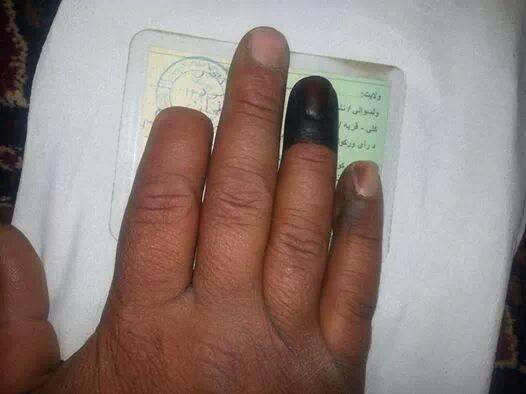
Over the last decade, Afghanistan has made impressive progress in telecommunications. Most Afghans own internet-enabled mobile phones. Millions of Afghans use Twitter and Facebook, and so social media was awash with photos of Afghans sharing their inked fingers with the world. The photo accompanying this article is one showing the hand of a man whose finger was cut off by the Taliban for voting at the last election – but here he is again, voting.
The unexpectedly large turnout surprised many but added more excitement to the whole affair. Voters updated their social media timelines with emotionally charged messages. My friends kept telling me about their joys and hopes. One told me: ‘This sense of unity in a fragmented country is unbelievable. All of sudden everyone is so kind to each other. When I look at the faces of the people waiting in the long queues, I just want to cry with joy.’
This was the first national election managed by the Afghans themselves, and Afghan forces provided the security. This was a big test of strength for the Afghan security forces, they had a successful day. Soon after the polls closed, Afghans and their political leaders praised the Afghan Nation Army and the police force.
The people of Afghanistan demonstrated that they have come a long way. Through their determination and enthusiasm, they proved that they want their future to be shaped by the ballot box. They defied the Taliban. Nothing had ever destroyed the Taliban’s hopes more than the Afghans last Saturday.
There remain grave and legitimate concerns about the transparency and cleanliness of the election. Expecting a fraud-free election is overoptimistic at best. Afghanistan remains structurally corrupt and fighting corruption has been the main pledge of the candidates.
As national emotions settle and election fever cools, and whoever becomes the country’s new president, the scale of the challenges facing Afghanistan is immense. Rampant and structural corruption, security threats and the lack of good and effective governance just a few. However, the peaceful power transfer from Hamid Karzai’s administration to the new president is the country’s biggest and the most important challenge. The west must help Karzai leave the presidential palace.
Afghanistan needs an inclusive government. How the loser candidates behave will determine the country’s immediate future. Ordinary Afghans made history – it now falls to their politicians to make history of their own. This was an extraordinary election in extraordinary circumstances in an extraordinary country.
———————————
Rohullah Yakobi is a member of Progress. He tweets @kohnadeh