
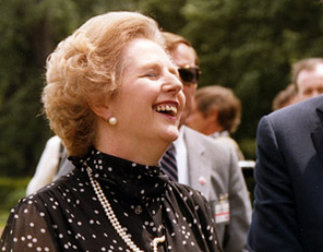
The morning after Margaret Thatcher passed away, listeners woke up to hear her voice on the radio. This time last year, for a short period of remembrance, her words were broadcast everywhere. My generation are too young to remember Thatcher as prime minister or regular radio guest. We grew up post-Thatcher (Blair’s babes). But one year on, and nearly 25 years later, we should still ask if we are listening to her ideas.
Cameron made a lot of his ‘post-Thatcherite’ brand of Conservatism in opposition – trading the ‘nasty party’ image for compassion and a tree. We were told there ‘is such a thing as society’. Of course, we were also told ‘vote blue, go green’ and ‘no top down reorganisation of the NHS’. In fact, the stories he has stuck to since gaining office have been a traditional shade of blue.
The basic premise is the same. That social democracy and the Labour party’s ‘irresponsible public spending’ have plunged us into crisis. Thatcher told the country that public spending was at the heart of their current problems. In spite of the influence of neoliberal economics and the inconvenient meltdown of the banking sector, Cameron agrees. And the damage is not just economic but social too. An active state, Cameron will tell us, limits personal ambition and dampens our will to succeed.
Because the problems are the same, more and more of the answers are turning out to be the same. We have had the rolling back of the state and the fight against ‘morally indefensible’ levels of welfare spending. Decisions have included the sell-off of the east coast mainline and privatisation of services previously un-tipped for sale, like probation. The east coast mainline handled one million extra journeys and increased its revenue by 11 per cent under public ownership. But privatisation is not a tool. It is a worthy end in its own right. Chris Grayling does not know how much his probation reforms will cost but, as he pointed out on the floor of the Commons last year, ‘sometimes you have to just believe something is right and do it’.
Moral-force politics are helpful on welfare too. Cuts to benefits and tax credits have hit disabled people and people in work, not just the spectral ‘workless’. Economically, the ‘spare room subsidy’ has failed – only six per cent of tenants have moved home, and 28 per cent have fallen into rent arrears. But the minutiae of these policies can be forgiven on principle. They are still symbolic of a greater good.
In ‘modern’ Conservative Britain, the deal between society and people is shifting. Personal tuition fees were hiked to allow for the public subsidy to be scrapped. Cuts to legal aid have restricted the list of people who are allowed to ask for help. The government tried to narrow the definition of domestic violence for the purpose of legal aid, to allow less victims onto its books. In Cameron’s Britain the ideal individual – be they citizen, student or victim – is self-reliant.
It has been nearly 25 years since Thatcher left Downing Street. But Cameron’s Conservatives are continuing the project that was left. In some areas they are already streaks ahead – Thatcher used to argue parents should have more power over schools, now Gove is telling them to open their own. What we should be worried about is what comes next. This is Conservative Britain, and their conviction will grow with every election they win.
———————————
Grace Wright works for a Labour MP in Westminster
———————————
Photo: Robert Huffstutter
To all those who won’t vote – shame on you! – whether you like it or not you are society and its destination is in your hands – so pull your fingers out, stop being sheep and vote for democracy
I will be voting I tend to try, I will be voting UKIP at the next one.
“In some areas they are already streaks ahead – Thatcher used to argue parents should have more power over schools, now Gove is telling them to open their own.”
Err, is that such a bad thing? We did some of that in government!