
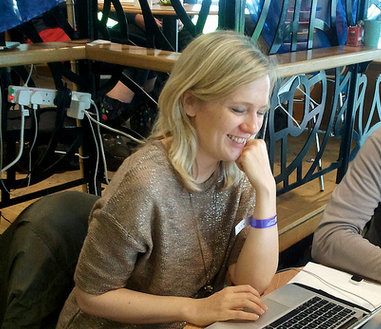
Politics has to be about more than wringing one’s hands, Stella Creasy tells Robert Philpot and Adam Harrison
It is a bold and unexpected claim. We are in the middle of a conversation which offers little cause for cheerfulness – ranging, as it does, over the financial challenges an incoming Labour government would face, the public’s disengagement with politics, household indebtedness, the snail’s pace increase in women’s representation in parliament, and the dispiriting nature of Nigel Farage’s pitch to the British people – when Stella Creasy suddenly declares, ‘I’m incredibly optimistic about the future.’
That optimism is no doubt fuelled by the fact that, alone among opposition members of parliament, she can claim to have changed government policy. When George Osborne announced at the end of last year that the coalition intended to legislate to cap the sky-high interest rates charged by payday lenders, few gave the chancellor any credit. Instead, the plaudits went to the high-profile campaign Creasy has waged since entering parliament in 2010. And those plaudits have come from both left and right. LabourList named her MP of the year in 2012, while the Spectator magazine awarded her the epithet of Campaigner of the Year in 2011, calling her ‘an example of how to do opposition politics.’ ConservativeHome described her as ‘Labour’s most interesting member of parliament.’
For Creasy, victory over the likes of Wonga offers a way to start to puncture the pervasive sense of pessimism about whether any party can make a difference which she believes is Labour’s biggest challenge. ‘People say to you “Does it really make a difference?” and we have to have that argument with them and I think when we do we have a case to make. We can show the difference it makes. That’s the thing for me on the payday lending stuff: we’re showing by being strong about what you stand for that just because we’re not in office you don’t [not] have power.’
But the campaign also showed, she argues, the need not simply to have ‘an analysis but to have answers.’ ‘I could have sat around the frontbench or backbench wringing my hands going “Ooh, yes, payday lending is terrible”. [But] as soon as we started saying to the government “here’s an alternative, here’s a way you can tackle this problem”, they’ve got to make choices, and as soon as you are pushing people to make choices, that’s when change happens.’
Creasy has no intention of resting on her laurels, however. She views the fight against payday lenders’ exorbitant rates as simply ‘the start of a conversation about consumer credit.’ Britons have £1.6tn of personal debts, a figure which is rising even without the increase in interest rates which is expected this autumn, and servicing those debts is part of the reason why many struggle to get to payday without a loan. ‘We have this big bubble of personal debt coming up and … it will drag us all down,’ she argues. While the long-term solutions may be complex, the starting point is simple. ‘We have to stop being British and coy about talking about debt because that’s where these companies do well, [it] is people feeling ashamed … It can’t be a silent source of shame any more, it’s got to be something we talk about and which we manage together as a community.’
If Labour wins next May, it will not only inherit this personal debt bubble, but a Treasury whose finances remain firmly in the red. As shadow minister for consumer affairs, such matters are beyond Creasy’s brief but her call in 2012 for Labour to adopt ‘zero-based budgeting’ – a line-by-line re-examination of every item of public expenditure – may have initially irritated the party’s Treasury team, but it was later adopted by it. While she jokes that her passionate advocacy of it makes her sound like a ‘killjoy’, Creasy’s optimism allows her to turn what many regard as a painful necessity into a virtuous cause. ‘If we get our economy wrong, it’s the poorest who miss out and they pay the most comparatively in taxes so that’s why, for me, zero-based budgeting is such a progressive thing,’ she suggests. It is also, Creasy believes, critical to Labour’s chances. Lack of trust in politicians is nothing new, she argues, but it has been compounded by a more recent ‘lack of a sense of efficacy’ about politics. Voters need an answer to the question: ‘Even if you say you want to do this, could you really make it happen?’ Creasy says. ‘What zero-based budgeting does is show that we are absolutely determined to be able not just to come up with good ideas but to put them into practice and pay for them and that’s why it is so important.’ She also sees opportunity in austerity. ‘Everyone’s very negative about this idea that we’re going to face difficult financial challenges,’ Creasy argues. She sees instead the chance to ‘reshape services to get better outcomes for people. Actually it will be cheaper.’
Before entering parliament Creasy had stints as a speechwriter and researcher for Charles Clarke and Douglas Alexander, but it is her time as deputy director of the public participation thinktank Involve, as well as her PhD research into social exclusion, which appears to have done most to shape her thinking. In recent months, Labour has begun to talk much more about its plans for ‘people-powered’ public services and a radical devolution of power. But this is a common refrain for all opposition parties. What makes Creasy think Labour will be any more willing to give power up once its frontbench are ensconced in Whitehall? ‘Let’s be very clear,’ she responds, ‘the next Labour government should not be organising lots of meetings for people because meetings and minutes are not empowerment and engagement.’ Creasy also draws a sharp distinction between accountability and participation. She is less interested in people’s ability to be ‘in a room with the person who’s made the decision to tell them why it’s a good or a bad thing’ than in ‘how we can give you the direct ability to be able individually and collectively to make decisions and shape things around you, because you will know best for yourself what works for you.’
But before we have the opportunity to test whether Labour will make good on its commitments to give power away, it needs to win it next May. Creasy appears outwardly unconcerned by the party’s weakening position in the polls and her relentless optimism does not founder in the face of the United Kingdom Independence party’s challenge. ‘Nigel Farage is seeking a reaction and in that sense he shares some similarities with people on the left who just want to wring their hands and say “Isn’t it all awful?” I think Nigel Farage is actually, frankly, deeply unpatriotic because he’s basically talking about managing the decline of Britain. He doesn’t seem to think that we can compete with German inventors or that we can compete with the French capital … he seems to have written us off.’
Creasy side-steps questions about whether Labour needs to do more to challenge Farage but her prescription for such an attack is clear: ‘I don’t think he offers anything for the future – he only offers a cry of pain for the past and a fear of change. Change is scary, we need to acknowledge that, but change can also bring opportunities that we wouldn’t previously have had.’ She is also unwilling to give any ground to Ukip on immigration. ‘Talk to Nigel Farage not just about the immigrants who come here and create jobs but the immigrants who come here and create skills and create opportunities for people and create new ideas for people,’ she argues. ‘There are now more people over the age of 65 than under the age of 16 in Britain,’ she continues. ‘So unless women like me have a lot of children very quickly our ability to sustain our economy, to sustain our public services [will come under threat]. It’s not just that these guys want to charge you to use the NHS, it’s that their policies will actually mean the NHS will not exist by [Britain] not being able to have an economy than can support it.’
Soon after being elected, Creasy was entering a lift in parliament when a Tory male politician stopped her and told her it was reserved for members of parliament. It was an early, probably unnecessary, warning to her of the institution’s ingrained, albeit at time unintended, sexism. Tweets from the Sun’s political editor about her clothes when asking a question at prime minister’s questions – she responded by asking whether he would also be commenting on David Cameron’s tie – as well as a fight with Twitter last summer about its seeming indifference to violent misogynistic messages (of which she later became a victim) have done little to assuage Creasy’s concern. ‘Society is rife with sexism and the Commons and politics is no different,’ she reflects. She notes that female representation in parliament has increased by just four per cent in the last 15 years. It ‘horrifies’ her that, at the current rate of progress, her three-year-old niece will be drawing her pension before there is parity in parliament. She would like to see a ‘timeline’ set to show ‘when we are going to see change.’ ‘Parliament, like society, is full of all sorts of unconscious barriers to equality,’ she argues. ‘You know, if I hear another person saying that “leadership takes balls” … This is not being disrespectful to Mr Balls, but surely we should say leadership is about guts. It’s not gender-specific.’ As the fourth anniversary of her election to parliament passes, Stella Creasy can lay some claim to having proved that point.
———————————
Bang on Stella. Got to take on the negativity of UKIP and offer real answers to people who are afraid. And also to get citizens involved in policy-making/ choosing, which is a lot more than a meeting. Some interesting examples here also from the Democratic Society http://www.demsoc.org
So standing up against the EU is allowing our island to become ‘disengaged’? What is your reply to this message; http://communities.washingtontimes.com/neighborhood/what-world/2013/jun/7/britain-may-be-islamic-nation-within-20-years/#ixzz33YwNSllm&w should we just sit back and do nothing, as Labour propose? We need to control our own borders and quickly, we are being inundated with unskilled labour and people with phoney EU passports, purchased ‘legally’ in places like Malta! The EU are trying to shoehorn us into a Corporate State, via it’s TTIP. This deal includes the SELL OFF of all our Public Service rights, to foreign corporations, yet you and the three stooges, would have us sit idly by while they achieve their objective?
What about a campaign for LESS council tax? We are paying on average £900 per household pa, that goes to paying out from as little as £12,500 a year to land owners via the CAP? Farmers are being paid a small fortune to ‘dig trees up’, because they can only claim the CAP if, there is no vegetation on the land and ‘trees’ are vegetation, according to EU! One wonders where all the ‘flooding’ comes from, when farmers are digging natures dams up?
Back to ‘women’, like the EU, LibLabCon’s have a habit of selecting women to make the numbers up, unlike these puppets, UKIP promote their women on merit and have a significant number in their ranks, not because they look good, but because they can actually do the job!
Fantastic effort to try and turn UKIP’s huge failure to appeal to women into a “you only got your job because you’re pretty” jibe.
Anyway, how can you argue in favour of UKIP when they haven’t even put out a manifesto yet? You don’t know what they stand for.
I thought Labour had given up its AWS nonsense blah blahs and looking good to women malarkey when it appointed a white male American to steer its ship? That and choosing a male to stand in Newark…..
Ms Creasy makes a valid point on making pointless noise which probably makes some think the “we’re sorry now” apology from the hierarchy needs a bit more to it, even if the sheep bleat the message of long ago to proclaim that it doesn’t.
It’s one of those irritating situations where, when anyone suggests quotas or even counts the number of women relative to men in a job at all, there is some conservative waiting to say “OH, SO YOU’RE SAYING I SHOULD GIVE JOBS TO WOMEN EVEN IF MEN ARE BETTER AT THEM”
And that’s the attitude that results in quotas – the complete refusal to accept that, if the “best possible candidate” turns out to be a white man who went to the same school as you over and over again, you might have a problem of *unconscious* bias. The alternative is to say “I’m not sexist, men just ARE better than women”, which most people have the sense to stop short of (unless they’re in UKIP).
But then, conservatism is not really defined by its willingness to accept even the existence of the unconscious, is it? To them, if an idea comes unbidden from within, that’s usually reason enough to just go with it and see what happens. And you have to be pretty rich to evolve that mentality without starving to death.
But I digress: the issue is more whether a party feels it has something to prove. UKIP made a huge deal about not accepting BNP members – while also pointing out the odd ex-BNP member who defected to Labour – and seemed genuinely perplexed as to why people’s response is “yeah, you’re the only party who really needs to do this”. Labour are not really in a position where people doubt their willingness to employ women to important roles in the way that the Tories have been. And with UKIP, we don’t really care.
UKIP voters do not know or care what they stand for, they are voting for Nigel Farage, just as the Germans voted for Adolf Hitler in 1933 (yes, he was a democratically elected leader, more so than Mahmud Abbas or Hamas in Gaza, who have been in power for longer without an election). The media are largely to blame for promoting the cult of personality, which ought to be irrelevant in a democracy, Attlee was a far better prime minister than Churchill.
This is a disgraceful slur. UKIP is a democratic party and does not rely on Brownshirts prowling the streets beating up jews, gays and the mentally handicapped to get votes and force a timid bourgeousie into the ballot box. There is no Mein Kampf manifesto which explicitly states a policy of Lebensraum and the displacement of non-native people. Your comparison is ridiculous and denigrates the millions of ordinary british people who voted for UKIP because they feel betrayed by the clique of phoneys that controls the levers of power in this country. Grow up.
The cult of personality is a dangerous one. It is lucky that Farage is not Nick Griffin and that Griffin is such an unattractive character, that’s all. As for the way you describe the Nazis, the ordinary German lumpenproletariat originally voted for them because of Hitler and his charisma just as the lumpenproletariat voted for Nigel Farage.
I think you’ve eaten too many of your mushrooms! Not much of what you say above makes sense. OK Farage is not Griffin. Agreed. And your point? My description of the Nazis is nothing more than a very brief recapitulation of their tactics in the run up to 1933. UKIP does not have such tactics so your comparison fails on that point.
I’ve thought for a long time that UKIP’s policy positions have a distinctly American flavour.
From their endorsement of religious objections to marriage equality, to Farage’s pro-handgun statements, to their pseudo-libertarianism, and most unsettlingly their rhetoric on abortion, they seem to think that the most pro-British thing they can do is dredge up debates that we as a culture concluded decades ago, but which coincidentally still go over in the US.
Maybe Farage has been spending too much time with Ron Paul.
Don’t get me wrong: I have no problem with *good* ideas that come from abroad. That’s the thing about patriotism, actually; it’s only necessary to defend bad ideas that happen to be Ours; good ideas don’t need it, because they can be defended purely on their actual merits.
I should thought my point was quite clear. The people who vote for cults of personality of any political persuasion are voting for a strong leader and that is not the same as voting for a political party. Strong leaders – or rather leaders perceived as strong – are very dangerous and promote crowd-pleasing policies, such as Margaret Thatcher’s flogging off council homes which has led to today’s housing crisis. Attlee can hardly be said to have been a “personality” but he led a brilliant government that extricated Britain from post-war near bankruptcy.
What a surprise, she’s just another career politician who has done nothing in the real world outside of politics.
The average Progressive is a tool and unwitting pawn of the arrogant, subversive, global elite…
Go UKIP! Leave the Subversive Commie European Union!
Here’s an amazing fact for you Greasy, immigrants get old aswell. Just an astonishing fact.