
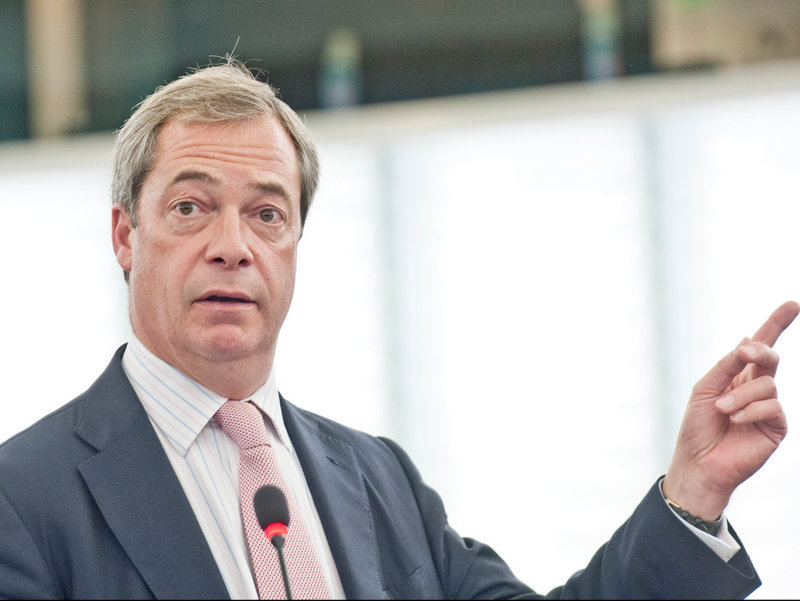
This weekend Nigel Farage made the first mistake of his general election campaign. Appearing on the Andrew Marr show on Sunday he said that as part of a drive to tackle a lack of social mobility Ukip’s manifesto will include a pledge to create a grammar school in every town. This announcement was a departure from the usual UKIP playbook and could prove to be a costly mistake.
Ukip’s electoral strategy thus far has been to build the widest possible support around the narrowest set of issues. This was at its most successful last month when it succeeded in gaining supporters in Tory shires and Labour heartlands around the twin issues of Europe and immigration, plus a healthy dose of anti-politics thrown in for good measure.
Partly because of this success and Farage’s seeming determination to mount a serious challenge at the general election, this strategy has carried Ukip’s bandwagon as far as it can go. Farage may have been able to bat away questions about eduction, tax, the NHS and law and order during a European campaign, but in the run-up to the general election all these issues will need to be addressed.
The problem with doing this is that while some true blue Tories and a few traditional Labour supporters may be able to unite against the European Union, they are unlikely to agree about much else. Farage is clearly alive to this danger and his Marr interview was designed to offer something to both sides. By linking the grammar schools pledge to social mobility, Ukip’s leader was betting he could square the circle, by advocating progressive aims through conservative means.
If this was indeed the ambition then I think he has miscalculated badly. I have no doubt that the thought of more grammar schools will have those core Conservative voters nodding along in approval, but equally Labour supporters should now be clear that Ukip really does not have their best interests at heart. It is up to all of us to ram this message home to them, quickly and ruthlessly.
Labour should have no hesitation in taking on Ukip over grammar schools. Academic selection did very little to improve the life chances of the less well-off. What social mobility there was for previous generations was a result of more room being created at the top, thanks to the postwar expansion of public services and the boom in white-collar jobs, not by grammar schools picking winners at age 11 and writing off the rest.
A return to academic selection then, far from increasing social mobility, would be a retrograde step, based on the false premise that it is ability, not opportunity, which is unfairly distributed in Britain.
But Labour must do more than simply attack Farage’s grammar school myth it must demolish it by offering an actual solution to the very real deficit in social mobility. As Alan Milburn’s social mobility taskforce has shown, ‘over decades we have become a wealthier society but we have struggled to become a fairer one’. Instead of being born poor leading to a lifetime of poverty, we must do much more to break the link between demography and destiny.
Providing a genuine answer to the problem of social mobility should be a major purpose of the modern Labour party. Let Ukip and the Tories spend their time pining for the return of a grammar school age, based on exclusion of the many for the benefit of a few. It is Labour who must offer a better way, one where the choice of going to a good school and learning from inspiring teachers is offered to all children, not just a lucky few. Ukip’s love of grammar schools has led Farage to make his first mistake. Labour’s task now is to ensure that it costs him dearly.
———————————
Rich Durber is a member of Progress. He tweets @richdurber and blogs here.
———————————
Rich, thanks for an excellent post. This issue should be a vote loser for UKIP particularly when people are reminded that “a grammar school in every town” also means “3 or 4 secondary modern schools in every town”. Taking the perspective of those who would lose out in a return to academic selection is a good way to puncture UKIP’s claim to represent society’s underdogs. Selection simply reinforces existing social inequality and segregation.
It would be good if Labour took on UKIP over grammar schools, but it would be even better if we had the courage to say we would also abolish academic selection where it still exists, in a quarter of all education authorities. Fifteen of these are fully selective so the secondary modern option is a daily reality in the lives of children in those areas. Shameful that we have done nothing about this.
Agreed!
i have just posted a piece on the Local Schools Network about the sheer impracticality of this policy
Sorry . I couldn’t write more than one sentence in previous post so have to continue here. Apart from all the arguments against selection what about all the towns served,usually very well, by one comprehensive?