
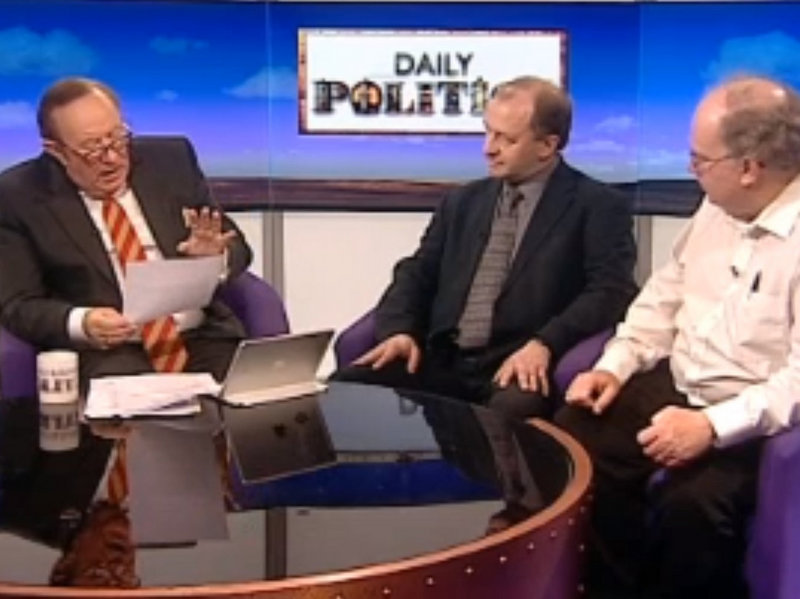
With a policy-feeble Queen’s speech on Wednesday, the real story was the lack of women providing commentary. Sitting watching the Queen’s speech surrounded by other young women working as researchers in parliament we noted the all-male BBC discussion panel.
This would be unwelcome on any occasion, but particularly so given that the filming was in London and there was plenty of notice regarding the date of the speech, allowing sufficient time for broadcasters to gather a representative panel. Whether it was a woman MP on the left or right of the spectrum, a political commentator, a Loose Woman, an academic, a political grandee or someone from the charity sector, they should have had someone.
We often hear that the press has a large Tory bias – we should also be aware that it is probably has a similar percentage of male bias too, which means Labour women are not going to have an easy ride with this two-pronged problem.
The recent furore surrounding Stella Creasy’s comments on the United Kingdom Independence party are an exemplar of the rubbish that women in the public sphere face. Creasy, who has a PhD and is clearly very intelligent, had her perfectly reasonable comments about the declining population and need for immigrants to counter the aging demographic, taken completely out of context by the Daily Mail.
That, however, is not the issue, politicians comments are taken out of context all the time. The issue here surrounds the way in which the Mail used Creasy’s youth and marital status to discredit her comments; they referred to her a ‘Miss Creasy’, rather than neutral ‘Ms’, and followed it up with ‘who does not have children’ as a way to delegitimise her view.
Her marital status is about as relevant to her point as whether she prefers chicken or turkey, football or rugby.
Women are all too often rendered incompetent and tarnished for their youth and marital status in a way that male politicians are not; I have never read an article that has so shamefully used a man’s marital status to try to devalue his comments. And, sadly, even if they did, I fear it would not have the same effect given the social acceptance of ‘bachelors’ vs the social stigma of ‘spinsters’.
Of course, men in the public eye face unfounded and trivial criticism – see the example of Ed Miliband eating a sandwich for that – but the nature of the criticism it is very different for women.
Rather than merely mocking women as the media do with men, the aim of the critique at women in the public eye is to devalue and delegitimise their comments. The media seeks to make women’s views less worthy by virtue of their relationship status or by using language to describe them that would not be out of place describing a spoilt child.
So, while I was pleased to hear some nods to women’s issues in the Queen’s speech, such as the continued commitment to end sexual violence in conflict, I was disheartened this week by the poor show from the press.
Broadcasters and others are becoming increasingly aware of gathering representative panels. Our focus should therefore be on providing women with the skills and confidence to agree to appear, and on appealing to the media to critique and provide analysis of what the women say – not their appearance, age or marital status, and certainly not whether they have children or not.
———————————
Beth Miller is women’s officer of Young Labour. She tweets @BethMillr
With women’s issues being so prevalent one would have thought the party would have chosen one of them ahead of a white American male to lead it or at least have one as a candidate in Newark….
Well said, Beth. The Labour Party doesn’t do enough to counter the media representation of women.